


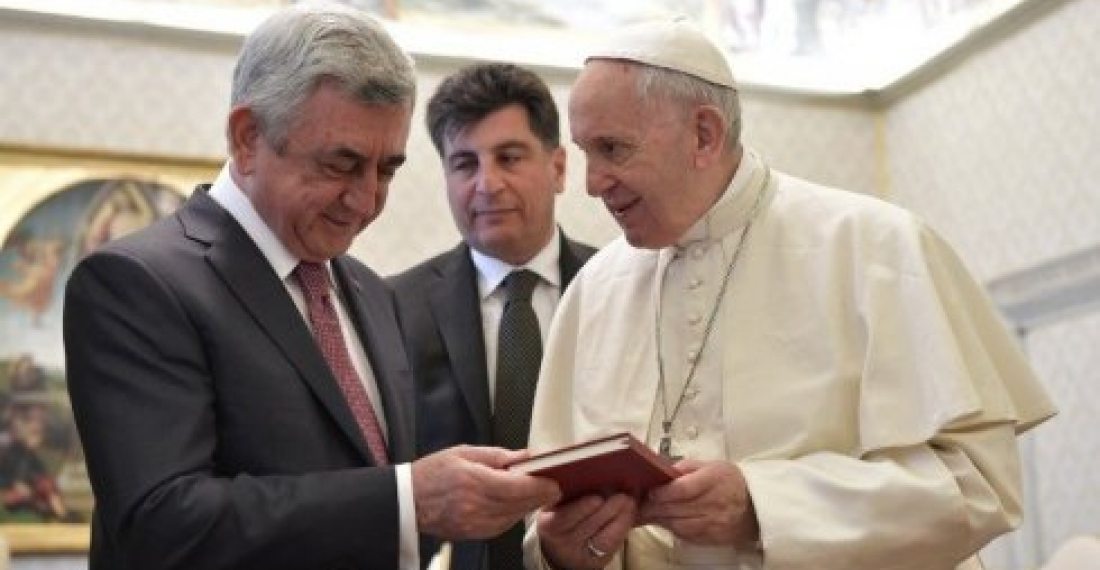
Президент Саргсян обсудил тему конфликтов с Папой Фрэнсисом в ходе визита в Ватикан

В заявлении Ватикана говорится: «Папа Фрэнсис и Саргсян также затронули вопросы, связанные с политическим контекстом региона, и выразили надежду на разрешение конфликтных ситуаций».

В четверг (5 апреля), в Ватикане, состоялась встреча Папы Фрэнсиса с религиозными и политическими лидерами Республики Армения во главе с президентом Сержем Саргсяном и религиозными лидерами, Католикосом всех армян Гарегином Вторым и Католикосом Великого Дома Киликийского Арамом Первым.

После встреч Папа и армянская делегация приняли участие в церемонии открытия и благословения статуи Святого Григора Нарекаци в Ватиканских садах. Папа Фрэнсис и армянские патриархи благословили бронзовую статую Святого Григора Нарекаци.

В коммюнике пресс-службы Святейшего Престола говорится, что во время сердечных дискуссий, состоявшихся между Папой и Президентом, было выражено большое удовлетворение о хороших отношениях между Святым Престолом и Арменией.

Он также отметил, что открытие статуи Святого Григора Нарекаци предоставила возможность укреплять те отношения, которые существуют между Армянской Апостольской Церковью и Католической Церковью.

В заявлении Ватикана говорится, что «Папа Фрэнсис и Саргсян также затронули вопросы, связанные с политическим контекстом региона, и выразили надежду на урегулирование конфликтных ситуаций, а также обратили внимание на другие текущие международные проблемы, в том числе положение христиан и религиозных меньшинств в зонах конфликтов».

Позднее президент Саргсян провел отдельную встречу с государственным секретарем кардиналом Пьетро Паролином и секретарем Ватикана по связям с государствами архиепископом Полем Ричардом Галлахером.

источник: commonspace.eu по материалам Ватиканского радио

фото: Папа Фрэнсис с президентом Армении Сержем Саргсяном на встрече в Ватикане, 5 апреля 2018 года (фото любезно предоставлено Ватиканским радио)


Related articles

Editor's choice
News
Azerbaijan-Armenia Internet Transit Deal Marks New Step in Regional Connectivity

Azerbaijan-Armenia Internet Transit Deal Marks New Step in Regional Connectivity

Azerbaijan and Armenia have signed an agreement allowing the mutual transit of international internet traffic, creating a direct telecommunications link between the two countries for the first time since the collapse of the Soviet Union. The deal, announced on 17 June by AzerTelecom and Telecom Armenia, is intended to improve route diversity and network resilience in the South Caucasus. The development follows a gradual process of normalisation of relations between Baku and Yerevan. Notably, Azerbaijan has repeatedly identified the restoration of transport and communication links as a key component of a future peace settlement. Since the initialling of a peace agreement during a summit in Washington in August 2025, the two sides have taken several important steps, including progress on border delimitation and the easing of certain transit restrictions. The telecommunications agreement is also significant because it was negotiated by private operators rather than government officials. Industry observers note that commercial infrastructure projects can create long-term economic ties and mutual dependencies that are more difficult to reverse than political declarations.

Popular

Editor's choice
Interview
Thursday Interview: Murad Muradov

Thursday Interview: Murad Muradov

Today, commonspace.eu starts a new regular weekly series. THURSDAY INTERVIEW, conducted by Lauri Nikulainen, will host  persons who are thinkers, opinion shapers, and implementors in their countries and spheres. We start the series with an interview with Murad Muradov, a leading person in Azerbaijan's think tank community. He is also the first co-chair of the Action Committee for a new Armenian-Azerbaijani Dialogue. Last September he made history by being the first Azerbaijani civil society activist to visit Armenia after the 44 day war, and the start of the peace process. Speaking about this visit Murad Muradov said: "My experience was largely positive. My negative expectations luckily didn’t play out. The discussions were respectful, the panel format bringing together experts from Armenia, Azerbaijan, and Turkey was particularly valuable during the NATO Rose-Roth Seminar in Yerevan, and media coverage, while varied in tone, remained largely constructive. Some media outlets though attempted to represent me as more of a government mouthpiece than an independent expert, which was totally misleading.  Overall, I see these initiatives as important steps in rebuilding trust and normalising professional engagement. The fact that soon a larger Azerbaijani civil society visits to Armenia followed, reinforces the sense that this process is moving in the right direction." (click the image to read the interview in full)

