


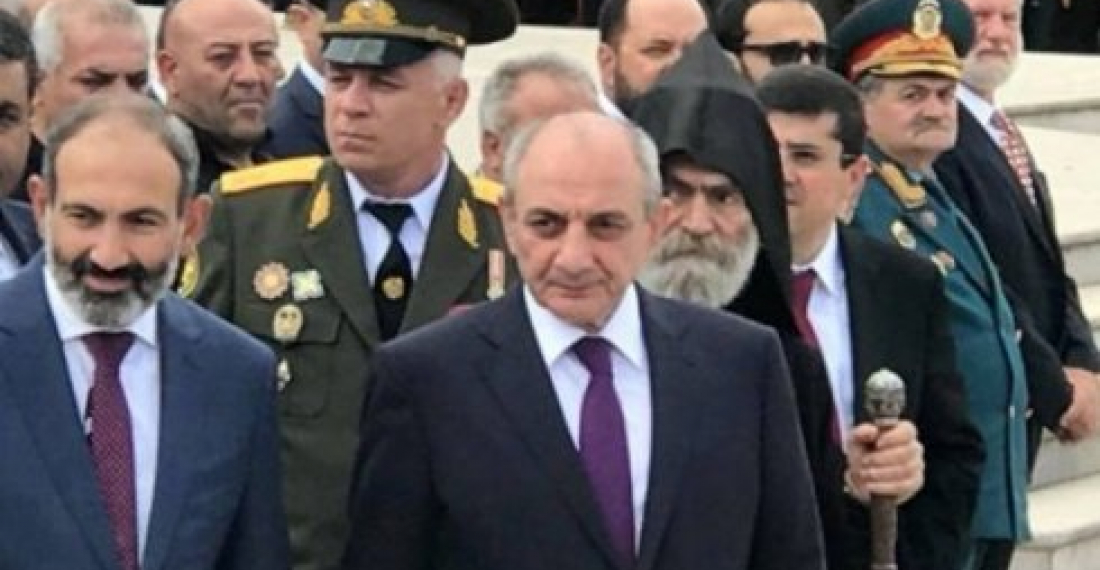
Пашинян посетил Карабах

В среду утром (9 мая), Нагорный Карабах посетил новый премьер-министр Армении Никол Пашинян, на следующий день после того, как он взял власть в Ереване. Вместе с де-факто главой самопровозглашенной Нагорно-Карабахской Республики, Бако Саакяном, Никол Пашинян побывал в Степанакерте на церемонии, посвященной памяти и возложению цветов к памятнику армянских солдат, павших в Великой Отечественной войне (Вторая мировая война) и в Карабахской войне.

Впоследствии Пашинян и Саакян отправились в Шуши, город, который 26 лет назад был захвачен армянскими силами.

По словам политического редактора Commonspace.eu, вопрос Карабаха станет одним из самых сложных вопросов, с которыми придется столкнуться новому премьер-министру.

"Первый президент Армении Левон Тер Петросян был свергнут в ходе дворцового переворота в 1998 году, якобы за то, что он предложил пойти на уступки в переговорах по карабахскому вопросу. С тех пор и до вчерашнего дня в Армении управляли люди, которые изначально были родом из Карабаха - Роберт Кочарян и Серж Саргсян.

Пашинян до сих пор сигнализировал о том, что он не станет вносить никаких немедленных изменений в нынешнюю позицию Армении по Карабаху, которая заключается в продолжении переговоров в рамках Минского процесса ОБСЕ и в поддержании независимости Нагорного Карабаха. Он даже упомянул, что Нагорный Карабах должен быть частью переговорного процесса, о чем в прошлом часто просили армянские дипломаты, но не настаивали.

Однако, для Пашиняна Карабах несет также и другие риски ближе к дому. Из-за своего своеобразного нынешнего статуса Карабах легко может стать очагом для любого, кто находится в оппозиции к правительству в Ереване. За последние два десятилетия это не было проблемой, так как у лидеров в Ереване были корни в Карабахе и полная поддержка руководства там. У Пашиняна нет этих верительных грамот, и предстоит понять, какой будет новая динамика в отношениях между Ереваном и Степанакертом.

Похоже, что Пашиняну пришлось двигаться быстро, чтобы успокоить Степанакерт, и оценить ситуацию на местах".

источник: commonspace.eu

фото: Никол Пашинян и Бако Саакян в Степанакерте в День Победы, 9 мая 2018 года.

Related articles

Editor's choice
News
The British prime minister says Europe must "stand on its own two feet" when it comes to defence

The British prime minister says Europe must "stand on its own two feet" when it comes to defence

The UK will deploy a carrier strike group, led by the aircraft carrier HMS Prince of Wales to the Arctic and the High North as part of efforts to bolster security against Russian threats. British prime minister, Sir Keir Starmer announced the deployment in a speech on Saturday (14 February) at the Munich Security Conference. Europe must be ready to fight to protect its people, values, and way of life,  Sir Keir told the Conference. Starmer also called for deeper links and cooperation, including economic ties, between the UK and EU. The PM stressed the continent must "stand on its own two feet" when it comes to defence commitments. "We must build our hard power, because that is the currency of the age," he told the conference. (Click image to read the full story).

Popular

Editor's choice
Interview
Thursday Interview: Murad Muradov

Thursday Interview: Murad Muradov

Today, commonspace.eu starts a new regular weekly series. THURSDAY INTERVIEW, conducted by Lauri Nikulainen, will host  persons who are thinkers, opinion shapers, and implementors in their countries and spheres. We start the series with an interview with Murad Muradov, a leading person in Azerbaijan's think tank community. He is also the first co-chair of the Action Committee for a new Armenian-Azerbaijani Dialogue. Last September he made history by being the first Azerbaijani civil society activist to visit Armenia after the 44 day war, and the start of the peace process. Speaking about this visit Murad Muradov said: "My experience was largely positive. My negative expectations luckily didn’t play out. The discussions were respectful, the panel format bringing together experts from Armenia, Azerbaijan, and Turkey was particularly valuable during the NATO Rose-Roth Seminar in Yerevan, and media coverage, while varied in tone, remained largely constructive. Some media outlets though attempted to represent me as more of a government mouthpiece than an independent expert, which was totally misleading.  Overall, I see these initiatives as important steps in rebuilding trust and normalising professional engagement. The fact that soon a larger Azerbaijani civil society visits to Armenia followed, reinforces the sense that this process is moving in the right direction." (click the image to read the interview in full)


