


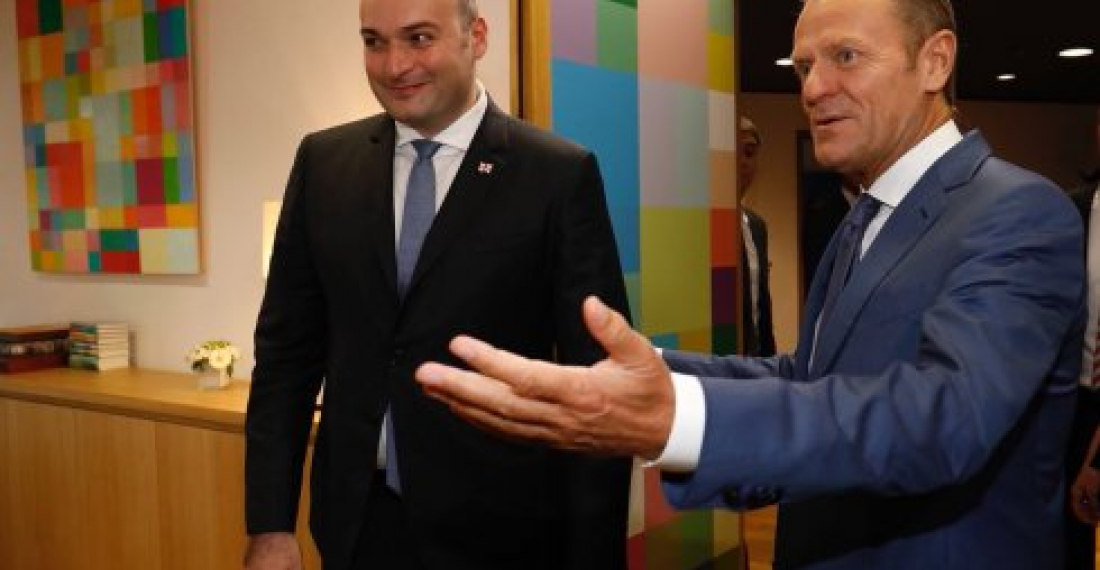
Дональд Туск подтвердил поддержку ЕС Грузии

"Европейский Союз и Грузия являются близкими партнерами и друзьями. На нашем сегодняшнем заседании мы с премьер-министром подтвердили нашу решимость и далее углублять наше сотрудничество на основе амбициозного соглашения об ассоциации и учитывать стратегический характер политической ассоциации Грузии и экономической интеграции с Союзом". Об этом заявил президент Европейского Совета Доналс-Туск, в ходе встречи с новым премьер-министром Грузии Мамукой Бахтадзе, который с момента своего назначения совершает свой первый официальный зарубежный визит. Туск поздравил Бахтадзе и сказал, что этот визит был очень символичным.

"ЕС остается решительным сторонником успешного процесса реформ в Грузии. Мы договорились о необходимости продолжать эти усилия", - добавил Туск.

Дональд Туск добавил:

"Я проявил большой интерес к нашим дискуссиям о региональной ситуации. Грузия находится в сложном регионе, где она играет решающую роль в качестве посредника и строителя мостов. ЕС высоко оценивает усилия Грузии в этом отношении, и мы с нетерпением ждем продолжения совместной работы для обеспечения стабильности, безопасности и развития в этом регионе. Кроме того, мы благодарим за конструктивную роль Грузию в Восточном партнерстве.

Поскольку мы скоро будем отмечать 10-ю годовщину войны между Грузией и Россией в августе 2008 года, позвольте мне подтвердить неизменную поддержку ЕС суверенитета и территориальной целостности Грузии в ее международно признанных границах. Важно отметить, что за последние десять лет Грузии удалось укрепить свои демократические институты и развивать процветающую экономику. Европейский Союз будет продолжать оказывать поддержку Грузии и укреплять устойчивость и способность страны искать мирное разрешение конфликтов. В этом контексте мы приветствуем инициативу «Шаг к лучшему будущему», которая предоставляет людям, живущим в Абхазии и Южной Осетии, новые возможности для торговли и образования. Мы готовы оказать дальнейшую помощь в поддержку его реализации".

источник: commonspace.eu

 

Related articles

Editor's choice
News
The British prime minister says Europe must "stand on its own two feet" when it comes to defence

The British prime minister says Europe must "stand on its own two feet" when it comes to defence

The UK will deploy a carrier strike group, led by the aircraft carrier HMS Prince of Wales to the Arctic and the High North as part of efforts to bolster security against Russian threats. British prime minister, Sir Keir Starmer announced the deployment in a speech on Saturday (14 February) at the Munich Security Conference. Europe must be ready to fight to protect its people, values, and way of life,  Sir Keir told the Conference. Starmer also called for deeper links and cooperation, including economic ties, between the UK and EU. The PM stressed the continent must "stand on its own two feet" when it comes to defence commitments. "We must build our hard power, because that is the currency of the age," he told the conference. (Click image to read the full story).

Popular

Editor's choice
Interview
Thursday Interview: Murad Muradov

Thursday Interview: Murad Muradov

Today, commonspace.eu starts a new regular weekly series. THURSDAY INTERVIEW, conducted by Lauri Nikulainen, will host  persons who are thinkers, opinion shapers, and implementors in their countries and spheres. We start the series with an interview with Murad Muradov, a leading person in Azerbaijan's think tank community. He is also the first co-chair of the Action Committee for a new Armenian-Azerbaijani Dialogue. Last September he made history by being the first Azerbaijani civil society activist to visit Armenia after the 44 day war, and the start of the peace process. Speaking about this visit Murad Muradov said: "My experience was largely positive. My negative expectations luckily didn’t play out. The discussions were respectful, the panel format bringing together experts from Armenia, Azerbaijan, and Turkey was particularly valuable during the NATO Rose-Roth Seminar in Yerevan, and media coverage, while varied in tone, remained largely constructive. Some media outlets though attempted to represent me as more of a government mouthpiece than an independent expert, which was totally misleading.  Overall, I see these initiatives as important steps in rebuilding trust and normalising professional engagement. The fact that soon a larger Azerbaijani civil society visits to Armenia followed, reinforces the sense that this process is moving in the right direction." (click the image to read the interview in full)


