

В Грузии православные священники остановили международный фестиваль рок-музыки

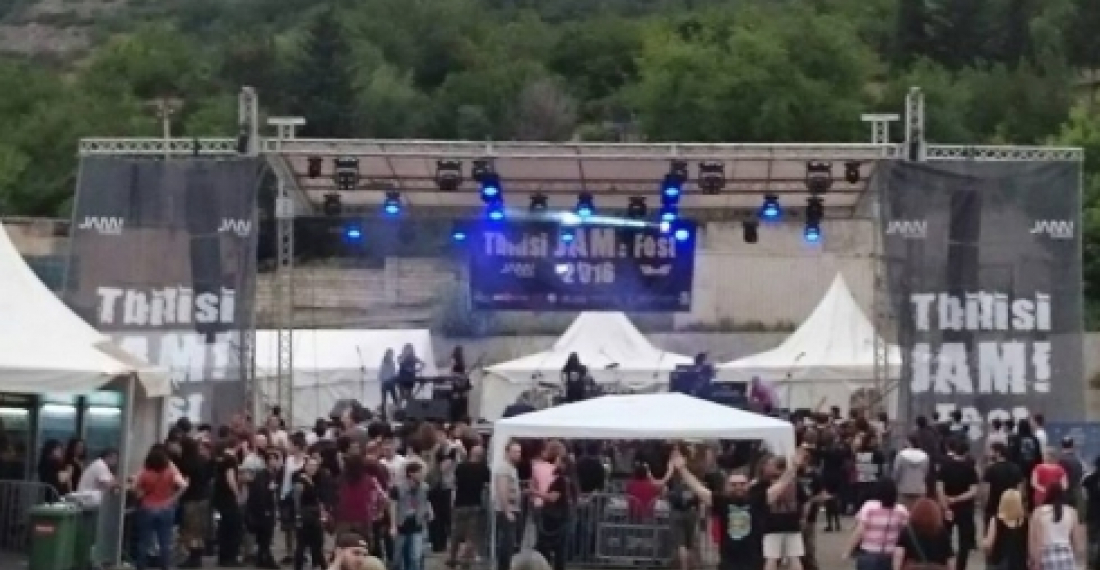
Начавшийся сегодня в пригороде Тбилиси международный рок-фестиваль был остановлен по требованию православных священников.

Фестиваль Tbilisi JAM! Fest проводится в Тбилиси с 2006 года и является официальным партнером крупнейшего немецкого фестиваля Wacken Open Air .

На этот раз организаторы выбрали для концертной площадки транспортный терминал на самой окраине Тбилиси, около Земо-Авчальской Гидроэлектростанции (ЗАГЭС). Фестиваль был согласован с мэрией, в нем принимали участие рок-группы из Швеции, Израиля, Украины, а также рок-музыканты из Армении и Азербайджана.

Однако, рок-музыка не понравилась священникам из расположенного неподалеку монастыря святой великомученицы Царицы Кетеван и они, призвав на помощь паству, пришли заявить свой протест.

Первые тревожные сигналы стали поступать от участников фестиваля Tbilisi JAM! Fest 2016 в фейсбуке: «Пришли батюшки и на концерте отключили свет!» «Полиция бездействует», «Подскажите, куда звонить?»

В итоге, во избежание конфликта, организаторы заявили слушателям, что концерт отменен и они постараются завтра найти альтернативное место для проведения.

Пользователь фейсбука Ana Aslanikashvili одна из тех, кто подробно описал ситуацию прямо с места событий:

«Сегодня у моей сестры был концерт - на рок-фестивале на территории терминала в ЗАГЭСе. Группы приехали в Грузию из разных стран. Группа моей сестры тоже долго готовилась.

Сначала все шло хорошо. Выступили две группы. Потом неожиданно отключили свет. Сначала мы подумали, что это авария, но потом оказалось вот что:

Представители духовенства пришли и заявили, что мы беспокоим души умерших. (там где-то неподалеку, оказывается, есть кладбище) и они протестуют против концерта.

Священники стоят неподалеку и их сдерживает патруль, чтобы они не ворвались на концерт. Начальник терминала испугался и отключил электроэнергию.

Звонили в патриархию - они ничего не могут сделать.

Звонили в мэрию - ничего не могут сделать.

Скажите мне, что делать?

P.S. Иностранцы смотрят на нас удивленными глазами. Мы еще раз опозорились перед всем миром».

«Потом я узнала, что какие-то люди стояли на выходе и дожидались нас с ножами и битами, их возглавлял какой-то человек в анафоре, но благодаря стараниям организаторов и полиции они разошлись и нам тоже разрешили уйти. Я поражена нашей беспомощностью и очень переживаю», - пишет в комментарии к своему посту Ana Aslanikashvili.

Украинская группа JINJER, которой так и не удалось выступить на фестивале, также опубликовала на своей странице в фейсбуке возмущенное сообщение.

«Друзья, у нас плохие новости! Впервые за столько лет выступление JINJER было отменено сегодня из-за атаки религиозных фанатиков. Тбилиси JAM Fest был остановлен, потому что не понравился находящемуся в 1 километре от нас монастырю, пришли священники с разъяренной толпой верующих и напали на территорию фестиваля !!! Несмотря на то, что фестиваль имел все необходимые разрешения от местных властей, фанатики просто отрубили электричество. Самым шокирующим было то, что полиция просто стояла в стороне и наблюдала ... Грустно осознавать, что в Грузии, в цивилизованной, казалось бы, стране, религия имеет больше власти, чем закон.

Мы очень надеемся, что организаторы смогут найти альтернативное место и JINJER будет играть завтра до того, как мы улетим назад в Украину», - пишет украинская рок-группа.

источник: newsgeorgia.ge

 

Related articles

Editor's choice
News
COP 17 in Armenia

COP 17 in Armenia

Armenia is currently hosting the COP17 conference of the Convention on Biological Diversity, which began earlier this week (19 October) and will run until 30 October, bringing around 15,000 participants from 196 different countries to Yerevan. At a leaders' summit held as part of COP17, Prime Minister Nikol Pashinyan expressed realistic ambitions: “We are halfway towards achieving these goals (Kunming-Montreal Global Biodiversity Framework), and we must honestly acknowledge that we are not yet moving in the right direction. Our task now is not to make new promises, but to fulfil the commitments we have already made.” Pashinyan pointed towards Armenia's own records, noting that the whitefish stock in Lake Sevan has increased substantially in the last ten years. Iranian President Masoud Pezeshkian and Georgian Prime Minister Irakli Kobakhidze also addressed the summit, with Turkiye sending its agriculture minister. However, there were no reports of Azerbaijani representatives attending. The conference has given Yerevan a valuable international platform, yet the absence of Azerbaijan is likely to be read as a sign that the peace process in the South Caucasus has not yet been translated into wider regional cooperation. The leaders' summit was opened by Armenian Prime Minister Nikol Pashinyan, who stressed that hosting the conference was a great honour for Armenia. He expressed hope that it would 'be productive and contribute to protecting our planet's biodiversity'. 'We – the citizens of Armenia, the government, state authorities and local governments – owe a debt to our nature,' the prime minister said. He noted that the international community had already developed the concept of 'living in harmony with nature’ and adopted the Kunming-Montreal Global Biodiversity Framework in 2022, setting out goals and specific targets to be achieved by 2030. 'We are halfway towards achieving these goals, and we must honestly acknowledge that we are not yet moving in the right direction. Our task now is not to make new promises, but to fulfil the commitments we have already made,' Nikol Pashinyan said. The COP17 conference is expected to adopt a declaration at leaders' level. More than 30 documents are scheduled for discussion. If approved, the commitments set out in them will become legally binding on countries that are parties to the Convention on Biological Diversity.”
Editor's choice
News
Landmines present to the European Union both a contradiction and a dilemma

Landmines present to the European Union both a contradiction and a dilemma

Finland’s decision to buy one million landmines creates a serious contradiction in the policy of the European Union, and is symbolic of a bigger dilemma facing European countries as they get used to the need to acquire “hard” power to face an increasing threat from Russia. Finland is seeking to acquire one million anti-personnel mines at a cost of 100 million euros. Finland, together with Poland, Latvia, Lithuania and Estonia last year abandoned the Ottawa agreement, the international framework that bans the use of anti-personnel mines, which the EU had been instrumental in establishing and supporting. All five countries cite the threat from Moscow as the reason. Colonel Riku Mikkonen of the Army Command told Finland’s national news agency STT that officials are now gathering information from suppliers regarding the deal, the AFP news agency reports. Helsinki would like domestic manufacturers to supply the mines, with contracts signed by the end of 2027 and production up and running by 2028. “It would be useful in many ways if Finnish companies produced the anti-personnel mines in Finland,” Mikkonen said. About half a dozen Finnish firms qualify, he told STT. “However, at this stage, buying the mines from abroad is not totally ruled out,” he added. LANDMINES PROVIDE THE EU WITH BOTH A CONTRADICTION, AND A DILEMMA Eliminating landmine contamination worldwide is one of the EU’s main soft power postures, and it basks in its record as the biggest funder of anti-landmine action in the world. But the fact that 5 of its 27 member states  have now left the Ottawa Treaty dents the EU moral high ground. It is a contradiction that is too big and important to be ignored. It also presents the European Union with a deeper dilemma. The threat from Russia is changing what the EU has stood for decades, namely a force for good able to mobilise its considerable soft power for the greater good of humanity. How the Union will implement this change will define its future. In the meantime landmines have not become any less lethal, benign, or unimportant. They remain in many parts of the world a major threat to life, an impediment to prosperity, and a potential trigger to further conflict. The 22 EU members states that still adhere to the Ottawa treaty must regroup, and be more assertive in their quest against anti-personnel land mines. All the reasons why they supported the Ottawa treaty in the first place still exist. The message must be clear: NO TO LANDMINES!

Popular

Editor's choice
Interview
Thursday Interview: Murad Muradov

Thursday Interview: Murad Muradov

Today, commonspace.eu starts a new regular weekly series. THURSDAY INTERVIEW, conducted by Lauri Nikulainen, will host  persons who are thinkers, opinion shapers, and implementors in their countries and spheres. We start the series with an interview with Murad Muradov, a leading person in Azerbaijan's think tank community. He is also the first co-chair of the Action Committee for a new Armenian-Azerbaijani Dialogue. Last September he made history by being the first Azerbaijani civil society activist to visit Armenia after the 44 day war, and the start of the peace process. Speaking about this visit Murad Muradov said: "My experience was largely positive. My negative expectations luckily didn’t play out. The discussions were respectful, the panel format bringing together experts from Armenia, Azerbaijan, and Turkey was particularly valuable during the NATO Rose-Roth Seminar in Yerevan, and media coverage, while varied in tone, remained largely constructive. Some media outlets though attempted to represent me as more of a government mouthpiece than an independent expert, which was totally misleading.  Overall, I see these initiatives as important steps in rebuilding trust and normalising professional engagement. The fact that soon a larger Azerbaijani civil society visits to Armenia followed, reinforces the sense that this process is moving in the right direction." (click the image to read the interview in full)