


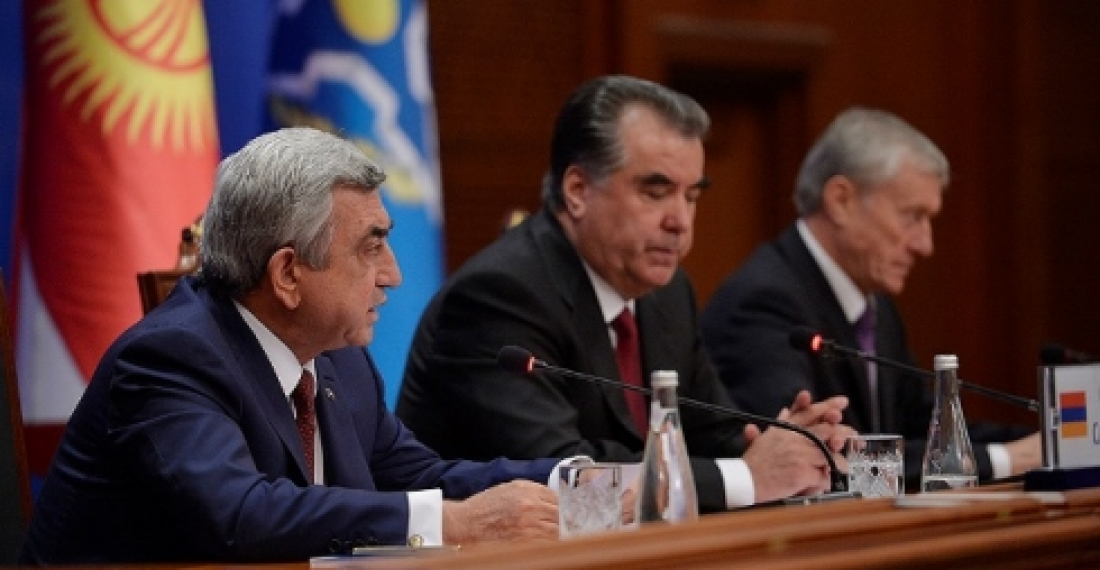
Армения принимает на себя председательство в ОДКБ.

Армения приняла на себя председательство в Организации Договора о коллективной безопасности (ОДКБ) на саммите военного альянса, который завершился сегодня (вторник 15 сентября) в столице Таджикистана, Душанбе. ОДКБ включает в себя Россию, Белоруссию, Армению, Таджикистан и Казахстан.

После открытия встречи лидеры ОДКБ перешли в закрый режим, чтобы обсудить ряд актуальных вопросов. Президент Армении Серж Саргсян позже на пресс-конференции заявил:

"Я проинформировал глав государств-членов ОДКБ о ситуации в регионе Южного Кавказа, с акцентированием внимания на существенный рост напряженности вдоль армяно-азербайджанской границы и азербайджано-карабахской линии соприкосновения. /.../ попытки азербайджанской стороны обострить обстановку, при отсутствии адекватной реакции международного сообщества, чреваты дестабилизацией обстановки во всем регион."

Говоря о развитии в рамках ОДКБ, президент Саргсян сказал, "В целом, мы удовлетворены тем, как развивается ОДКБ. Ведется интенсивная работа по повышению потенциала силовой составляющей Организации."

Президент Саргсян обрисовал приоритеты председательства Армении в ОДКБ на следующий год. А именно:

- наращивание коллективного потенциала ОДКБ в соответствии с Уставом Организации и на принципе преемственности;
- дальнейшее развитие концептуальных основ деятельности ОДКБ, развитие системы кризисного реагирования;
- институциональные аспекты повышения эффективности деятельности ОДКБ, в том числе вопросы совершенствования внешнеполитической координации и развития сотрудничества с другими международными организациями;
- дальнейшее совершенствование системы управления силами и средствами системы ОДКБ, наращивание ее миротворческого потенциала, углубление военно-технического и военно-экономического сотрудничества, оптимизация логистической составляющей, транзита и перевозок.

Президент Армении заявил, что, кроме того, ОДКБ намерена сосредоточиться на вопросах совместного противодействия международному терроризму и экстремизму, нео-фашизму, шовинизму и проявлению других форм ксенофобии, а также придает большое значение совместным усилиям в области кибербезопасности.

источник: commonspace.eu по материалам агентств

фото: Президент Армении Серж Саргсян на пресс-конференции по кончанию саммита ОДКБ, прошедшего в Душанбе, Таджикистане, во вторник, 15 сентября 2015 года (фото любезно предоставлено пресс-службой президента Армении).

 

Related articles

Editor's choice
News
Borrell tells the European Parliament that the situation in Afghanistan was critical, but the EU will remain engaged

Borrell tells the European Parliament that the situation in Afghanistan was critical, but the EU will remain engaged

Borrell underlined that the European Union will make every effort to support the peace process and to remain a committed partner to the Afghan people. "Of course, we will have to take into account the evolving situation, but disengagement is not an option.  We are clear on that: there is no alternative to a negotiated political settlement, through inclusive peace talks.
Editor's choice
News
Germany accuses Russia of cyberattacks and disinformation campaign

Germany accuses Russia of cyberattacks and disinformation campaign

The German government holds Russia responsible for a cyberattack on German air traffic control, and for targeted disinformation campaigns before the last federal election. According to the German Foreign Office in Berlin, the incidents could be clearly attributed to the Russian military intelligence service, the GRU. In response, the Russian ambassador to Berlin was summoned to the Foreign Ministry. "We have been observing a massive increase in threatening hybrid activities by Russia for some time now," a spokesperson for the Foreign Ministry stated. These range from disinformation campaigns and espionage to cyberattacks and sabotage attempts. The aim is to divide society, sow distrust, and undermine confidence in democratic institutions. The spokesperson added that with these actions, Russia is "very concretely threatening our security, not only through its war of aggression against Ukraine, but also here in Germany."  The Foreign Ministry spokesperson explained that the cyberattack on air traffic control in August 2024 was clearly attributed to the hacker collective "APT28," known as "Fancy Bear," and to the responsibility of the Russian military intelligence service, the GRU. Furthermore, it could now be "conclusively stated" that Russia had attempted "to influence and destabilize both the last Federal election and the ongoing internal affairs of the Federal Republic of Germany." There was "absolutely irrefutable evidence" for this". The so-called "Storm 1516" campaign, which has been running since 2024, is allegedly backed by "reliable information" that the Moscow-based think tank "Center for Geopolitical Expertise" is behind it. The Center is also said to be supported by Russian military intelligence. Its primary aim is to influence democratic elections in the West. (Click the image to read more).

Popular

Editor's choice
News
Germany accuses Russia of cyberattacks and disinformation campaign

Germany accuses Russia of cyberattacks and disinformation campaign

The German government holds Russia responsible for a cyberattack on German air traffic control, and for targeted disinformation campaigns before the last federal election. According to the German Foreign Office in Berlin, the incidents could be clearly attributed to the Russian military intelligence service, the GRU. In response, the Russian ambassador to Berlin was summoned to the Foreign Ministry. "We have been observing a massive increase in threatening hybrid activities by Russia for some time now," a spokesperson for the Foreign Ministry stated. These range from disinformation campaigns and espionage to cyberattacks and sabotage attempts. The aim is to divide society, sow distrust, and undermine confidence in democratic institutions. The spokesperson added that with these actions, Russia is "very concretely threatening our security, not only through its war of aggression against Ukraine, but also here in Germany."  The Foreign Ministry spokesperson explained that the cyberattack on air traffic control in August 2024 was clearly attributed to the hacker collective "APT28," known as "Fancy Bear," and to the responsibility of the Russian military intelligence service, the GRU. Furthermore, it could now be "conclusively stated" that Russia had attempted "to influence and destabilize both the last Federal election and the ongoing internal affairs of the Federal Republic of Germany." There was "absolutely irrefutable evidence" for this". The so-called "Storm 1516" campaign, which has been running since 2024, is allegedly backed by "reliable information" that the Moscow-based think tank "Center for Geopolitical Expertise" is behind it. The Center is also said to be supported by Russian military intelligence. Its primary aim is to influence democratic elections in the West. (Click the image to read more).

