


Ильхам Алиев восхваляет связи с Грузией
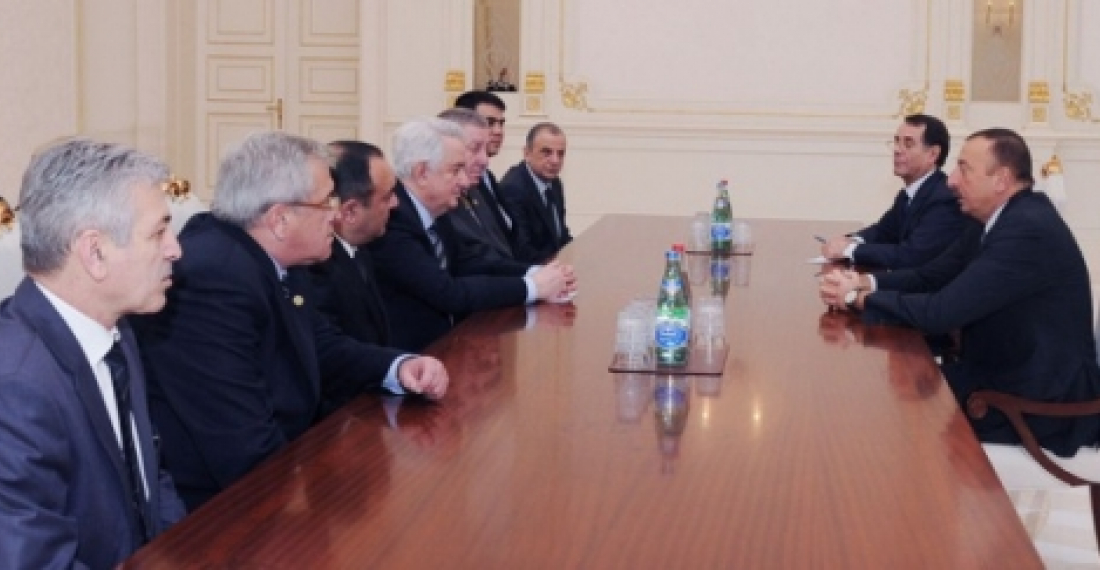
Президент Азербайджана Ильхам Алиев принял делегацию во главе с вице-спикером парламента Грузии и председателя грузино-азербайджанской межпарламентской группы дружбы, Фридона Тодуа.

Президент выразил удовлетворение успешным развитием двусторонних отношений между Грузией и Азербайджаном во всех сферах. Подчеркивая, что сотрудничество между двумя странами в политической и экономической сферах и в области инвестиций была на высоком уровне, Президент Ильхам Алиев отметил важность межпарламентского сотрудничества для развития отношений.

Выразив удовлетворение в связи с визитом в Азербайджан, Фридон Тодуа сказал, что это его второй визит в страну, и что он был свидетелем важнейших событий в Азербайджане за прошедший период.

Отношения между Грузией и Азербайджаном лидеры двух стран часто называют стратегическими. Азербайджан зависит от Грузии в транзите своих энергоресурсов на европейские и международные рынки. Строительство железной дороги Баку-Тбилиси-Джейхан оказался дальновидным проектом, который дал Азербайджану экономической независимости и является стратегическим активом для энергетической безопасности Европы. Со ещё важнее сейчас она является бенефициаром больших объёмов инвестиции из Азербайджана.

Президент Грузии Михаил Саакашвили и Ильхам Алиев построили хорошие личные и официальные отношения между ними, независимо от различий в подходах и политике. Предложение президента Саакашвили, что Грузия и Азербайджан должны "объединиться" было вежливо проигнорировано в Баку. Азербайджанские официальные лица часто выражают озабоченность по поводу условий проживания больших азербайджанских меньшинств в Грузии, но на данный момент больше преобладает удовлетворение.

Источник: commonspace.eu

Фото: Президент Азербайджана на встрече с парламентской делегацией из Грузии в Баку 17 января 2012 года. (фото любезно предоставлено Пресс-службой президента Азербайджана)

Related articles

Editor's choice
News
The British prime minister says Europe must "stand on its own two feet" when it comes to defence

The British prime minister says Europe must "stand on its own two feet" when it comes to defence

The UK will deploy a carrier strike group, led by the aircraft carrier HMS Prince of Wales to the Arctic and the High North as part of efforts to bolster security against Russian threats. British prime minister, Sir Keir Starmer announced the deployment in a speech on Saturday (14 February) at the Munich Security Conference. Europe must be ready to fight to protect its people, values, and way of life,  Sir Keir told the Conference. Starmer also called for deeper links and cooperation, including economic ties, between the UK and EU. The PM stressed the continent must "stand on its own two feet" when it comes to defence commitments. "We must build our hard power, because that is the currency of the age," he told the conference. (Click image to read the full story).

Popular

Editor's choice
Interview
Thursday Interview: Murad Muradov

Thursday Interview: Murad Muradov

Today, commonspace.eu starts a new regular weekly series. THURSDAY INTERVIEW, conducted by Lauri Nikulainen, will host  persons who are thinkers, opinion shapers, and implementors in their countries and spheres. We start the series with an interview with Murad Muradov, a leading person in Azerbaijan's think tank community. He is also the first co-chair of the Action Committee for a new Armenian-Azerbaijani Dialogue. Last September he made history by being the first Azerbaijani civil society activist to visit Armenia after the 44 day war, and the start of the peace process. Speaking about this visit Murad Muradov said: "My experience was largely positive. My negative expectations luckily didn’t play out. The discussions were respectful, the panel format bringing together experts from Armenia, Azerbaijan, and Turkey was particularly valuable during the NATO Rose-Roth Seminar in Yerevan, and media coverage, while varied in tone, remained largely constructive. Some media outlets though attempted to represent me as more of a government mouthpiece than an independent expert, which was totally misleading.  Overall, I see these initiatives as important steps in rebuilding trust and normalising professional engagement. The fact that soon a larger Azerbaijani civil society visits to Armenia followed, reinforces the sense that this process is moving in the right direction." (click the image to read the interview in full)



