Активисты гражданского общества призывают к большей открытости и прозрачности в мирных переговорах по Карабаху.

ЗАЯВЛЕНИЕ

Мы, совместно с другими представителями гражданских обществ и экспертами, 8 декабря 2010 года г.Тбилиси в рамках инициативы Независимого Гражданского Минского Процесса (НГМП) по урегулированию нагорно-карабахского конфликта подписали Декларацию, которая призвала руководства сторон:
- положить конец воинственной риторике, политическим и информационным акциям, направленным на эскалацию конфликта;
- предпринять неотложные шаги по укреплению режима прекращения огня и предотвращению вооруженных инцидентов, обеспечить незамедлительный вывод снайперов с линии соприкосновения;
- добавить к базовым нормам урегулирования конфликта на основе Хельсинкского Заключительного Акта (неприменение силы, территориальная целостность, равноправие и право народов на самоопределение) принцип «мирное урегулирование споров».
- приступить к разработке «Дорожной карты» нагорно-карабахского урегулирования.

Достойно глубокого сожаления, что за прошедший период призывы НГМП так и не были услышаны, и 20-летие режима прекращения огня наши народы встретили не на пути к мирному урегулированию, решению практических задач по восстановлению добрососедства, сотрудничества и региональной интеграции, а в обстановке сложившейся тупиковой ситуации в официальном переговорном процессе, усиления напряженности на линии соприкосновения войск и роста угрозы возобновления крупномасштабных военных действий, связанных также и с процессами, начавшимися в постсоветском пространстве.

Конфликт уже принес огромную беду - гибель десятков тысяч людей, сотни тысяч раненых и инвалидов, более миллиона лишившихся родных очагов, а отсутствие прогресса в урегулирования конфликта между нашими народами создало большие проблемы для попыток создания социально-экономического благополучия, сильного гражданского общества, демократической государственности на принципах верховенства закона, гарантий основных свобод и прав человека.

Сложившийся статус-кво не может продолжаться, «замораживания ситуации» не происходит: почти от ежедневных обстрелов гибнут люди, расширяется ареал вооруженных инцидентов, нарастает гонка вооружений между сторонами конфликта, радикализируется риторика на государственном и общественном уровне. Дальнейшие попытки удержания статус-кво неизбежно станут составной частью новых опасных тенденций в постсоветском пространстве, которые угрожают не только общеевропейской безопасности, но и независимости и суверенитету наших стран.

В сложившейся взрывоопасной ситуации, как показала беспрецедентная вспышка насилия на линии соприкосновения в июле-августе этого года, даже незначительные ошибки одной из сторон конфликта могут быть использованы, чтобы навязать нам новую войну.

Мы поддерживаем инициативу сопредседателя Минской Группы ОБСЕ посла Джеймса Уорлика, изложенную 07 мая 2014г в докладе "Нагорный Карабах: пути урегулирования" и Заявление сопредседателей Минской Группы ОБСЕ от 12 мая 2014 г. В этом сбалансированном подходе аккумулирован опыт многолетних переговоров и длительной работы и сторон конфликта, и предыдущих и нынешних составов сопредседателей МГ ОБСЕ. Мы считаем, что три принципа и указанные шесть элементов являются действенной основой для разработки в рамках МГ ОБСЕ Мирного Соглашения и «дорожной карты» по урегулированию нагорно-карабахского конфликта.

Мы считаем, что переговорный процесс урегулирования конфликта должен стать открытым и прозрачным для наших обществ и призываем созывать международные форумы с участием представителей властей и гражданского общества сторон нагорно-карабахского конфликта, представителей международных организаций с целью поддержки мирного процесса и его практической реализации.

Мы поддерживаем идею использования международных сил по поддержанию мира в ходе реализации Мирного Соглашения и считаем, что в состав международных сил не должны входить ни страны - сопредседатели МГ ОБСЕ, ни соседних со сторонами конфликта стран. Для практической реализации этих согласованных принципов международное посредничество должно быть свободно от каких-либо геополитических конъюнктурных соображений таких как борьба за сферы влияния и доминирование над регионом.

Мы обращаемся к руководствам стран-сопредседателей Минской Группы ОБСЕ, ко всем государствам с настойчивым призывом прекратить поставку всех видов наступательных вооружений в регион нагорно-карабахского конфликта. Мирное урегулирование вооруженного конфликта возможно только как при готовности сторон конфликта к взаимным компромиссам, отказе от максималистских требований и предварительных условий и осознании общих национальных интересов наших народов, при искреннем стремлении международных посредников мирным путем разрешить нагорно-карабахский конфликт.

Мы обращаемся к политическим руководствам сторон, несмотря на различные толкования отдельных положений принципов урегулирования и наличия разногласий по целому ряду вопросов, безотлагательно приступить к разработке Мирного Соглашения нагорно-карабахского урегулирования на основе инициативы сопредседателя Минской Группы ОБСЕ посла Джеймса Уорлика от 07 мая 2014г и Заявления сопредседателей Минской Группы ОБСЕ от 12 мая 2014 г.

Мы призываем гражданское общество всех сторон конфликта, все политические и общественные силы стать активными участниками мирного процесса, начать поиск необходимых компромиссов, отказаться от максималистских требований и взять на себя свою долю ответственности в мирном урегулировании нагорно-карабахского конфликта.


Давид Шахназарян
Чрезвычайный и полномочный посол,
посол по особым поручениям
Президента Республики Армения
в 1992-95гг. Эльдар Намазов
Помощник и руководитель
Секретариата Президента Азербайджанской Республики в 1993-99гг.


3-е ноября 2014г.
Хельсинки, Финляндия

Заявление поддержали:

Арзу Абдуллаева, Председатель Хельсинской Гражданской Ассамблеи-Азербайджан, лауреат премии Джорджа Маршалла

Карен Оганджанян, Координатор Нагорно-Карабахского комитета «Хельсинская инициатива-92»

Наталя Мартиросян, Председатель Хельсинской Гражданской Ассамблеи-Армения

Али Абасов, профессор, политолог

Зардушт Ализаде, доктор философии, политолог

Агаси Енокян, Армянский центр политических и международных отношений, директор

Лейла Алиева, Центр национальных и международных исследований, политолог

Айкак Аршамян, Центр Региональных Исследований, историк, политический аналитик

 

Latest

Editor's choice
Monday Commentary
Monday Commentary: PEACE IN OUR TIME?

Monday Commentary: PEACE IN OUR TIME?

Making peace between Armenia and Azerbaijan was never going to be simple, nor easy, nor quick. It is taking time, writes Dennis Sammut in this Monday Commentary. “There is a sense of realism coming from the leaders of the two countries – President Ilham Aliyev of Azerbaijan and prime minister Nikol Pashinyan of Armenia, that frankly, is necessary and welcome”, he writes. At a time when conflicts are raging all over the world – from Ukraine to the Gulf, from Africa to South Asia, the prospect that Armenia and Azerbaijan had finally, after decades of conflict that left thousands of dead and many more displaced, decided on embarking on a journey of peace was welcomed. Peace between Armenia and Azerbaijan can be top-down up to a point. Both leaders have spent political capital preparing for a peace deal. But both are aware that their people are not ready for peace yet. In fact, in Armenia, most of the elite are negative toward a peace deal with Azerbaijan. Pashinyan needs time to persuade his countryfolk. That is why 2031 is realistic. Ilham Aliyev runs a tighter shop, but he is also not immune to public opinion. Every time someone hits a landmine in Karabakh, which unfortunately happens often, peace comes into question. Which is why Aliyev chooses to sound hardline, more often than not. In pursuing the peace agenda, both Aliyev and Pashinyan need to proceed cautiously. But they are right in making peace the central issue in their agenda. It is the main issue, and the one that will define them in history. So forward, cautiously but resolutely! In pursuing the peace agenda, Aliyev and Pashinyan need to be supported clearly and unambiguously. There are too many people in Baku and Yerevan who are sitting on the sides, waiting. The international community is not doing enough. It is time to be counted. Otherwise, the spoilers will win, and the region will go back to its bad habits. (Click the image to read the full commentary).
Editor's choice
News
Ukraine Peace Talks Set to Expand as Russia and Europe Clash Over Post-war Security

Ukraine Peace Talks Set to Expand as Russia and Europe Clash Over Post-war Security

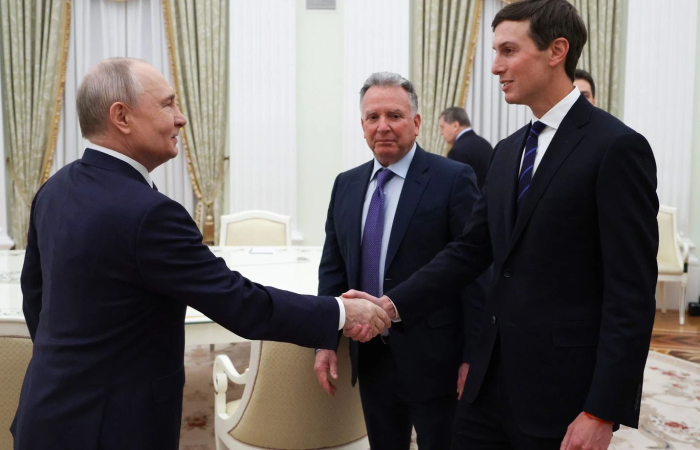
Ukraine and Russia could see European countries join the next round of peace negotiations, following talks between US special envoys Steve Witkoff and Jared Kushner and Russian President Vladimir Putin in Moscow on Thursday (November 12). However, conflicting positions over European military involvement, Ukraine’s territorial future and the continent’s security arrangements highlight the difficulties facing the diplomatic process. Speaking after the meeting, Witkoff said European participation would be an important development, describing the countries concerned as key partners. Kushner also indicated that Washington had noticed a shift in European attitudes and believed their involvement would not obstruct progress. In a statement published on X, he said the expanded discussions would address broader European security arrangements alongside territorial disputes between Russia and Ukraine. The US envoys subsequently travelled to Dublin, where they met Ukrainian President Volodymyr Zelenskyy during a European summit. Zelenskyy welcomed the possibility of European participation and expressed hope that the negotiations would include measures to reduce tensions and establish ceasefires. He also reiterated the importance of European representation in decisions concerning the continent’s security. Moscow, however, has offered a more cautious interpretation of the proposed expansion. Putin's aide, Yuri Ushakov, suggested that European countries should first reconsider their military assistance to Kyiv, arguing that their current actions demonstrated an unwillingness to pursue peace. Putin similarly called on Washington to work with its European allies to establish whether they genuinely wanted peace or continued confrontation with Russia. The Russian president also rejected the prospect of European peacekeeping troops being deployed to Ukraine following a potential agreement, describing such a presence as a continuation of the war. His position reflects wider disagreements over the future European security architecture, with Moscow seeking discussions on the continent's broader security arrangements, while European leaders insist that such negotiations cannot replace a settlement of the war. Simultaneously, Zelenskyy raised concerns about disruptions to Starshield, the US-made satellite communications service used by Ukrainian forces. He described Washington’s discussions with Moscow about Europe's future security as unusual and warned against decisions that could undermine Ukraine's sovereignty. Despite the diplomatic activity, fighting continued. Russian drone attacks killed two people in Ukraine's Sumy region and injured five in Rivne, while a separate attack in Russia's Belgorod region killed one person and injured four. Ukrainian agricultural company Kernel Holding also suspended operations at all its oilseed extraction facilities following repeated Russian attacks.

Popular

Editor's choice
Monday Commentary
Monday Commentary: European-Azerbaijan relations need an intensive and multifaceted dialogue that is frank and honest

Monday Commentary: European-Azerbaijan relations need an intensive and multifaceted dialogue that is frank and honest

Last week I visited Baku, Azerbaijan. My visit was relatively short, but very intensive, and had many meetings with stakeholders and colleagues. When I arrived in Baku first time in 1996,  Azerbaijan was a different country: weak, poor, and shaken by defeat in war. For thirty year the Karabakh issue dominated the agenda: the political agenda but also the popular mindset. Now, thirty years later, Azerbaijan has returned to Karabakh, and peace with Armenia is on the horizon. It is a new era for Armenia-Azerbaijan relations, for the South Caucasus, but also for Europe.  But we cannot be complacent: the Peace agreement has been initialed but not signed; borders remain closed; TRIPP is ambitious but remains an idea; and there are spoilers who want to turn the clock back. We must not allow them, and in this Europe and Azerbaijan must work together. Europe’ vanguard organization is the European Union – it is a free union of 27 member states; it is a strong global economic force, and increasingly a diplomatic and military force too. But it remains “work in progress” and can often appear dysfunctional. It often lacks collective and institutional memory. In its dealings with Azerbaijan the EU has made many mistakes – not least opening the delegation here late – in 2008. It sometimes appears condescending. Some utterances from the European Parliament and from some quarters in some member states are not understandable even for me. They irritate the Azerbaijanis, but serve no other purpose But Azerbaijan has also not handled relations with the EU well. It has failed to respond when the hand of friendship reached out; and it confused irritating actions, sometimes by well-meaning people; sometimes by outright spoilers, with strategic action. In short, EU-Azerbaijan relations have suffered from a lack of proper dialogue. This dialogue must be frank, honest and multi-faceted involving different segments of society on both sides.   Is Azerbaijan Europe? When Azerbaijan applied to join the Council of Europe in the 1990s, there were some who opposed, saying this was not Europe. I was one of the people who argued that Armenia and Azerbaijan may be on the periphery of the continent geographically, but were European in essence. Certainly their elites. During the discussion on 4 September in Baku, my friend Farhad Mammedov, mentioned that Azerbaijan is not interested in joining the EU, and was now close to the Central Asian countries in the 5 plus 1 format. Neither things mean that Azerbaijan is not Europe. There are several European countries that are not in the EU, and do not want to be, for example Norway and Switzerland. Iceland has recently voted to stay out of the EU. The UK was a member and left. Europe is bigger than the EU, and the holding of the European Political Community summit in Baku in 2027 proves that. Despite all the rhetoric, I never heard the president of Azerbaijan  saying that Azerbaijan is not Europe, nor have I heard any European president say it either. Not wanting to join the EU and forging close relations with neighbouring regions does not make Azerbaijan any less European. It is only logical that when Europeans talk to Azerbaijan they talk like family. The conversation is often frank. It must also be honest, and Europeans need always to remember this too. A frank, honest and multi-faceted dialogue A frank, honest and multifaceted dialogue will contribute to relations between Azerbaijan and the rest of Europe: it will avoid misperception, which unfortunately is very common on both sides; it will provide a forum where problems can be discussed and resolved, and it will increase mutual trust, so that together common problems can be addressed. (click image to read the full Monday Commentary)
Editor's choice
Monday Commentary
Monday Commentary: “The barren rocks of Aden” and “These lands of Yemen are so ruthless”

Monday Commentary: “The barren rocks of Aden” and “These lands of Yemen are so ruthless”

There are two early 20th-century tunes that mark foreign attempts to occupy and “pacify” Yemen. The Scottish tune “The barren rocks of Aden” marks the mobilisation of Highland soldiers, enlisted to be deployed to the Yemeni port of Aden, that in 1837 became the last colony to be incorporated into the British Empire. The tune talks of the harshness of the terrain, but is celebratory, It was even played as a farewell tune to Sir William Luce at the parade in Sharjah celebrating his end as “British Viceroy” in the Middle East in 1966. The second tune is an Anatolian lament. As Ilker Sezer reminded us this weekend, in his weekly feature on “Turkiye Today”, it “mourns the tragic fate of Ottoman soldiers dispatched to the harsh, remote deserts of Yemen during the fall of the empire, young men who marched away from their villages and never returned home. Most of their names, and numbers, were never recorded. Yet, their fate left a mark on the Turkish psyche.” Subsequent invaders have discovered that Yemen is a grave that cannot be overcome by the strength of modern technology, and that whilst Yemeni society is splintered and divided, building a reliable alliance with Yemeni factions is difficult. These are the harsh lessons facing Saudi Arabia, as the Kingdom faces its biggest challenge in its modern history. The leadership of the Kingdom now has to respond decisively. At stake is their very credibility. This is likely to be a long and messy conflict. Saudi military objectives need to be focused: to box in the Houthis rather than destroy them. This is likely to include: (a) regaining territory lost on the Red Sea coast; (b) control over Bab el Mandeb Strait; (c) some kind of cordon sanitaire on the Saudi-Yemeni border; and if things go well (d) the capture of Sanaa. All this would not eliminate the Houthi problem, but it will contain it. In the end the Saudis will have to continue managing Yemen with a mixture of carrot and stick. For the moment, the stick is likely, but the carrot cannot be forgotten either. (click the image to read the Monday Commentary in full)