


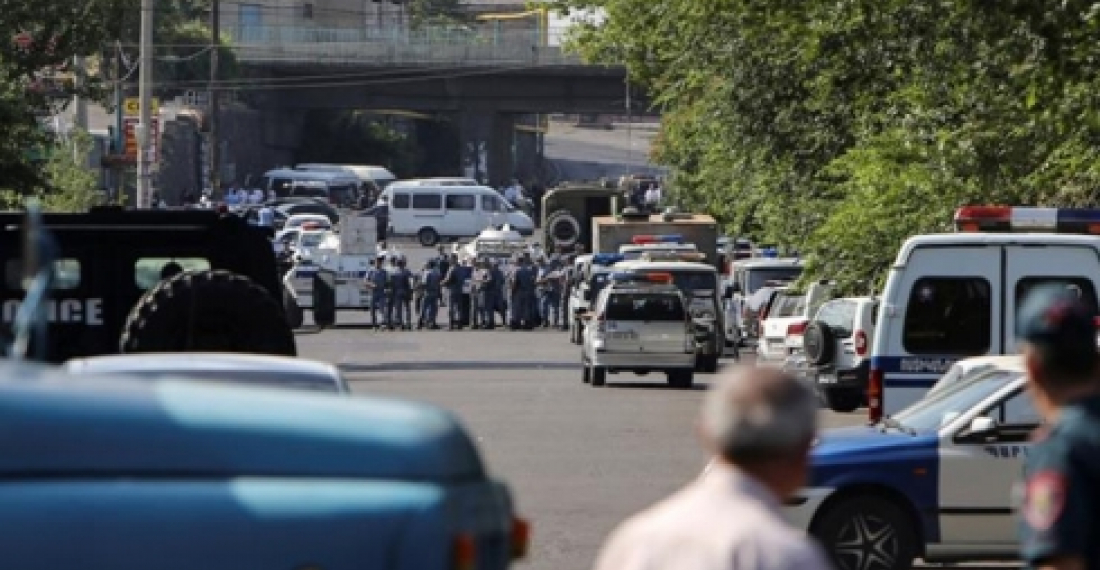
За событиями в Ереване стоит более серьезная проблема связанная с Карабахом - политолог.

В воскресенье, в Ереване, группа вооруженных людей взяла штурмом полицейский участок. В результате штурма был убит полковник Артур Ваноян и еще четверо полицеских получили ранения.

Лица, захватившие участок, являются членами армянской оппозиционной гражданской инициативы "Учредительный парламент". Они потребовали освобождения своего лидера, Жирайра Сефиляна, который является ярым критиком нынешнего правительства, но власти отклонили их требования.

В понедельник силы безопасности окружили полицейский участок, находящийся в районе Эребуни, в рамках подготовки к операции по освобождению.

По словам первого заместителя главы полиции страны генерала Унана Погосяна силовики продолжают переговоры с вооруженными лицами. "Если они не прислушаются к нашим призывам, мы нейтрализуем их, потому что с убийцами нельзя вести себя иначе", - сказал генерал полиции.

В видео, опубликованном на Facebook, люди, вооруженные автоматами, говорят, что "начинают бунт" против правительства.

Но службы безопасности опровергли подобные заявления. "Служба национальной безопасности официально заявляет о том, что такая информация абсолютно не соответствует действительности", говорится в заявлении.

Соседи из близлежащих домов сообщают о взрывах и выстрелах. В центре Еревана очень много полицейских, некоторые дороги заблокированы. Алек Енигомшян, член Учредительного парламента, сообщил "Hetq", что группа, удерживающая заложников, прошлой ночью освободила одного полицейского в знак доброй воли, в результате чего число заложников уменьшилось до шести.

По мнению политолога Ирины Капланян в интервью CivilNet, ключевым фактором в объяснении нынешней напряженности является продолжающийся территориальный спор с Азербайджаном по поводу Нагорного Карабаха.

"Мы знаем, что произошли некоторые события [о возможном мирном соглашении], но общественности ничего неизвестно о возможных соглашениях, которые были достигнуты", сказала она.

Группа Сефиляна известна решительными выступлениями против действующей политики Сержа Саргсяна в отношении к Карабаху. Его группа базируется на принципах против предоставления каких-либо территориальных уступок Азербайджану, и часто проводит митинги в столице Армении.

В июне были арестованы он и еще шесть его сторонников, после того, как власти заявили о том, что они готовили заговор с целью захватить несколько правительственных зданий в Ереване, как сообщает RFE/RL. Его также арестовывали в 2006 году после призывов к свержению правительства, и еще раз в 2015 году.

источники: commonspace.eu по материалам агентств

 

Related articles

Editor's choice
News
Women emerge favourite to lead United Nations from next year, after straw-poll of UN Security Council members

Women emerge favourite to lead United Nations from next year, after straw-poll of UN Security Council members

​ Two women have emerged as favourite to lead the United Nations as Secretary-General from 1 January 2027, when the term of the present incumbent, Antonio Gutteres, expires. A straw poll of the members of the UN Security Council, held on Thursday, 30 July showed that of the seven candidates, Rebecca Grynspan of Costa Rica and Carolyn Rodriguez-Birkett of Guyana received ten and nine positive endorsements respectively, by the 15 members UN Security Council Although the poll and its result are supposed to be secret, the result leaked within minutes, and was carried on world media outlets, such as Reuters. The result was as follows   Michelle Bachelet 6 encourage 5  discourage   4 no opinion María Fernanda Espinosa 5 2 8 Rafael Grossi 7 2 6 Rebeca Grynspan 10 1 4 Olara Otunnu 2 5 8 Carolyn Rodrigues-Birkett 9 2 4 Macky Sall 6 7 2   Article 97 of the UN Charter states that the “Secretary-General shall be appointed by the General Assembly upon the recommendation of the Security Council”. Straw polls are informal ballots used to determine the viability of Secretary-General candidates.  The seven current candidates are: Michelle Bachelet Jeria (Chile), who was nominated by Brazil, Chile, and Mexico on 2 February, with Chile withdrawing its nomination on 24 March; María Fernanda Espinosa Garcés (Ecuador), who was nominated by Antigua and Barbuda on 11 May; Rafael Mariano Grossi (Argentina), who was nominated by Argentina on 26 November 2025; Rebeca Grynspan Mayufis (Costa Rica), who was nominated by Costa Rica on 3 March; Olara Otunnu (Uganda), who was nominated by Uganda on 24 July; Carolyn Rodrigues Birkett (Guyana), who was nominated by Guyana on 15 June; and Macky Sall (Senegal), who was nominated by Burundi on 2 March. At Thursday's straw poll, there was no difference between the ballots presented to the five permanent members (P5) and the ten elected members (E10). Council members received one ballot per candidate, containing the candidate’s name followed by three options: “encouraged”, “discouraged”, and “no opinion expressed”.   It is ofcourse early days, and the straw poll is just an informal indication of the mood of the UN Security Council, but the strong showwing by the two womencandidates may be an indication that for the first time, the head of the UN can be a women. (click image to read more) ​

Popular

Editor's choice
Interview
Thursday Interview: Murad Muradov

Thursday Interview: Murad Muradov

Today, commonspace.eu starts a new regular weekly series. THURSDAY INTERVIEW, conducted by Lauri Nikulainen, will host  persons who are thinkers, opinion shapers, and implementors in their countries and spheres. We start the series with an interview with Murad Muradov, a leading person in Azerbaijan's think tank community. He is also the first co-chair of the Action Committee for a new Armenian-Azerbaijani Dialogue. Last September he made history by being the first Azerbaijani civil society activist to visit Armenia after the 44 day war, and the start of the peace process. Speaking about this visit Murad Muradov said: "My experience was largely positive. My negative expectations luckily didn’t play out. The discussions were respectful, the panel format bringing together experts from Armenia, Azerbaijan, and Turkey was particularly valuable during the NATO Rose-Roth Seminar in Yerevan, and media coverage, while varied in tone, remained largely constructive. Some media outlets though attempted to represent me as more of a government mouthpiece than an independent expert, which was totally misleading.  Overall, I see these initiatives as important steps in rebuilding trust and normalising professional engagement. The fact that soon a larger Azerbaijani civil society visits to Armenia followed, reinforces the sense that this process is moving in the right direction." (click the image to read the interview in full)


