Editorial: Macron’s state visit to Saudi Arabia highlights shared vision for strategic cooperation

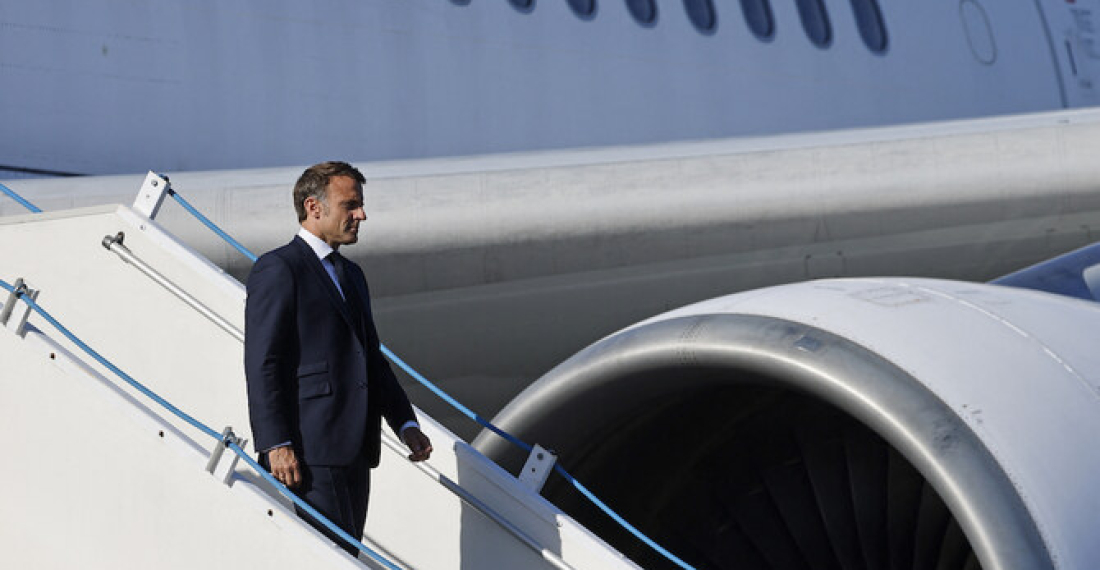
French President Emmanuel Macron’s arrival in Riyadh on Monday for a three-day state visit demonstrates the deepening ties between France and Saudi Arabia. The visit follows an invitation from Crown Prince Mohammed bin Salman and it reflects the shared ambition to enhance cooperation across various sectors in conjunction with both Saudi Vision 2030 and France 2030.

The visit underscores a partnership rooted in mutual respect and long-term collaboration and is the latest of several high-profile exchanges, including President Macron’s Gulf tour in December 2021, which concluded in Jeddah, and Crown Prince Mohammed bin Salman’s visit to Paris in June 2023, accompanied by a ministerial delegation.

Macron’s schedule includes high-level meetings, a visit to Riyadh Metro, the Saudi-French Economic Forum and a number of cultural visits. The significance of this visit may be viewed in the context of the extent to which the European Union considers Saudi Arabia’s ongoing modernisation and reforms as vital to the strengthening of Saudi Arabia’s position as a central player in a more interconnected Middle East. It should be pointed out that France supports Saudi bids for major global events, such as hosting Expo 2030, the 2034 football World Cup and the Winter Olympics, considering them as opportunities for deeper cooperation

The historical relationship between France and Saudi Arabia predates the Kingdom’s establishment. France opened its first consulate in 1830 in Jeddah in a part of the Arabian Peninsula that would later emerge as the Kingdom of Saudi Arabia. It was also one of the first countries to recognise Saudi Arabia as a sovereign state in 1926. Nearly a century later, the two countries share common values in international relations such as the principle of non-interference and respect for international law.

This partnership between the two countries has evolved to address contemporary challenges. At the Summit for a New Global Financial Compact in June 2023, Saudi Arabia and France emphasised the need for an inclusive financial system to combat inequality, fund green transitions and achieve the UN Sustainable Development Goals. Their shared vision highlighted an alignment of priorities including a commitment to development and innovation.

Through the centuries, France has positioned itself as a global power in defence, energy, engineering, diplomacy, art and culture. But France today is also undergoing a transformation aimed at adapting its economy to new emerging industries, and its youth, and addressing climate-related challenges.

This transformation into a greener, more technology-driven economy aligns with Saudi Arabia’s ambitions under Vision 2030. Both countries have prioritised clean energy, with Saudi Arabia emerging as a significant player in renewable energy. Its investments in solar, wind, and hydro projects are matched by its leadership in the circular carbon economy, all key pillars of its Saudi Green and Middle East Green Initiatives. These initiatives resonate with France’s own climate goals, fostering a natural synergy between the two nations.

The trade exchanges between the two nations are increasingly shifting toward strategic and capital goods, particularly in sectors such as aviation, aerospace, renewable energy, healthcare, pharmaceuticals and rehabilitation services. Additionally, approximately 400 French companies are currently engaged in joint projects and investments with Saudi Arabia Saudi businessmen and companies are also enhancing their investments and partnerships with France.

President Macron is accompanied on this visit by a significant commercial and economic delegation that includes the CEOs of major French companies and manufacturers that are either existing partners with Saudi Arabia or seeking to establish partnerships. While the presence of French companies and brands is not new to Saudi Arabia, recent years have witnessed notable advancements following the modernisation of Saudi commercial and investment regulations in the framework of Vision 2030.

This visit takes on exceptional significance against the backdrop of current regional and international circumstances. At the forefront is the ongoing Gaza conflict, where civilian casualties continue to mount and Israeli military operations persist, while ceasefire negotiations remain deadlocked and humanitarian aid access faces significant challenges. Both countries have pledged to redouble their diplomatic efforts to address these urgent concerns.
source: This editorial comment was prepared by the editorial team of commonspace.eu.

Related articles

Editor's choice
News
Borrell tells the European Parliament that the situation in Afghanistan was critical, but the EU will remain engaged

Borrell tells the European Parliament that the situation in Afghanistan was critical, but the EU will remain engaged

Borrell underlined that the European Union will make every effort to support the peace process and to remain a committed partner to the Afghan people. "Of course, we will have to take into account the evolving situation, but disengagement is not an option.  We are clear on that: there is no alternative to a negotiated political settlement, through inclusive peace talks.
Editor's choice
News
NATO Chief says war is on Europe's doorstep, and warns against complacency

NATO Chief says war is on Europe's doorstep, and warns against complacency

Russia could attack a Nato country within the next five years, the Secretary General of NATO, Mark Rutte, said in a stark new warning. "Nato's own defences can hold for now," Rutte warned in Berlin, but conflict was "next door" to Europe and he feared "too many are quietly complacent, and too many don't feel the urgency, too many believe that time is on our side. "Russia is already escalating its covert campaign against our societies," Rutte said in a speech in Germany. "We must be prepared for the scale of war our grandparents or great-grandparents endured." Earlier this month, Russia's President Vladimir Putin said his country was not planning to go to war with Europe, but it was ready "right now" if Europe wanted to - or started a war. But similar reassurances were given by Moscow in 2022, just before 200,000 Russian troops crossed the border and invaded Ukraine. Putin has accused European countries of hindering US efforts to bring peace in Ukraine - a reference to the role Ukraine's European allies have recently played in trying to change a US peace plan to end the war, whose initial draft was seen as favouring Russia. But Putin was not sincere, Nato's secretary-general said in the German capital, Berlin. Supporting Ukraine, he added, was a guarantee for European security. "Just imagine if Putin got his way; Ukraine under the boot of Russian occupation, his forces pressing against a longer border with Nato, and the significantly increased risk of an armed attack against us." Russia's economy has been on a war footing for more than three years now - its factories churn out ever more supplies of drones, missiles and artillery shells. According to a recent report by the Kiel Institute for the World Economy, Russia has been producing each month around 150 tanks, 550 infantry fighting vehicles, 120 Lancet drones and more than 50 artillery pieces. The UK, and most of its Western allies, are simply not anywhere near this point. Analysts say it would take years for Western Europe's factories to come close to matching Russia's mass-production of weapons. "Allied defence spending and production must rise rapidly, our armed forces must have what they need to keep us safe," the Nato chief said.

Popular

Editor's choice
News
NATO Chief says war is on Europe's doorstep, and warns against complacency

NATO Chief says war is on Europe's doorstep, and warns against complacency

Russia could attack a Nato country within the next five years, the Secretary General of NATO, Mark Rutte, said in a stark new warning. "Nato's own defences can hold for now," Rutte warned in Berlin, but conflict was "next door" to Europe and he feared "too many are quietly complacent, and too many don't feel the urgency, too many believe that time is on our side. "Russia is already escalating its covert campaign against our societies," Rutte said in a speech in Germany. "We must be prepared for the scale of war our grandparents or great-grandparents endured." Earlier this month, Russia's President Vladimir Putin said his country was not planning to go to war with Europe, but it was ready "right now" if Europe wanted to - or started a war. But similar reassurances were given by Moscow in 2022, just before 200,000 Russian troops crossed the border and invaded Ukraine. Putin has accused European countries of hindering US efforts to bring peace in Ukraine - a reference to the role Ukraine's European allies have recently played in trying to change a US peace plan to end the war, whose initial draft was seen as favouring Russia. But Putin was not sincere, Nato's secretary-general said in the German capital, Berlin. Supporting Ukraine, he added, was a guarantee for European security. "Just imagine if Putin got his way; Ukraine under the boot of Russian occupation, his forces pressing against a longer border with Nato, and the significantly increased risk of an armed attack against us." Russia's economy has been on a war footing for more than three years now - its factories churn out ever more supplies of drones, missiles and artillery shells. According to a recent report by the Kiel Institute for the World Economy, Russia has been producing each month around 150 tanks, 550 infantry fighting vehicles, 120 Lancet drones and more than 50 artillery pieces. The UK, and most of its Western allies, are simply not anywhere near this point. Analysts say it would take years for Western Europe's factories to come close to matching Russia's mass-production of weapons. "Allied defence spending and production must rise rapidly, our armed forces must have what they need to keep us safe," the Nato chief said.