


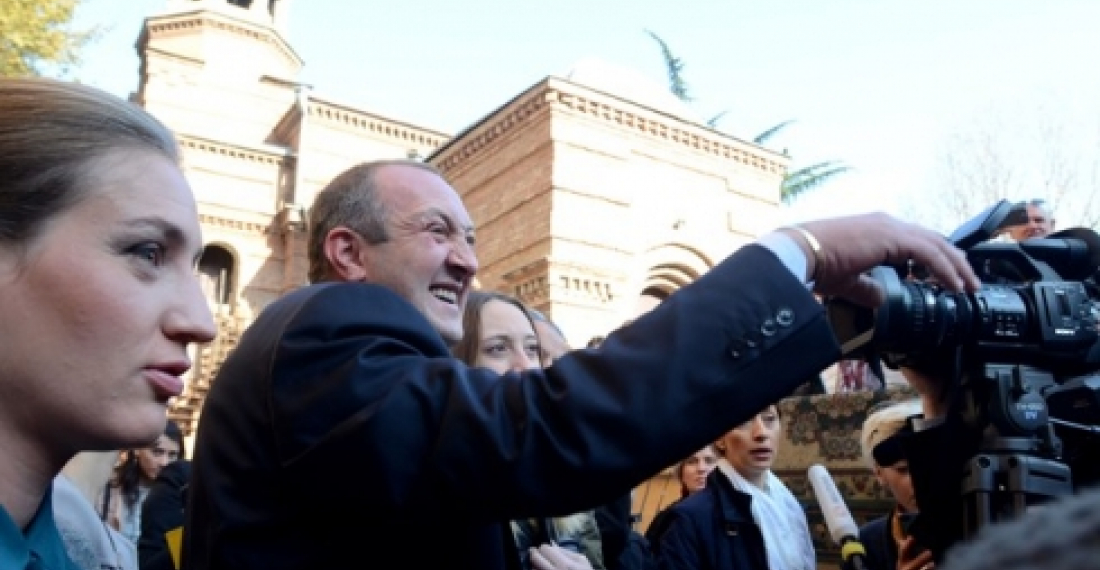
Маргвелашвили протягивает руку России. Новоизбранный президент Грузии в интервью российскому телевидению заявил, что стабильная Грузия, с Соглашением об ассоциации с ЕС, в интересах России.

Новоизбранный президент Грузии заявил в воскресенье, что он рассматривает возможность посещения зимних Олимпийских игр 2014, которые пройдут в России, на черноморском курорте Сочи в феврале, это шаг, который в конечном счете может уменьшить политическую напряженность между двумя странами.

Георгий Маргвелашвили, который 27 октября одержал победу на президентских выборах в Грузии, набрав в первом туре 62,11 процента голосов, заявил программе "Воскресное Время" на Первом канале России, что Олимпиада может "дать старт новым отношениям не только в России, но и во всем мире".

Маргвелашвили, который будет приведен к присяге в качестве президента 17 ноября, также заявил, что сближение Грузии с Европейским Союзом в интересах России. Он сообщил, что открытие российского рынка для грузинской продукции стало весьма позитивным событием, он также сказал, что в Грузии созданы все условия для развития российского бизнеса. 

"Мы еще создаем новый формат. Мы создаем возможность для русских бизнесменов инвестировать в Грузию, как в страну, которая будет иметь свободные торговые отношения с Европой", сказал Маргвелашвили, ссылаясь на Соглашение об ассоциации, которое Грузия планирует скоро подписать с Европейским Союзом, и которое также включает в себя глубокое и всеобъемлющее соглашение о свободной торговле.

На вопрос, как Грузия планирует принять во внимание интересы России в то время как стремится к интеграции с Европой, Маргвелашвили ответил: "Интеграция Грузии и ассоциирование с Европой в нашем видении - это и есть интерес России. Стабильная страна на южном направлении реально создает возможность для углубления отношений и для стабильного развития так же Российской Федерации, которая, кстати, тоже очень активна с Европой."

"Мы видим только плюс для России в этом аспекте. Так что, я думаю, здесь учтены интересы России". Сказал он. 

"В России тоже сейчас стабильная политическая ситуация и в Грузии стабильная политическая ситуация. Это является хорошим предпосылкой для того, чтобы начать решать эти вопросы", сказал Маргвелашвили.

Источник: commonspace.eu по материалам агентств

фото: Георгий Маргвелашвили в ходе избирательной кампании в прошлом месяце (фото (C) commonspace.eu / Молли Корсо).

Related articles

Editor's choice
News
Women emerge favourite to lead United Nations from next year, after straw-poll of UN Security Council members

Women emerge favourite to lead United Nations from next year, after straw-poll of UN Security Council members

​ Two women have emerged as favourite to lead the United Nations as Secretary-General from 1 January 2027, when the term of the present incumbent, Antonio Gutteres, expires. A straw poll of the members of the UN Security Council, held on Thursday, 30 July showed that of the seven candidates, Rebecca Grynspan of Costa Rica and Carolyn Rodriguez-Birkett of Guyana received ten and nine positive endorsements respectively, by the 15 members UN Security Council Although the poll and its result are supposed to be secret, the result leaked within minutes, and was carried on world media outlets, such as Reuters. The result was as follows   Michelle Bachelet 6 encourage 5  discourage   4 no opinion María Fernanda Espinosa 5 2 8 Rafael Grossi 7 2 6 Rebeca Grynspan 10 1 4 Olara Otunnu 2 5 8 Carolyn Rodrigues-Birkett 9 2 4 Macky Sall 6 7 2   Article 97 of the UN Charter states that the “Secretary-General shall be appointed by the General Assembly upon the recommendation of the Security Council”. Straw polls are informal ballots used to determine the viability of Secretary-General candidates.  The seven current candidates are: Michelle Bachelet Jeria (Chile), who was nominated by Brazil, Chile, and Mexico on 2 February, with Chile withdrawing its nomination on 24 March; María Fernanda Espinosa Garcés (Ecuador), who was nominated by Antigua and Barbuda on 11 May; Rafael Mariano Grossi (Argentina), who was nominated by Argentina on 26 November 2025; Rebeca Grynspan Mayufis (Costa Rica), who was nominated by Costa Rica on 3 March; Olara Otunnu (Uganda), who was nominated by Uganda on 24 July; Carolyn Rodrigues Birkett (Guyana), who was nominated by Guyana on 15 June; and Macky Sall (Senegal), who was nominated by Burundi on 2 March. At Thursday's straw poll, there was no difference between the ballots presented to the five permanent members (P5) and the ten elected members (E10). Council members received one ballot per candidate, containing the candidate’s name followed by three options: “encouraged”, “discouraged”, and “no opinion expressed”.   It is ofcourse early days, and the straw poll is just an informal indication of the mood of the UN Security Council, but the strong showwing by the two womencandidates may be an indication that for the first time, the head of the UN can be a women. (click image to read more) ​

Popular

Editor's choice
Interview
Thursday Interview: Murad Muradov

Thursday Interview: Murad Muradov

Today, commonspace.eu starts a new regular weekly series. THURSDAY INTERVIEW, conducted by Lauri Nikulainen, will host  persons who are thinkers, opinion shapers, and implementors in their countries and spheres. We start the series with an interview with Murad Muradov, a leading person in Azerbaijan's think tank community. He is also the first co-chair of the Action Committee for a new Armenian-Azerbaijani Dialogue. Last September he made history by being the first Azerbaijani civil society activist to visit Armenia after the 44 day war, and the start of the peace process. Speaking about this visit Murad Muradov said: "My experience was largely positive. My negative expectations luckily didn’t play out. The discussions were respectful, the panel format bringing together experts from Armenia, Azerbaijan, and Turkey was particularly valuable during the NATO Rose-Roth Seminar in Yerevan, and media coverage, while varied in tone, remained largely constructive. Some media outlets though attempted to represent me as more of a government mouthpiece than an independent expert, which was totally misleading.  Overall, I see these initiatives as important steps in rebuilding trust and normalising professional engagement. The fact that soon a larger Azerbaijani civil society visits to Armenia followed, reinforces the sense that this process is moving in the right direction." (click the image to read the interview in full)


