


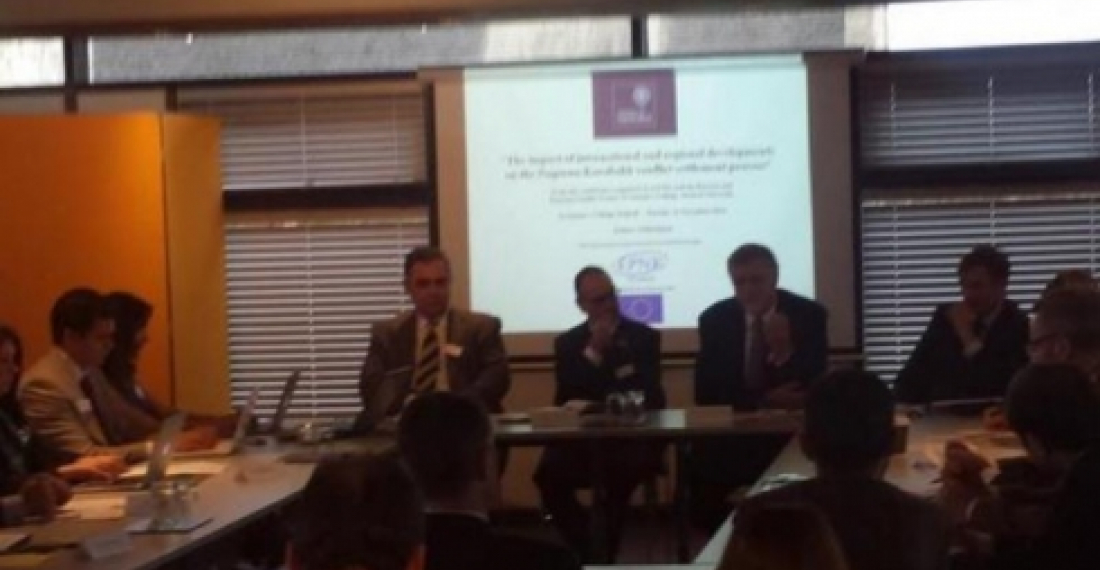
Карабахский конфликт в центре внимания на конференции в Оксфорде

Армянские и азербайджанские дипломаты, ученые и активисты гражданского общества, а также коллеги из ряда европейских стран, 11 ноября собрались в Оксфорде на конференцию на тему "Влияние международных и региональных событий на процесс урегулирования нагорно-карабахского конфликта".

Однодневная конференция была организована LINKS и Центром исследований России и Евразии при колледже Святого Антония Оксфордского университета.

Так как конференция была открыта в одиннадцатом часу, в одиннадцатый день, одиннадцатого месяца - конференция началась с двух минутного молчания, посвященного всем, кто погиб в войнах прошлого века.

Среди выступавших на конференции были: профессор Дэн Хили, директор  Центра изучения России и Евразии при Колледже Святого Антония Оксфордского университета; Деннис Саммут (директор LINKS, Оксфордский университет); Доктор Уолтер Кемп, (Международный институт мира, Вена); Посол Герберт Зальбер (специальный представитель Европейского Союза по Южному Кавказу и конфликтам в Грузии). Профессор Рой Аллисон (RESC, Оксфордский университет) Ричард Киракосян (Центр краеведения,  Ереван), посол Хазар Ибрагим (Постоянный представитель Азербайджана в НАТО), Аманда Пол (из Европейского центра политики, Брюссель). Доктор Сабина Фрейзер (из Атлантического совета центра Евразия, Вашингтон, округ Колумбия); Аваз Гасанов (Общество гуманитарных исследований, Баку); Масис Маилян (Общественный совет по внешней политике и безопасности, Степанакерт); Профессор Нейл Макфарлейн (Департамент международных связей, Оксфордский университет); Доктор Лоуренс Броерс ( Caucasus Program Associate, Ресурсы примирения, Лондон); Орхан Акперов, (Совет азербайджанской общины Нагорного Карабаха, Баку); и Крейг Олифант (Безопасный мир, Лондон).

Источник: commonspace.eu

фото: открытие конференции по урегулированию нагорно-карабахского конфликта, состоявшейся в Оксфорде 11 ноября 2014 года.


Related articles

Editor's choice
News
The British prime minister says Europe must "stand on its own two feet" when it comes to defence

The British prime minister says Europe must "stand on its own two feet" when it comes to defence

The UK will deploy a carrier strike group, led by the aircraft carrier HMS Prince of Wales to the Arctic and the High North as part of efforts to bolster security against Russian threats. British prime minister, Sir Keir Starmer announced the deployment in a speech on Saturday (14 February) at the Munich Security Conference. Europe must be ready to fight to protect its people, values, and way of life,  Sir Keir told the Conference. Starmer also called for deeper links and cooperation, including economic ties, between the UK and EU. The PM stressed the continent must "stand on its own two feet" when it comes to defence commitments. "We must build our hard power, because that is the currency of the age," he told the conference. (Click image to read the full story).

Popular

Editor's choice
Interview
Thursday Interview: Murad Muradov

Thursday Interview: Murad Muradov

Today, commonspace.eu starts a new regular weekly series. THURSDAY INTERVIEW, conducted by Lauri Nikulainen, will host  persons who are thinkers, opinion shapers, and implementors in their countries and spheres. We start the series with an interview with Murad Muradov, a leading person in Azerbaijan's think tank community. He is also the first co-chair of the Action Committee for a new Armenian-Azerbaijani Dialogue. Last September he made history by being the first Azerbaijani civil society activist to visit Armenia after the 44 day war, and the start of the peace process. Speaking about this visit Murad Muradov said: "My experience was largely positive. My negative expectations luckily didn’t play out. The discussions were respectful, the panel format bringing together experts from Armenia, Azerbaijan, and Turkey was particularly valuable during the NATO Rose-Roth Seminar in Yerevan, and media coverage, while varied in tone, remained largely constructive. Some media outlets though attempted to represent me as more of a government mouthpiece than an independent expert, which was totally misleading.  Overall, I see these initiatives as important steps in rebuilding trust and normalising professional engagement. The fact that soon a larger Azerbaijani civil society visits to Armenia followed, reinforces the sense that this process is moving in the right direction." (click the image to read the interview in full)

