


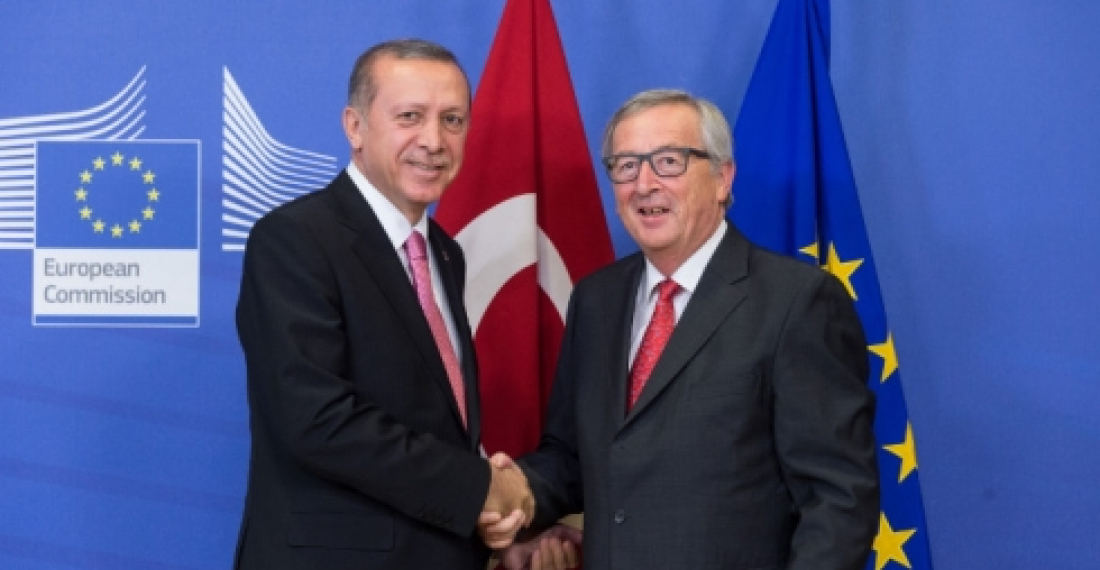
"Турция и ЕС идут и работают вместе."

Визит президента Турции Реджепа Тайип Эрдогана в европейские институты в Брюсселе на этой неделе состоялся в самый решающий момент для двух сторон.

Для Европейского Союза, который столкнулся с потоком сотен тысяч беженцев из Сирии и из-за ее пределов, Турция является незаменимым элементом в управлении этим потоком в то же время облегчая массовые страдания, который создал сирийский кризис. Для Турции бремя ухода за миллионами сирийских беженцев - то, что страна делала с большим великодушием и с незначительной посторонней помощью на протяжении многих лет - начинает иметь экономические и социальные последствия.

Решение Европейского Союза признать важность роли Турции в разрешении нынешнего кризиса беженцев в Европе назрело уже давно, но лучше поздно, чем никогда. Как сказал президент Юнкер, выступая в Европейском парламенте, в понедельник (6 октября), "ЕС готов и далее активизировать помощь Турции для улучшения условии в местах приема беженцев и условии их пребывания. В кризис беженцев Турция и ЕС идут вместе и работают вместе."

Можно почувствовать некоторую симпатию к президенту, который через два дня сказал журналистами, сопровождающих в его поездке в Японию, что приток беженцев, вызванный продолжающимся сирийским кризисом, еще раз подчеркнул исключительную важность Турции для Европы и, что лидерам ЕС напомнили об этом факте.

Кризис беженцев возглавил повестку дня во время встреч с президентом Европейского парламента Мартином Шульцом, президентом Европейского совета Дональдом Туском и президентом Европейской комиссии Жан-Клод Юнкером. Шульц, Туск и Юнкер, казалось больше стремятся к сотрудничеству, чем раньше, сказал президент, добавив: "Все они признают бремя, которое лежит на плечах Турции, особенно в отношении беженцев. Они согласны, что ЕС должен разделить это бремя, то о чем они решат после обсуждений между собой". Турцию, которая укрывает 2 млн. сирийцев и иракцев, 400,000 из которых находятся только в Стамбуле, обнадёжит то, если Европа продолжит оставаться столь же чувствительной к их бедственному положению, как сейчас, сказал он.

Эрдоган выразил оптимизм касательно улучшения отношений Турции с ЕС. "Мои встречи с Шульцем, Туском и Юнкером, которые являются наиболее высокопоставленными чиновниками ЕС, были очень позитивными", сказал он журналистам.

Испытание Турции.

Однако, для Турции это неделя также стало испытанием - неделя, в течение которой она поняла, кто её настоящие друзья. Инциденты с российскими военными самолетами на турецкой границе с Сирией выявили, насколько хрупки российско-турецкие отношения, и насколько по-прежнему важны отношения Турции с НАТО. Президент Эрдоган не подбирал мягких слов в выражении своего разочарования действиями России заявив, что нарушения воздушного пространства Турции российской стороной в последние несколько дней несовместимы с установившимися тесными связями между двумя странами и добавил, что российская сторона близка к потере друга в лице Турции. Он отметил, что Совет НАТО провел экстренное заседание и выступил с жестким заявлением, осуждающим действия России. "В нем сказано, что нарушение воздушного пространства Турции означает нарушение воздушного пространства НАТО. Я должен признать, что российские заявления об этих нарушениях не могут рассматриваться как серьезные. Для России совершать такие акты по отношению к соседней стране, с которой у нее создан совет по сотрудничеству на высшем уровне недостойно." Он сказал, что встречался с президентом России Владимиром Путиным в конце прошлого месяца, и также говорил с ним после того, как Россия начала наносить свои воздушные удары в Сирии. "Нарушения воздушного пространства после все не соответствуют серьезной государственной деятельности. Мы, безусловно, расстроены. Это не должно было случиться."

Когда его спросили, намерен ли он переговорить с Путиным, чтобы нарушения не переросли в столкновения, Эрдоган сказал: "Я не думаю, что Россия пойдет на это. Экстренное заседание НАТО показало, насколько серьезно они рассматривают это." Он сказал, что нарушения имели место после того, как он имел разговор с Путиным, и он не считает, что есть смысл снова звонить Путину при таких обстоятельствах.

Дружба проходит испытание в трудную минуту, и для Европейского Союза, и для Турции это момент проверки. Обе стороны в прошлом упускали возможность поставить свои отношения на более прочную основу. Из нынешних кризисов может возникнуть новая солидарность между Турцией и ЕС. В настоящее время обе стороны рассматривают их отношения с более прагматичной и менее эмоциональной позиции. Нынешние кризисы открывают новые возможности и все заинтересованные стороны в этот раз должны воспользоваться этим правильно.

Источник: Этот комментарий был подготовлен редакционной командой commonspace.eu по материалам пресс-службы Европейской комиссии, Daily Sabah (Турция) и других агентств.

Фото: Президент Эрдоган и президент Еврокомиссии Юнкер в Брюсселе, 5 октября 2015 года (фото любезно предоставлено пресс-службой Еврокомиссии.)

 

Related articles

Editor's choice
News
COP 17 in Armenia

COP 17 in Armenia

Armenia is currently hosting the COP17 conference of the Convention on Biological Diversity, which began earlier this week (19 October) and will run until 30 October, bringing around 15,000 participants from 196 different countries to Yerevan. At a leaders' summit held as part of COP17, Prime Minister Nikol Pashinyan expressed realistic ambitions: “We are halfway towards achieving these goals (Kunming-Montreal Global Biodiversity Framework), and we must honestly acknowledge that we are not yet moving in the right direction. Our task now is not to make new promises, but to fulfil the commitments we have already made.” Pashinyan pointed towards Armenia's own records, noting that the whitefish stock in Lake Sevan has increased substantially in the last ten years. Iranian President Masoud Pezeshkian and Georgian Prime Minister Irakli Kobakhidze also addressed the summit, with Turkiye sending its agriculture minister. However, there were no reports of Azerbaijani representatives attending. The conference has given Yerevan a valuable international platform, yet the absence of Azerbaijan is likely to be read as a sign that the peace process in the South Caucasus has not yet been translated into wider regional cooperation. The leaders' summit was opened by Armenian Prime Minister Nikol Pashinyan, who stressed that hosting the conference was a great honour for Armenia. He expressed hope that it would 'be productive and contribute to protecting our planet's biodiversity'. 'We – the citizens of Armenia, the government, state authorities and local governments – owe a debt to our nature,' the prime minister said. He noted that the international community had already developed the concept of 'living in harmony with nature’ and adopted the Kunming-Montreal Global Biodiversity Framework in 2022, setting out goals and specific targets to be achieved by 2030. 'We are halfway towards achieving these goals, and we must honestly acknowledge that we are not yet moving in the right direction. Our task now is not to make new promises, but to fulfil the commitments we have already made,' Nikol Pashinyan said. The COP17 conference is expected to adopt a declaration at leaders' level. More than 30 documents are scheduled for discussion. If approved, the commitments set out in them will become legally binding on countries that are parties to the Convention on Biological Diversity.”
Editor's choice
News
Landmines present to the European Union both a contradiction and a dilemma

Landmines present to the European Union both a contradiction and a dilemma

Finland’s decision to buy one million landmines creates a serious contradiction in the policy of the European Union, and is symbolic of a bigger dilemma facing European countries as they get used to the need to acquire “hard” power to face an increasing threat from Russia. Finland is seeking to acquire one million anti-personnel mines at a cost of 100 million euros. Finland, together with Poland, Latvia, Lithuania and Estonia last year abandoned the Ottawa agreement, the international framework that bans the use of anti-personnel mines, which the EU had been instrumental in establishing and supporting. All five countries cite the threat from Moscow as the reason. Colonel Riku Mikkonen of the Army Command told Finland’s national news agency STT that officials are now gathering information from suppliers regarding the deal, the AFP news agency reports. Helsinki would like domestic manufacturers to supply the mines, with contracts signed by the end of 2027 and production up and running by 2028. “It would be useful in many ways if Finnish companies produced the anti-personnel mines in Finland,” Mikkonen said. About half a dozen Finnish firms qualify, he told STT. “However, at this stage, buying the mines from abroad is not totally ruled out,” he added. LANDMINES PROVIDE THE EU WITH BOTH A CONTRADICTION, AND A DILEMMA Eliminating landmine contamination worldwide is one of the EU’s main soft power postures, and it basks in its record as the biggest funder of anti-landmine action in the world. But the fact that 5 of its 27 member states  have now left the Ottawa Treaty dents the EU moral high ground. It is a contradiction that is too big and important to be ignored. It also presents the European Union with a deeper dilemma. The threat from Russia is changing what the EU has stood for decades, namely a force for good able to mobilise its considerable soft power for the greater good of humanity. How the Union will implement this change will define its future. In the meantime landmines have not become any less lethal, benign, or unimportant. They remain in many parts of the world a major threat to life, an impediment to prosperity, and a potential trigger to further conflict. The 22 EU members states that still adhere to the Ottawa treaty must regroup, and be more assertive in their quest against anti-personnel land mines. All the reasons why they supported the Ottawa treaty in the first place still exist. The message must be clear: NO TO LANDMINES!

Popular

Editor's choice
Interview
Thursday Interview: Murad Muradov

Thursday Interview: Murad Muradov

Today, commonspace.eu starts a new regular weekly series. THURSDAY INTERVIEW, conducted by Lauri Nikulainen, will host  persons who are thinkers, opinion shapers, and implementors in their countries and spheres. We start the series with an interview with Murad Muradov, a leading person in Azerbaijan's think tank community. He is also the first co-chair of the Action Committee for a new Armenian-Azerbaijani Dialogue. Last September he made history by being the first Azerbaijani civil society activist to visit Armenia after the 44 day war, and the start of the peace process. Speaking about this visit Murad Muradov said: "My experience was largely positive. My negative expectations luckily didn’t play out. The discussions were respectful, the panel format bringing together experts from Armenia, Azerbaijan, and Turkey was particularly valuable during the NATO Rose-Roth Seminar in Yerevan, and media coverage, while varied in tone, remained largely constructive. Some media outlets though attempted to represent me as more of a government mouthpiece than an independent expert, which was totally misleading.  Overall, I see these initiatives as important steps in rebuilding trust and normalising professional engagement. The fact that soon a larger Azerbaijani civil society visits to Armenia followed, reinforces the sense that this process is moving in the right direction." (click the image to read the interview in full)

