


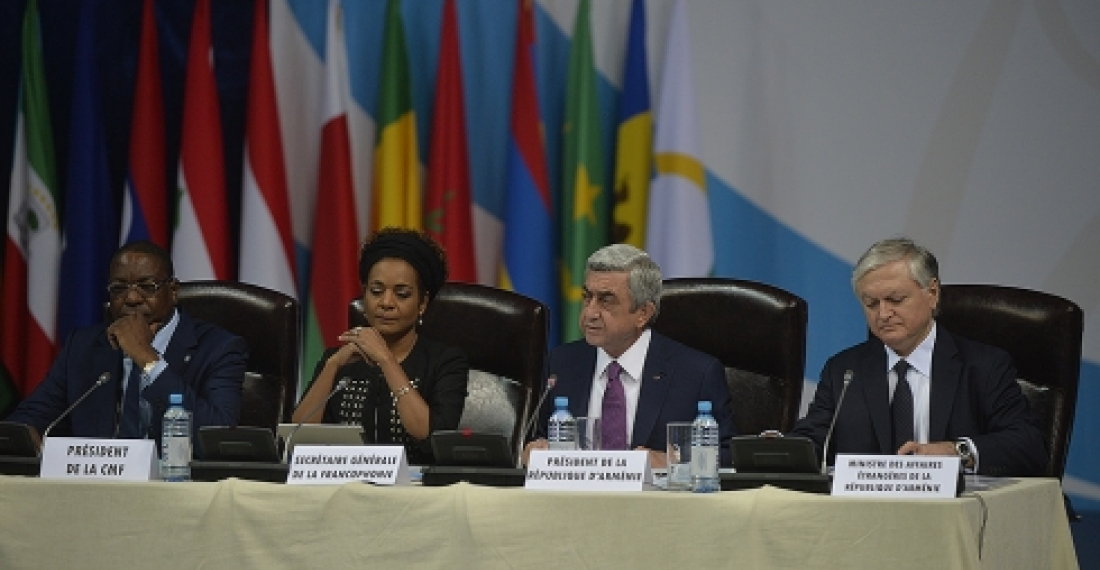
В Армении проходит конференция министров франкоязычных стран

31-й Совет министров франкоязычных стран, организация франкоязычных стран, открылся в столице Армении, Ереване. Среди делигации, участвующих в мероприятии, представители 57 государств-членов организации, а также 23 государств-наблюдателей.

Президент Серж Саргсян принял участие в открытии мероприятия, которое состоялось в Спортивно-концертном комплексе Карена Демирчяна. Обращаясь к более пятисот делегатам, президент Армении заявил, что "Сегодня мы живем в условиях выявившихся на международной арене новых кризисов и угроз, становимся очевидцами углубления разделительных линий. Поэтому особую важность получают международные и региональные организации, которые не разделяют, а объединяют. Мы должны укреплять наши структуры, повышать их эффективность и значение. В этом плане Международная организация франкофонии имеет исключительную важность, ведь мы сплотились в первую очередь исходя из ценностных соображений, которые являются дорогим и долгосрочным объединяющим фактором в современном мире."

Президент Саргсян добавил, что "К сожалению, конфликты и кризисы продолжают угрожать также безопасности некоторых регионов пространства франкофонии и подвергать опасности их устойчивое развитие. Не случайно, что Армения в качестве главной темы министерской конференции предложила именно тему «Мир, терпимость, диалог и взаимопонимание на пространстве франкофонии». Мы верим, что посредством терпимости можно избежать многочисленных проблем. И наоборот, нетерпимость может привести к кризисам, конфликтам и даже к осуществлению направленного против человечества самого жестокого преступления - геноцида. Мы это знаем по собственному опыту."

Вы можете ознакомиться с речью президента Армении в полном объеме на сайте председательства Армении здесь

Вы можете прочитать больше об организации франкоязычных стран здесь

источник: commonspace.eu

Фото: Президент Армении Серж Саргсян на открытии 31 Совета министров франкоязычных стран в Ереване, в субботу, 10 октября 2015 года (фото любезно предоставлено La Francophionie)


 

Related articles

Editor's choice
News
The British prime minister says Europe must "stand on its own two feet" when it comes to defence

The British prime minister says Europe must "stand on its own two feet" when it comes to defence

The UK will deploy a carrier strike group, led by the aircraft carrier HMS Prince of Wales to the Arctic and the High North as part of efforts to bolster security against Russian threats. British prime minister, Sir Keir Starmer announced the deployment in a speech on Saturday (14 February) at the Munich Security Conference. Europe must be ready to fight to protect its people, values, and way of life,  Sir Keir told the Conference. Starmer also called for deeper links and cooperation, including economic ties, between the UK and EU. The PM stressed the continent must "stand on its own two feet" when it comes to defence commitments. "We must build our hard power, because that is the currency of the age," he told the conference. (Click image to read the full story).

Popular

Editor's choice
Interview
Thursday Interview: Murad Muradov

Thursday Interview: Murad Muradov

Today, commonspace.eu starts a new regular weekly series. THURSDAY INTERVIEW, conducted by Lauri Nikulainen, will host  persons who are thinkers, opinion shapers, and implementors in their countries and spheres. We start the series with an interview with Murad Muradov, a leading person in Azerbaijan's think tank community. He is also the first co-chair of the Action Committee for a new Armenian-Azerbaijani Dialogue. Last September he made history by being the first Azerbaijani civil society activist to visit Armenia after the 44 day war, and the start of the peace process. Speaking about this visit Murad Muradov said: "My experience was largely positive. My negative expectations luckily didn’t play out. The discussions were respectful, the panel format bringing together experts from Armenia, Azerbaijan, and Turkey was particularly valuable during the NATO Rose-Roth Seminar in Yerevan, and media coverage, while varied in tone, remained largely constructive. Some media outlets though attempted to represent me as more of a government mouthpiece than an independent expert, which was totally misleading.  Overall, I see these initiatives as important steps in rebuilding trust and normalising professional engagement. The fact that soon a larger Azerbaijani civil society visits to Armenia followed, reinforces the sense that this process is moving in the right direction." (click the image to read the interview in full)

