


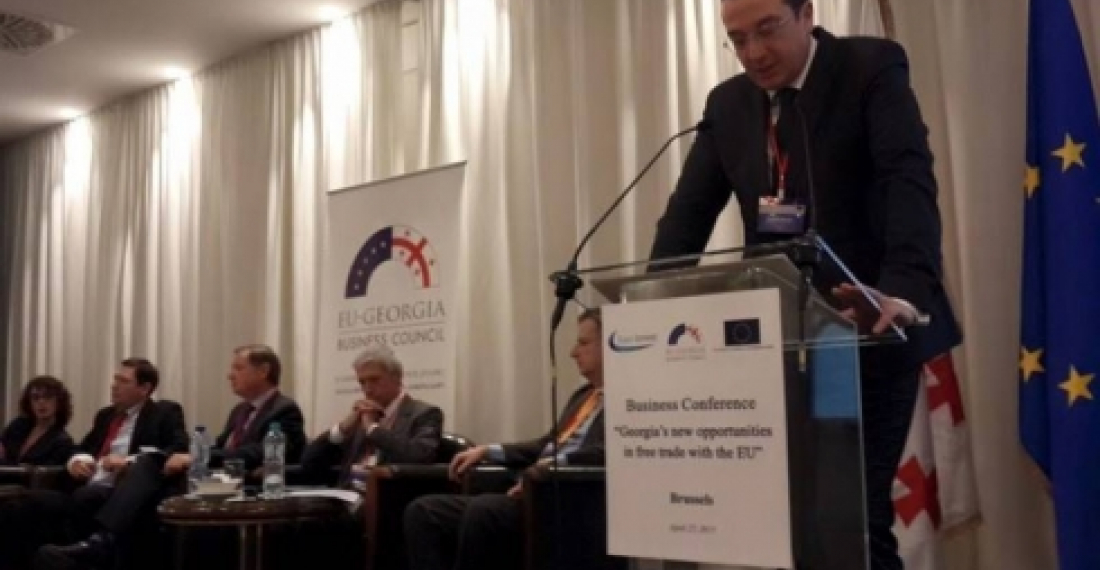
У Грузии впереди большие вызовы, но возможностей еще больше.

"Грузинское правительство не питает иллюзий по поводу того, что путь к реализации Соглашения об ассоциации с Европейским Союзом простой, но мы полны решимости, чтобы показать, что мы можем сделать возможным то, что когда-то казалось невозможным". Об этом заявил государственный министр Грузии по вопросам евроатлантической интеграции Давид Бакрадзе, выступая на конференции «Новые возможности Грузии в рамках свободной торговли с ЕС", которая состоялась в понедельник (27 апреля), в Брюсселе. Конференция была организована деловым советом ЕС-Грузия, в ней приняли участие представители европейских компаний, а также десятки грузинских бизнесменов. Конференция предоставляет хорошую возможность оценить как реализуются Соглашение об ассоциации (AA) и Глубокой и всеобъемлющей свободной торговле (DCFTA), которые были подписаны в прошлом году. Представитель ВР Эммануил Хаттон заявил, что впервые в Европе проходит такая большая конференция грузинского бизнеса.

В своей вступительной речи на конференции государственный министр Бакрадзе говорил о мерах, которые были осуществлены в 2014 году, как часть процесса гармонизации законодательства, а также бизнес-практики, с тем чтобы Грузия могла полностью извлечь выгоду из этих соглашений. Он также сказал, что правительство дало высокий приоритет этим задачам и, что премьер-министр, Ираклий Гарибашвили, взял на себя личную ответственность возглавить процесс мониторинга.

Выступая от имени Европейской Комиссии, директор Департамента ЕС по политике соседства Герхард Шуман Хицлер сказал, что перед Грузией стоят большие вызовы с началом реализации АА и DCFTA с ЕС, но возможности, которые они предоставляют еще больше. Хицлер также сказал, что в то время как основные выгоды от этих соглашений будут ощущаться в среднесрочной и долгосрочной перспективе некоторые из их преимуществ начнут ощущаться в уже в краткосрочной перспективе.

В дискуссиях в ходе конференции представители грузинских предприятий поделились своим опытом того, как новые соглашения с ЕС начали обретать форму. Чувствовалась общее ощущение оптимизма у представителей бизнес, которые рассказали, как свободная торговля с ЕС способствует их бизнесу. АА и DCFTA придают Грузии значительную и стабильную правовую основу, к которым иностранные инвесторы стремятся, и их результаты уже начинают ощущаться. Касательно вопроса о соответствии нормам ЕС, один из бизнесменов, Константин Векуа, директор компании, оперирующей в сфере агробизнеса, "Нергета", сообщил, что большинство из новых требований компаний и так выполняли до этого, хоть и немного увеличилось бумажной волокиты в результате все должны извлечь выгоду из этих лучших бизнес-практик.

Несмотря на то, что выступавшие на конференции были оптимистичны о будущем, в их речи также чувствовался и тон реализма на протяжении всей встречи, когда выступающие повторяли о необходимости неизменной приверженности со стороны как правительства Грузии, так и Европейского Союза. Лучше всего, пожалуй, подытожил Дирк Шубель, Европейской Службы внешних связей, который сказал, что Грузия и ЕС могут поздравить себя за то, что они уже достигли, но важно не самодовольство вжаться этим. Шубель подчеркнул важность того, что грузинское общество также считает, что оно является частью этого процесса и по-прежнему приверженно к его успеху.

Вопрос безвизового режима для грузин был поднят в презентации как министра Бакрадзе, так и посла Натали Сабанадзе, главы грузинского представительства в ЕС. Директор Шуман Хицлер в своем выступлении сказал, что отчет оценки прогресса в достижении введения безвизового режима будет опубликован в течение двух недель, и это позволит государствам-членам ЕС принять решение.

По словам политического редактора Commonspace.eu "Конференция состоялась своевременной, всего за несколько недель до рижского саммита Восточного партнерства, где ЕС и Грузия будут анализировать прогресс, достигнутый до сих пор. Конференция задала правильный тон, с чувством оптимизма, сдерживамая тяжелой дозой реализма. Бизнес-сообщество довольно единодушно в том, что им нравится то, что происходит в результате первых нескольких месяцев опыта новых отношений с ЕС. Они уверены в будущем, и достаточно позитивно оценивают настоящее. Для тех, кто следил за Грузией в течение длительного времени эта конференция стала счастливым отходом от прошлого, когда оценки со стороны Грузии были полны или пессимизмом или нереалистичнымт и преувеличенными прогнозами. И для Грузии и для Европейского Союза в слишком много поставлено на карту в настоящее время, чтобы совершать ошибки. Обе стороны должны продолжить целенаправленную работу, а также должны объяснять свои действия обществу в целом. Тот факт, что участники конференции, состоявшейся в Брюсселе в минувший понедельник, похоже, что хорошо понимают это уже позитив".

Источник: commonspace.eu

Фото: Государственный министр Грузии Давид Бакрадзе на конференции «Новые возможности Грузии в рамках свободной торговли с ЕС" в отеле Radisson Blu Royal, в Брюсселе, понедельник, 27 апреля 2015.


 

Related articles

Editor's choice
News
Israeli parliament votes to bring back the death penalty, but only for Palestinians

Israeli parliament votes to bring back the death penalty, but only for Palestinians

srael’s parliament approved a bill on Monday that would allow the execution of Palestinians convicted on terror charges for deadly attacks, a move that has been criticized as discriminatory and immediately drew a court challenge. Sixty-two lawmakers, including Prime Minister Benjamin Netanyahu, voted in favor and 48 against the bill, championed by far-right National Security Minister Itamar Ben Gvir. There was one abstention and the rest of the lawmakers were not present. Ben Gvir in the run-up to the vote had worn a lapel pin in the shape of a noose, symbolising his support for the legislation. “We made history!!! We promised. We delivered,” he posted on X after the vote. The bill would make the death penalty the default punishment for Palestinians in the Israeli-occupied West Bank found guilty of intentionally carrying out deadly attacks deemed “acts of terrorism” by an Israeli military court. The bill says that the sentence may be reduced to life imprisonment under “special circumstances.” Palestinians in the West Bank are automatically tried in Israeli military courts. Meanwhile, under the bill, in Israeli criminal courts anyone “who intentionally causes the death of a person with the aim of harming an Israeli citizen or resident out of an intention to put an end to the existence of the State of Israel shall be sentenced to death or life imprisonment.” Criminal courts try Israeli nationals, including Palestinian citizens and residents of east Jerusalem. The bill sets the execution method as hanging, adding that it should be carried out within 90 days of the sentencing, with a possible postponement of up to 180 days. - ‘Parallel tracks’ - The bill appears to conflict with Israel’s Basic Laws, which prohibit arbitrary discrimination, and shortly after it was passed, a leading human rights group announced that it had filed a petition with the Supreme Court demanding the legislation’s annulment. “The law creates two parallel tracks, both designed to apply to Palestinians,” the Association for Civil Rights in Israel said in a statement. “In military courts — which have jurisdiction over West Bank Palestinians — it establishes a near-mandatory death sentence,” the rights group said. In civilian courts, the law’s stipulation that defendants must have acted “with the aim of negating the existence” of Israel “structurally excludes Jewish perpetrators,” the group added. The association argued the law should be annulled on both jurisdictional and constitutional grounds. During the debate in parliament, opposition lawmaker and former deputy Mossad director, Ram Ben Barak, expressed outrage at the legislation. “Do you understand what it means that there is one law for Arabs in Judea and Samaria, and a different law for the general public for which the State of Israel is responsible?” he asked fellow parliamentarians, using the Israeli name for the West Bank. “It says that Hamas has defeated us. It has defeated us because we have lost all our values.” - ‘Discriminatory application’ - Lawmaker Limor Son Har-Melech from Ben Gvir’s party, who years ago survived an attack by Palestinian militants in which her husband was killed, urged fellow parliamentarians to approve the bill. “For years, we endured a cruel cycle of terror, imprisonment, release in reckless deals, and the return of these human monsters to murder Jews again ... And today, my friends, this cycle has come full circle.” The Palestinian Authority condemned the law’s adoption, saying that “Israel has no sovereignty over Palestinian land.” “This law once again reveals the nature of the Israeli colonial system, which seeks to legitimize extrajudicial killing under legislative cover,” it added. In February, Amnesty International had urged Israeli lawmakers to reject the legislation, citing its “discriminatory application against Palestinians.” On Sunday, Britain, France, Germany and Italy expressed “deep concern” over the bill, which they said risked “undermining Israel’s commitments with regards to democratic principles.” While the death penalty exists for a small number of crimes in Israel, it has become a de facto abolitionist country — the Nazi Holocaust perpetrator Adolf Eichmann was the last person to be executed in 1962. Israel has occupied the West Bank since 1967 and violence there has soared since Hamas’s October 7, 2023 attack on Israel triggered the Gaza war. (read more by clicking the image above).

Popular

Editor's choice
Interview
Thursday Interview: Murad Muradov

Thursday Interview: Murad Muradov

Today, commonspace.eu starts a new regular weekly series. THURSDAY INTERVIEW, conducted by Lauri Nikulainen, will host  persons who are thinkers, opinion shapers, and implementors in their countries and spheres. We start the series with an interview with Murad Muradov, a leading person in Azerbaijan's think tank community. He is also the first co-chair of the Action Committee for a new Armenian-Azerbaijani Dialogue. Last September he made history by being the first Azerbaijani civil society activist to visit Armenia after the 44 day war, and the start of the peace process. Speaking about this visit Murad Muradov said: "My experience was largely positive. My negative expectations luckily didn’t play out. The discussions were respectful, the panel format bringing together experts from Armenia, Azerbaijan, and Turkey was particularly valuable during the NATO Rose-Roth Seminar in Yerevan, and media coverage, while varied in tone, remained largely constructive. Some media outlets though attempted to represent me as more of a government mouthpiece than an independent expert, which was totally misleading.  Overall, I see these initiatives as important steps in rebuilding trust and normalising professional engagement. The fact that soon a larger Azerbaijani civil society visits to Armenia followed, reinforces the sense that this process is moving in the right direction." (click the image to read the interview in full)

