Соглашение об ассоциации между ЕС и Грузией вступает в полную силу

Соглашение об ассоциации между ЕС и Грузией, которое было подписано в июне 2014 года, вступило в силу с 1 июля 2016 года после того, как оно было ратифицировано парламентами всех 28 государств-участниц Европейского Союза. Соглашение об ассоциации, с Соглашением о глубокой и всеобъемлющей зоне свободной торговли (DCFTA), предусматривает политическую и экономическую интеграцию с ЕС за счет значительного углубления связей в этих сферах. Многие положения соглашения уже вступили в силу, а некоторые даже начали давать ощутимые результаты, такие как открытие европейских рынков для грузинского экспорта.

Отношения между ЕС-Грузия являются историей успеха. ЕС оказывал последовательную поддержку Грузии на протяжении многих лет. Однако, среди грузин есть и те, кто разочарован тем, что соглашение о либерализации визового режима еще не подписано, и отсутствует перспектива полного членства в краткосрочной и среднесрочной перспективе.

В комментарии, опубликованном сегодня утром ведущим аналитическим центром ЕС, Центр европейской политики, Деннис Саммут сказал следующее:

"Несмотря на трудности, отношения между Грузией и ЕС успешные. В настоящее время они входят в новую фазу, где акцент должен быть сделан на том, чтобы все то что было достигнуто в результате подписания АА и DCFTA работало на благо грузинского народа. Со временем будут появляться проблемы, которые будут проверять на прочность эти отношения - в основном из-за несбывшихся ожиданий - но, учитывая, что основа у отношении прочная, то и проблемы эти будут преодолены. Обе стороны должны быть готовы поддерживать долгосрочную перспективу, и ставить перед собой амбициозную повестку: гармонизация законодательства, расширение сотрудничества, особенно в области образования, а также развитие контактов между бизнесом. Такие конкретные, непрерывные инициативы также будут определять будущее."

Деннис Саммут утверждает, что правительство "Грузинской мечты" ускорило процесс евроатлантической интеграции и появление в грузинском парламенте межпартийного консенсуса по основным аспектам внешней политики является основным источником стабильности. Однако, он предостерегает, что некоторые новые популистские политические силы, часть из которых может иметь поддержку Москвы, ставят под сомнение эту политику. Несмотря на то, что они и не были представлены в парламенте последних лет, ситуация может изменится после выборов 8 октября. Эти выборы станут дальнейшим испытанием евроатлантической интеграции и обязательств Грузии." Полный текст читайте на сайте EPC здесь

источник: commonspace.eu по материалам epc.eu
 

Related articles

Editor's choice
News
Uzbekistan strengthens its relations with China and US

Uzbekistan strengthens its relations with China and US

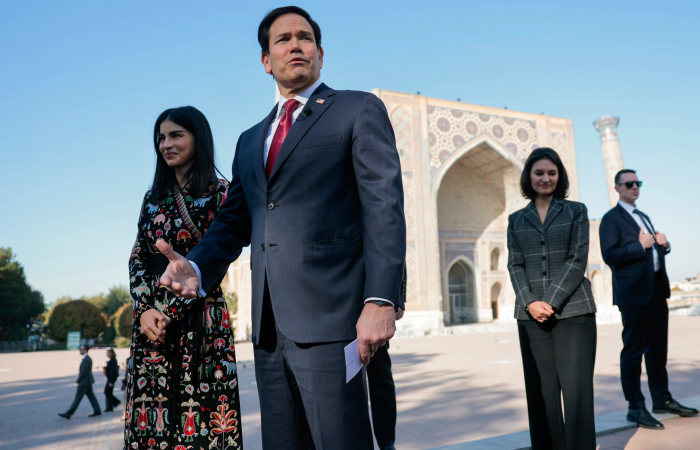
In recent days, Uzbekistan welcomed the Chinese and American governments in quick succession. During Chinese Premier Li Qiang’s visit on 17-18 October, the Uzbek presidential administration said that joint projects backed by firm agreements had reached nearly $60 billion. US Secretary of State Marco Rubio then arrived in Samarkand for C5+1 talks, accompanied at the time by American business leaders seeking contracts, particularly in critical minerals. During the visit, Uzbekistan announced 54 agreements covering trade, investment, and technology. The agreements are said to be worth a total of $12 billion, according to Uzbekistan’s Ministry of Investment, Industry and Trade. However, China still accounts for 23% of Uzbekistan’s foreign trade in January-August 2026, while US goods trade with Uzbekistan totalled at $1.05 billion in 2025, which is less than a fifteenth of the value of its trade with China. Rubio said Washington was not asking Central Asian countries to stop cooperating with other partners, but would instead compete for investment. Tashkent is likely to welcome investment from both sides, but the trade gap shows how challenging it will be if it were to decrease its dependence on Beijing. “Chinese Premier Li Qiang visited Uzbekistan on October 17–18, just ahead of United States Secretary of State Marco Rubio, who arrived in Samarkand on October 18 with a delegation of American business leaders seeking new contracts. While China already has a substantial presence in Uzbek manufacturing and energy, Washington is seeking to expand American involvement in critical minerals and technology. The visits highlight the growing competition between the world’s two largest economies for influence in Central Asia. On October 17, President Shavkat Mirziyoyev received Li Qiang. According to the Uzbek presidential administration, the portfolio of joint projects backed by firm agreements has reached nearly $60 billion. More than 6,000 joint ventures with Chinese participation have been established in Uzbekistan. (...) Construction of the China–Kyrgyzstan–Uzbekistan railway was another topic of discussion. Work officially began in December 2024. The route will cross mountainous areas of Kyrgyzstan and connect the railway networks of China and Uzbekistan. The 304-kilometer section through Kyrgyzstan alone is estimated to cost $4.7 billion and will require 50 bridges and 29 tunnels. (...) On October 19, Rubio attended talks in Samarkand under the C5+1 format, bringing together the U.S. and Kazakhstan, Kyrgyzstan, Tajikistan, Turkmenistan, and Uzbekistan. Rubio said nearly 300 American businesses were represented in Samarkand. Companies were discussing agreements potentially worth billions of dollars, with concrete announcements expected following the meetings. Among Washington’s priorities are critical minerals used in advanced technologies, including electronics and batteries.”

Popular

Editor's choice
Interview
Thursday Interview: Murad Muradov

Thursday Interview: Murad Muradov

Today, commonspace.eu starts a new regular weekly series. THURSDAY INTERVIEW, conducted by Lauri Nikulainen, will host  persons who are thinkers, opinion shapers, and implementors in their countries and spheres. We start the series with an interview with Murad Muradov, a leading person in Azerbaijan's think tank community. He is also the first co-chair of the Action Committee for a new Armenian-Azerbaijani Dialogue. Last September he made history by being the first Azerbaijani civil society activist to visit Armenia after the 44 day war, and the start of the peace process. Speaking about this visit Murad Muradov said: "My experience was largely positive. My negative expectations luckily didn’t play out. The discussions were respectful, the panel format bringing together experts from Armenia, Azerbaijan, and Turkey was particularly valuable during the NATO Rose-Roth Seminar in Yerevan, and media coverage, while varied in tone, remained largely constructive. Some media outlets though attempted to represent me as more of a government mouthpiece than an independent expert, which was totally misleading.  Overall, I see these initiatives as important steps in rebuilding trust and normalising professional engagement. The fact that soon a larger Azerbaijani civil society visits to Armenia followed, reinforces the sense that this process is moving in the right direction." (click the image to read the interview in full)