Основные цвета: Киев в состоянии войны. Из столицы Украины нащ спецкор Джозеф Д'Урсо

Спустя год после исторических событий на Майдане, Киев все еще зажат в политической драме. Несмотря на то, что стрельба в столице Украины прекратилась, отголоски конфликта на востоке страны резонируют здесь по-разному.

Наш специальный корреспондент Джозеф Де-Урсо на прошлой неделе 
побывал в Киеве и подготовил это фото-эссе специально для commonspace.eu.


♦ Каждый киоск, каждый забор, каждый аниматор на улице - все в Киеве в данный момент пропитано политикой. Все и везде напоминает о войне в восточной Украине. 

Даже небольшие пункты обмена валюты, повсеместно расположенные в каждом восточном европейском городе, рассказывают историю. Когда я приехал, 22 февраля, один американский доллар стоил 28 гривен. Два дня спустя он стоил уже 33. Затем снова упал. Женщина, которая управляет обменным пунктом дописала нули ручкой.


♦ Пенсии, выделяемые в украинской валюте становятся все более бесполезными, а мечты молодых людей выехать за границу становятся все менее сбыточными. Павел, одетый в костюм тигра, и с его друг медведь панда, который не захотел   поделиться своим именем, зарабатывают деньги, на фотографиях, сделанных с туристами.

Кажется, что они не очень заняты этим февралем. "Много людей погибло здесь. Мы видим как люди плачут. Но мы можем подарить им улыбки. F*** Путин!" говорит Павел.


♦ Действительно, много людей погибло в прошлом году, на пятачке бетона, который находится за спиной тигра и панды. Сто протестующих были застрелены год назад правительственными войсками, которые пытались разогнать протест "Евромайдан". Президент Янукович был отстранен от должности вскоре после этого, с новыми выборов, состоявшихся в мае.

Призраки "небесной сотни" все еще преследуют Киев. По улице, где раздавался снайперский огонь лежат цветы, фонари и фотографии мертвых. Их даты рождения охватывают десятилетия, но их даты смерти датируются февралем 2014. Многие из них были подростками.

♦ Этот город далек от того, каким был летом 2012 года, когда туристы наводнили город к чемпионату Европы. Киевляне по-прежнему с любовью говорят о гостях из Швеций, которые разбили лагерь на несколько недель в лесу на левом берегу реки Днепр. Людмила, гид, показывает ее фотографии с Джеймсом Милнером и Филом Ягелка, два английских футболиста у одного из главных соборов Киева. "У меня раньше было по 30 человек на туры," говорит она. "Теперь же хорошо, если ниберется один или два." На прошлой неделе, тащился через снег к стадиону, где Англия была выбита из турнира по итогам матча с Италией в 2012 году. ФК Динамо Киев играл с французской Генгам в плей-офф Лиги Европы. Когда Динамо забила второй гол, трибуна с  "Ultras" привлекла к себе внимание: тысячи полуобнаженных мужчин прыгали вверх и вниз в мокрый снег.

Игра была приостановлена на десять минут, когда фанаты французской команды выбежали на поле. В конечном счете украинская сторона победила. Фанаты разошлись на метро после финального свистка, скандируя Слава Украине! Слава героям! и после грубой песни о Владимире Путине. Динамо предстоит одолеть Английский Эвертон в следующем раунде. Фил Ягелка вернется в Киев.

В толпе, в которой преобладали синий и белый цвет фанатов Динамо заметен приправленный золотом и синий флаг Украины. Также можно видеть красно черный флаг украинского национализма: флаг Украинской повстанческой армии, которая боролась с Советами во время Второй мировой войны.

♦ В нынешней политической ситуации, красный и черный представляет правый сектор, крайне правая партия, которая показала плохие результаты на парламентских выборах в мае прошлого года, но она занимается организацией отправки боевиков-добровольцев для борьбы с сепаратистами на востоке страны. Спорная организация, кажется, которая открыто собирает деньги на Майдане стало нормой в жизни в Киеве. На демонстрации перед зданием Национального банка Украины, где требуют отставки Валерия Алексеевна Гонтарева, председателя банка, все больше красно-черного флага, чем синих и желтых.

♦ Знаки отличия батальона Азов, которые имеют некоторое сходство с изображением свастики, можно увидеть на плакатах и граффити.

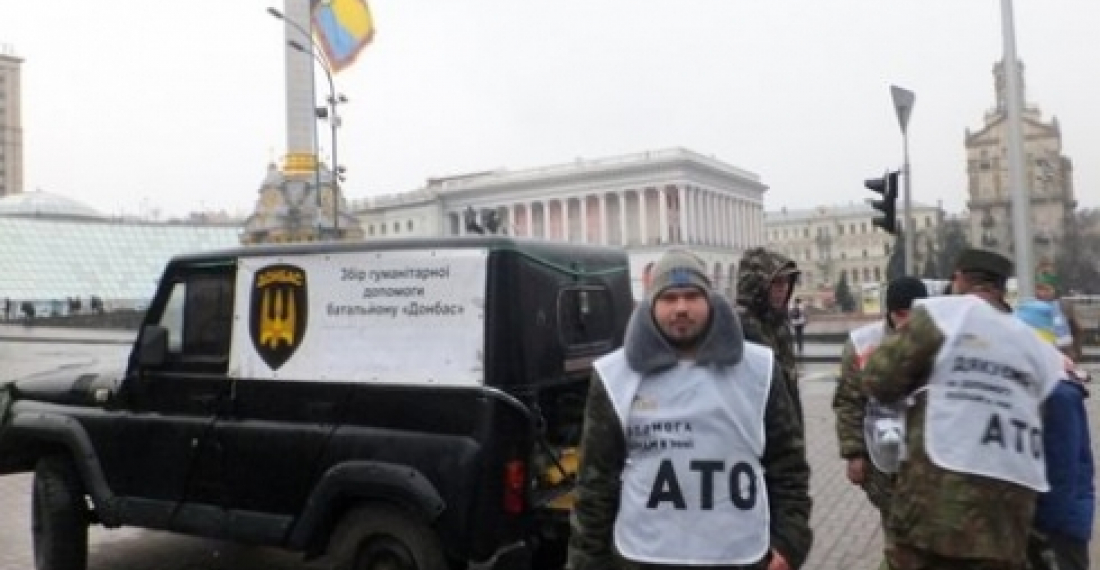
♦ Однако, чаще, люди, как Руслан, стоят под золотисто голубым национальным флагом Украины и привлекают средства для «ATO» (украинская армия относится к операции на востоке страны как к «антитеррористической операции"). Если вы сейчас пройдете по Майдану, люди из ATO, несомненно, подойдут к вам.

♦ В какой-то степени, жизнь продолжается в обычном режиме. В захватывающей дух Печерской Лавре, общаются паломники и монахи, люди почитают святых, зажигая свечи. Но есть среди них несколько туристов, и, явно, они не английские футболисты.


♦ Однако, за пределами Свято-Михайловского храма, еще один великолепный монастырь в центре Киева, стоят сгоревшие  бронетранспортные средства и разбросаны отстрелянные гильзы. Это техника с российскими серийныами номерами, как "доказательство российской военной агрессии на территории Украины". В Киеве, сейчас, любое отвлечение от войны может быть только временным.

Источник: Фото-эссе Джозефа Де-Урсо специально для commonspace.eu

(C) commonspace.eu

Related articles

Editor's choice
News
COP 17 in Armenia

COP 17 in Armenia

Armenia is currently hosting the COP17 conference of the Convention on Biological Diversity, which began earlier this week (19 October) and will run until 30 October, bringing around 15,000 participants from 196 different countries to Yerevan. At a leaders' summit held as part of COP17, Prime Minister Nikol Pashinyan expressed realistic ambitions: “We are halfway towards achieving these goals (Kunming-Montreal Global Biodiversity Framework), and we must honestly acknowledge that we are not yet moving in the right direction. Our task now is not to make new promises, but to fulfil the commitments we have already made.” Pashinyan pointed towards Armenia's own records, noting that the whitefish stock in Lake Sevan has increased substantially in the last ten years. Iranian President Masoud Pezeshkian and Georgian Prime Minister Irakli Kobakhidze also addressed the summit, with Turkiye sending its agriculture minister. However, there were no reports of Azerbaijani representatives attending. The conference has given Yerevan a valuable international platform, yet the absence of Azerbaijan is likely to be read as a sign that the peace process in the South Caucasus has not yet been translated into wider regional cooperation. The leaders' summit was opened by Armenian Prime Minister Nikol Pashinyan, who stressed that hosting the conference was a great honour for Armenia. He expressed hope that it would 'be productive and contribute to protecting our planet's biodiversity'. 'We – the citizens of Armenia, the government, state authorities and local governments – owe a debt to our nature,' the prime minister said. He noted that the international community had already developed the concept of 'living in harmony with nature’ and adopted the Kunming-Montreal Global Biodiversity Framework in 2022, setting out goals and specific targets to be achieved by 2030. 'We are halfway towards achieving these goals, and we must honestly acknowledge that we are not yet moving in the right direction. Our task now is not to make new promises, but to fulfil the commitments we have already made,' Nikol Pashinyan said. The COP17 conference is expected to adopt a declaration at leaders' level. More than 30 documents are scheduled for discussion. If approved, the commitments set out in them will become legally binding on countries that are parties to the Convention on Biological Diversity.”
Editor's choice
News
Landmines present to the European Union both a contradiction and a dilemma

Landmines present to the European Union both a contradiction and a dilemma

Finland’s decision to buy one million landmines creates a serious contradiction in the policy of the European Union, and is symbolic of a bigger dilemma facing European countries as they get used to the need to acquire “hard” power to face an increasing threat from Russia. Finland is seeking to acquire one million anti-personnel mines at a cost of 100 million euros. Finland, together with Poland, Latvia, Lithuania and Estonia last year abandoned the Ottawa agreement, the international framework that bans the use of anti-personnel mines, which the EU had been instrumental in establishing and supporting. All five countries cite the threat from Moscow as the reason. Colonel Riku Mikkonen of the Army Command told Finland’s national news agency STT that officials are now gathering information from suppliers regarding the deal, the AFP news agency reports. Helsinki would like domestic manufacturers to supply the mines, with contracts signed by the end of 2027 and production up and running by 2028. “It would be useful in many ways if Finnish companies produced the anti-personnel mines in Finland,” Mikkonen said. About half a dozen Finnish firms qualify, he told STT. “However, at this stage, buying the mines from abroad is not totally ruled out,” he added. LANDMINES PROVIDE THE EU WITH BOTH A CONTRADICTION, AND A DILEMMA Eliminating landmine contamination worldwide is one of the EU’s main soft power postures, and it basks in its record as the biggest funder of anti-landmine action in the world. But the fact that 5 of its 27 member states  have now left the Ottawa Treaty dents the EU moral high ground. It is a contradiction that is too big and important to be ignored. It also presents the European Union with a deeper dilemma. The threat from Russia is changing what the EU has stood for decades, namely a force for good able to mobilise its considerable soft power for the greater good of humanity. How the Union will implement this change will define its future. In the meantime landmines have not become any less lethal, benign, or unimportant. They remain in many parts of the world a major threat to life, an impediment to prosperity, and a potential trigger to further conflict. The 22 EU members states that still adhere to the Ottawa treaty must regroup, and be more assertive in their quest against anti-personnel land mines. All the reasons why they supported the Ottawa treaty in the first place still exist. The message must be clear: NO TO LANDMINES!

Popular

Editor's choice
Interview
Thursday Interview: Murad Muradov

Thursday Interview: Murad Muradov

Today, commonspace.eu starts a new regular weekly series. THURSDAY INTERVIEW, conducted by Lauri Nikulainen, will host  persons who are thinkers, opinion shapers, and implementors in their countries and spheres. We start the series with an interview with Murad Muradov, a leading person in Azerbaijan's think tank community. He is also the first co-chair of the Action Committee for a new Armenian-Azerbaijani Dialogue. Last September he made history by being the first Azerbaijani civil society activist to visit Armenia after the 44 day war, and the start of the peace process. Speaking about this visit Murad Muradov said: "My experience was largely positive. My negative expectations luckily didn’t play out. The discussions were respectful, the panel format bringing together experts from Armenia, Azerbaijan, and Turkey was particularly valuable during the NATO Rose-Roth Seminar in Yerevan, and media coverage, while varied in tone, remained largely constructive. Some media outlets though attempted to represent me as more of a government mouthpiece than an independent expert, which was totally misleading.  Overall, I see these initiatives as important steps in rebuilding trust and normalising professional engagement. The fact that soon a larger Azerbaijani civil society visits to Armenia followed, reinforces the sense that this process is moving in the right direction." (click the image to read the interview in full)