


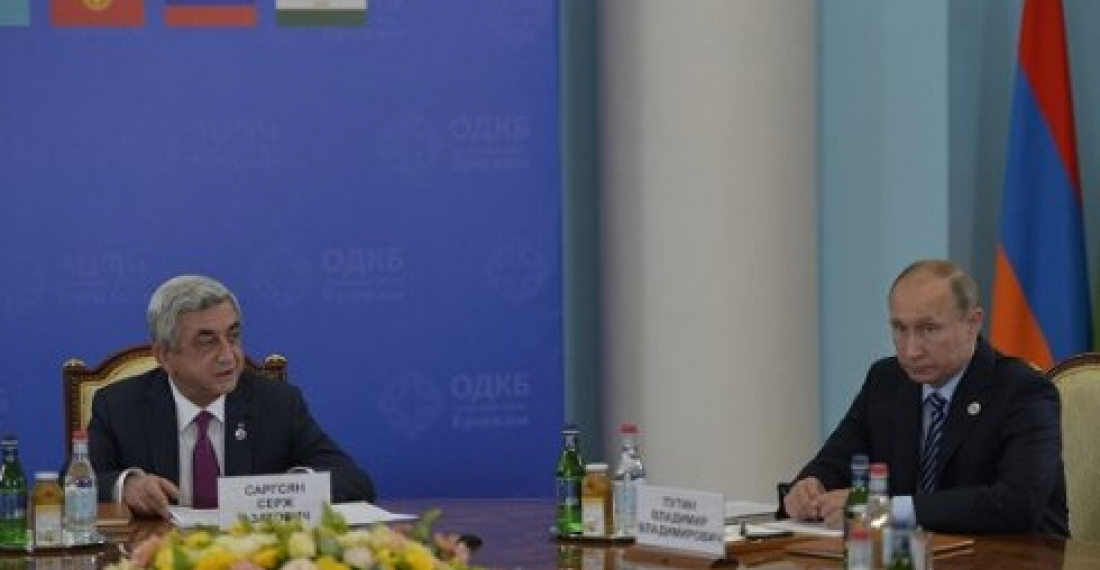
Заседание ОДКБ в Ереване обнажило напряженность в отношениях между Арменией и ОДКБ

Армения недовольна поддержкой со стороны своих союзников по ОДКБ в конфликте с Азербайджаном из-за Нагорного Карабаха.

В пятницу, в Ереване, лидеры России, Армении, Белоруссии, Казахстана, Кыргызстана и Таджикистана, в ходе заседания Организации Договора о коллективной безопасности (ОДКБ) приняли коллективную стратегию безопасности, в которой изложены приоритеты их военного союза в рамках ОДКБ до 2025 года, а также определенны все основные направления сотрудничества.

"Государства-члены вновь подтвердили свою решимость выстраивать отношения с членами мирового сообщества на основах равенства и неделимости безопасности, воздерживаться в международных отношениях от угрозы силой или ее применения, при этом в решении возникающих проблем отдавать приоритет политико-дипломатическим методам," сообщил президент Армении Серж Саргсян журналистам, подводя итоги саммита в Ереване.

В Армении были ожидания, что ОДКБ поддержит Армению в конфликте с Азербайджаном вокруг Нагорного Карабаха и займет по этому поводу позицию. Однако, организация заняла не обязывающую позицию.

"Партнеры по ОДКБ выразили поддержку договоренностям, достигнутым на организованных в текущем году в Вене и в Санкт-Петербурге саммитах по нагорно-карабахской проблеме, направленных на недопущение эскалации ситуации в зоне конфликта, стабилизацию обстановки и создание условий для продвижения мирного процесса," - сказал президент Серж Саргсян.

"На сессии подтверждена необходимость исключительно мирного решения нагорно-карабахской проблемы, выражена поддержка усилиям сопредседателей Минской группы ОБСЕ по урегулированию конфликта на основе норм и принципов международного права, положений Устава ООН, Хельсинкского Заключительного Акта, в частности, касающихся неприменения силы или угрозы применения силы, территориальной целостности государств, равноправия и права народа на самоопределение."

На полях саммита наблюдалось также редкое публичное несогласие между армянскими и российскими дипломатами. Министр иностранных дел России Сергей Лавров говорил с журналистами о возможной роли Турции в урегулировании карабахского конфликта, заявив, что Турция могла бы сыграть позитивную роль. Армянские дипломаты днем ранее заявили, что Турция должна остаться в стороне от процесса урегулирования карабахского конфликта как можно подальше.

На встрече в Ереване также было принято решение отложить обсуждение вопроса о выборе нового Генерального секретаря организации. Ходили слухи о том, что были рассмотрены несколько армянских кандидатур, но в результате совещаний пришли к том, что решение по этому вопросу будет принято в Санкт-Петербурге до конца года.

источник: commonspace.eu по материалам Общественного радио Армении и агентств

фото: Президент Саргсян Армении и президент России Владимир Путин на саммите ОДКБ в Ереване, 14 октября 2016 года (фото любезно предоставлено Общественным радио Армении)


 

Related articles

Editor's choice
News
Key European countries back Denmark in the face of Trump's continuing insistence on taking over Greenland

Key European countries back Denmark in the face of Trump's continuing insistence on taking over Greenland

 Six major European countries have declared their support to Denmark following renewed insistence by the US that it must have control over Greenland. "Greenland belongs to its people, and only Denmark and Greenland can decide on matters concerning their relations," said the leaders of the UK, France, Germany, Italy, Poland, and Spain, in a joint statement, issued on Tuesday (6 January), together with Denmark. On Sunday, Donald Trump said the US "needed" Greenland - a semi-autonomous region of fellow Nato member Denmark - for security reasons. He has refused to rule out the use of force to take control of the territory, and Danish Prime Minister Mette Frederiksen warned on Monday that an attack by the US would spell the end of Nato. The issue of Greenland's future resurfaced in the wake of the US military intervention in Venezuela, during which elite troops went in to seize the country's President Nicolás Maduro and take him to face drugs and weapons charges in New York. Following the raid, Trump said the US would "run" Venezuela for an unspecified period of time. He also said the US was returning to an 1823 policy of US supremacy in its sphere of influence in the Western hemisphere - and he warned a number of countries the US could turn its attention to them. The US military raid in Venezuela has reignited fears that the US may consider using force to secure control of Greenland. A day after the raid, Katie Miller - the wife of one of Trump's senior aides - posted on social media a map of Greenland in the colours of the American flag, alongside the word "SOON". On Monday, her husband Stephen Miller said it was "the formal position of the US government that Greenland should be part of the US". In an interview with CNN, he also said the US "is the power of Nato. For the US to secure the Arctic region, to protect and defend Nato and Nato interests, obviously Greenland should be part of the US." Asked repeatedly whether the US would rule out using force to annex it, Miller responded: "Nobody's going to fight the US over the future of Greenland." Stressing they were as keen as the US in Arctic security, the seven European signatories of Tuesday's joint statement said this must be achieved by Nato allies, including the US "collectively" - whilst "upholding the principles of the UN Charter, including sovereignty, territorial integrity and the inviolability of borders". Greenland's Prime Minister Jens-Frederik Nielsen welcomed the statement and called for "respectful dialogue". "The dialogue must take place with respect for the fact that Greenland's status is rooted in international law and the principle of territorial integrity," Nielsen said. Trump has claimed that making Greenland part of the US would serve American security interests due to its strategic location and its abundance of minerals critical to high-tech sectors. Greenland, which has a population of 57,000 people, has had extensive self-government since 1979, though defence and foreign policy remain in Danish hands. While most Greenlanders favour eventual independence from Denmark, opinion polls show overwhelming opposition to becoming part of the US.

Popular

