


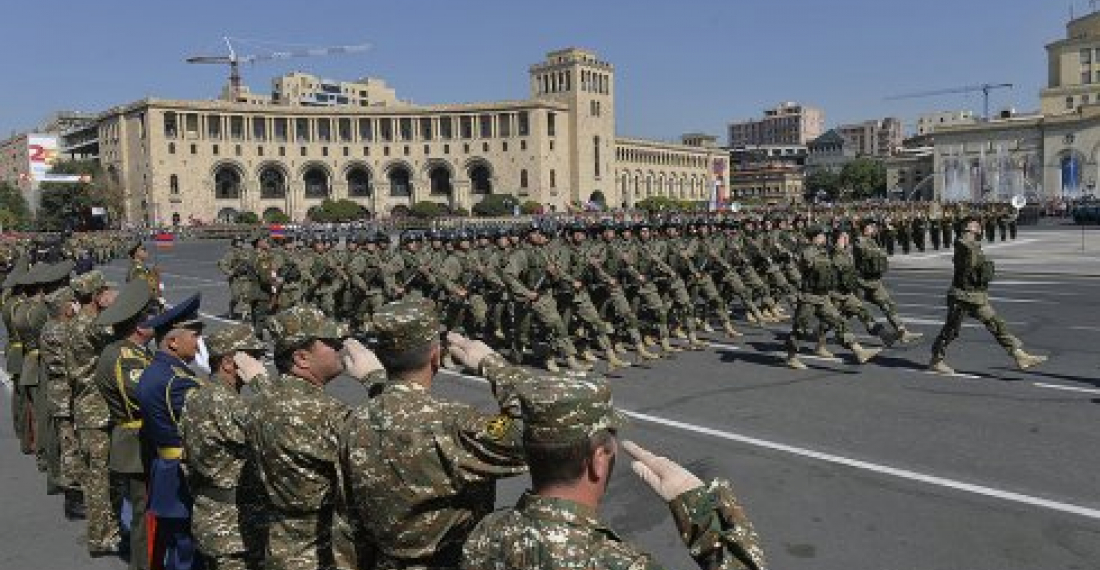
В 2017 году на расходы в сфере обороны Армения направит 15,4% бюджета страны

В 2017 году Армения планирует выделить на расходы в сфере обороны 15,4% государтсвенного бюджета страны.

Правительство Армении представило на рассмотрение проект бюджета страны на 2017 год. Бюджет должен будет составить 1,210 триллионов драм ($2,551 млрд.), из которых 15,4% будут выделены на оборону.

Как сообщает Hetq.am, расходная часть бюджета составит 1,360 триллионов драм, дефицит бюджета составит 150.1 млрд. драм ($316,2 миллион)

Согласно HETQ.am ассигнования в рамках различных бюджетных линий будут выглядеть следующим образом:

Социальная защита: 408.9 млрд. драм ($862 млн.)
Государственные службы: 276.5 млрд. драм ($583 млн.)
Оборона: 209.8 млрд. драм ($442.8 миллион)
Образование 128.7 млрд. драм ($271.3 миллион)
Охрана общественного порядка, национальная безопасность и судебная деятельность: 101.7 млрд. драм ($214.4 млн.)
Экономика: 92.8 млрд. драм ($195.6 млн.)
Здравоохранение: 85.7 млрд. драм ($180.7 млн.)
Культура и Религия: 26 млрд. драм ($54.8 млн.)
(US$1 = 474.34 драм)

Commonspace.eu собщает, что Армения борется за модернизацию своих вооруженных сил и обороноспособности, в тоже время не слишком обременяя общий бюджет страны. Несмотря на это расходы на оборону по-прежнему в более чем в два раза превышают затраты на здравоохранение.

Выделенный объем средств на оборону в бюджете на следующий год несильно отличается от бюджета 2016 года. Но это так только отчасти. Армения получает часть вооружении из России в рамках своего альянса с ней по Организации Договора о коллективной безопасности (ОДКБ). Армения также взяла кредит у России на приобретение таких вооружений как ракетные системы "Искандер", которые были представлены во время парада в Ереване в прошлом месяце. Россия продает Армении вооружения по той же цене, по какой ее военно-промышленный комплекс продает ВС России. Но несмотря на это расходы Азербайджана значительно превосходят расходы Армении на оборону. Азербайджан закупает большую часть своих вооружений в России и Израиле.

источник: commonspace.eu по материалам HETQ.am

фото: Солдаты ВС Армении на военном параде в Ереване, сентябрь 2016 года (фото из архива)

 

Related articles

Editor's choice
News
The British prime minister says Europe must "stand on its own two feet" when it comes to defence

The British prime minister says Europe must "stand on its own two feet" when it comes to defence

The UK will deploy a carrier strike group, led by the aircraft carrier HMS Prince of Wales to the Arctic and the High North as part of efforts to bolster security against Russian threats. British prime minister, Sir Keir Starmer announced the deployment in a speech on Saturday (14 February) at the Munich Security Conference. Europe must be ready to fight to protect its people, values, and way of life,  Sir Keir told the Conference. Starmer also called for deeper links and cooperation, including economic ties, between the UK and EU. The PM stressed the continent must "stand on its own two feet" when it comes to defence commitments. "We must build our hard power, because that is the currency of the age," he told the conference. (Click image to read the full story).

Popular

Editor's choice
Interview
Thursday Interview: Murad Muradov

Thursday Interview: Murad Muradov

Today, commonspace.eu starts a new regular weekly series. THURSDAY INTERVIEW, conducted by Lauri Nikulainen, will host  persons who are thinkers, opinion shapers, and implementors in their countries and spheres. We start the series with an interview with Murad Muradov, a leading person in Azerbaijan's think tank community. He is also the first co-chair of the Action Committee for a new Armenian-Azerbaijani Dialogue. Last September he made history by being the first Azerbaijani civil society activist to visit Armenia after the 44 day war, and the start of the peace process. Speaking about this visit Murad Muradov said: "My experience was largely positive. My negative expectations luckily didn’t play out. The discussions were respectful, the panel format bringing together experts from Armenia, Azerbaijan, and Turkey was particularly valuable during the NATO Rose-Roth Seminar in Yerevan, and media coverage, while varied in tone, remained largely constructive. Some media outlets though attempted to represent me as more of a government mouthpiece than an independent expert, which was totally misleading.  Overall, I see these initiatives as important steps in rebuilding trust and normalising professional engagement. The fact that soon a larger Azerbaijani civil society visits to Armenia followed, reinforces the sense that this process is moving in the right direction." (click the image to read the interview in full)


