


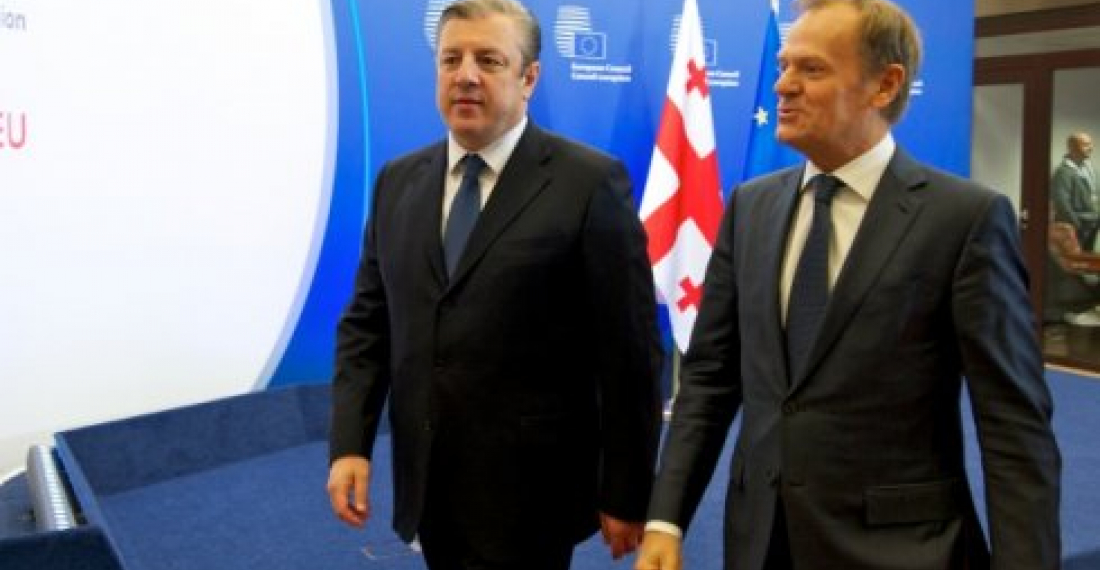
Растерянные лидеры ЕС оказали теплый прием премьер-министру Грузии

Премьер-министр Грузии Георгий Квирикашили в настоящее время находится в Брюсселе, где ему был оказан очень теплый прием лидерами Европейского Союза. Квирикашили, в сопровождении ряда высокопоставленных министров, сегодня (пятница, 2 декабря), примет участие в заседании Совета ЕС-Грузия. В то же время он провел встречи с лидерами Европейского Союза, в том числе президентом Совета Европы, Дональдом Туском, президентом Европарламента Мартином Шульцем и рядом европейских комиссаров.

Визит был частично омрачнен новостью о том, что принятие решения о предоставлении безвизового режима для граждан Грузии, желающих посетить страны Шенгена, в очередной раз было отложено. Причиной отсрочки является сложные процессы принятия решений в ЕС, и не имеет ничего общего с выполнением необходимых критериев со стороны Грузии. Все лидеры ЕС и должностные лица, которые говорили по этому вопросу подтвердили, что Грузия сделала все то, что ожидалось от нее по этому вопросу.

Ситуация вызвала некоторый конфуз среди официальных лиц ЕС, которые должны были объяснить её своим грузинским коллегам. Президент Совета Европы Дональд Туск после встречи с Георгием Квирикашвили сообщил журналистам, что "Грузия заслуживает своевременного и позитивного завершения процесса либерализации визового режима", поскольку страна выполнила все свои обязательства по этому вопросу.

"Сейчас мы работаем над ответным действием ЕС. И я хочу подчеркнуть, что [работаем] только со стороны ЕС, потому что теперь это исключительно наша внутренняя проблема; надо убедиться, что необходимый механизм приостановки безвизового режима /.../ будет согласован как можно скорее", - сказал Туск.

Однако, и ЕС, и грузинские официальные лица, весьма оптимистичны касательно нынешнего состояния отношений между Грузией и ЕС. Официальные лица ЕС приложили все усилия, чтобы оказать Квирикашвили теплый прием во время его пребывания в Брюсселе и дали высокую оценку его руководству, а также реализации Грузией амбициозной программы реформ. В ходе каждой встречи чиновники ЕС поздравляли Квирикашили в связи с его недавней победой на выборах и высоко оценили проведение выборов.

Высокопоставленный источник в Брюсселе сообщил commonspace.eu, что отношения ЕС-Грузия являются образцовыми, и ЕС полон решимости не допустить того, чтобы вопрос о либерализации визового режима подпортил их. Кажется, у грузинской стороны такой же подход. Выступая на ужине в посольстве Грузии в Брюсселе, на котором присутствовали высокопоставленные должностные лица ЕС, депутаты Европарламента и представители аналитических центров, Георгий Квирикашили сказал, что грузинское правительство верит тому, что ЕС выполнит свои обещания. В своем выступлении Квирикашили отметил те перемены, которые правительство осуществляет в области образования в рамках своей стратегии построения сильного государтсва.

источник: commonspace.eu

фото: президент Европейского Совета, Дональд Туск, с премьер-министром Грузии Георгием Квирикашвили в Брюсселе, 1 декабря 2016 года (фото предоставлено пресс-службой Европейского Совета)


 

Related articles

Editor's choice
News
Women emerge favourite to lead United Nations from next year, after straw-poll of UN Security Council members

Women emerge favourite to lead United Nations from next year, after straw-poll of UN Security Council members

​ Two women have emerged as favourite to lead the United Nations as Secretary-General from 1 January 2027, when the term of the present incumbent, Antonio Gutteres, expires. A straw poll of the members of the UN Security Council, held on Thursday, 30 July showed that of the seven candidates, Rebecca Grynspan of Costa Rica and Carolyn Rodriguez-Birkett of Guyana received ten and nine positive endorsements respectively, by the 15 members UN Security Council Although the poll and its result are supposed to be secret, the result leaked within minutes, and was carried on world media outlets, such as Reuters. The result was as follows   Michelle Bachelet 6 encourage 5  discourage   4 no opinion María Fernanda Espinosa 5 2 8 Rafael Grossi 7 2 6 Rebeca Grynspan 10 1 4 Olara Otunnu 2 5 8 Carolyn Rodrigues-Birkett 9 2 4 Macky Sall 6 7 2   Article 97 of the UN Charter states that the “Secretary-General shall be appointed by the General Assembly upon the recommendation of the Security Council”. Straw polls are informal ballots used to determine the viability of Secretary-General candidates.  The seven current candidates are: Michelle Bachelet Jeria (Chile), who was nominated by Brazil, Chile, and Mexico on 2 February, with Chile withdrawing its nomination on 24 March; María Fernanda Espinosa Garcés (Ecuador), who was nominated by Antigua and Barbuda on 11 May; Rafael Mariano Grossi (Argentina), who was nominated by Argentina on 26 November 2025; Rebeca Grynspan Mayufis (Costa Rica), who was nominated by Costa Rica on 3 March; Olara Otunnu (Uganda), who was nominated by Uganda on 24 July; Carolyn Rodrigues Birkett (Guyana), who was nominated by Guyana on 15 June; and Macky Sall (Senegal), who was nominated by Burundi on 2 March. At Thursday's straw poll, there was no difference between the ballots presented to the five permanent members (P5) and the ten elected members (E10). Council members received one ballot per candidate, containing the candidate’s name followed by three options: “encouraged”, “discouraged”, and “no opinion expressed”.   It is ofcourse early days, and the straw poll is just an informal indication of the mood of the UN Security Council, but the strong showwing by the two womencandidates may be an indication that for the first time, the head of the UN can be a women. (click image to read more) ​

Popular

Editor's choice
Interview
Thursday Interview: Murad Muradov

Thursday Interview: Murad Muradov

Today, commonspace.eu starts a new regular weekly series. THURSDAY INTERVIEW, conducted by Lauri Nikulainen, will host  persons who are thinkers, opinion shapers, and implementors in their countries and spheres. We start the series with an interview with Murad Muradov, a leading person in Azerbaijan's think tank community. He is also the first co-chair of the Action Committee for a new Armenian-Azerbaijani Dialogue. Last September he made history by being the first Azerbaijani civil society activist to visit Armenia after the 44 day war, and the start of the peace process. Speaking about this visit Murad Muradov said: "My experience was largely positive. My negative expectations luckily didn’t play out. The discussions were respectful, the panel format bringing together experts from Armenia, Azerbaijan, and Turkey was particularly valuable during the NATO Rose-Roth Seminar in Yerevan, and media coverage, while varied in tone, remained largely constructive. Some media outlets though attempted to represent me as more of a government mouthpiece than an independent expert, which was totally misleading.  Overall, I see these initiatives as important steps in rebuilding trust and normalising professional engagement. The fact that soon a larger Azerbaijani civil society visits to Armenia followed, reinforces the sense that this process is moving in the right direction." (click the image to read the interview in full)

