


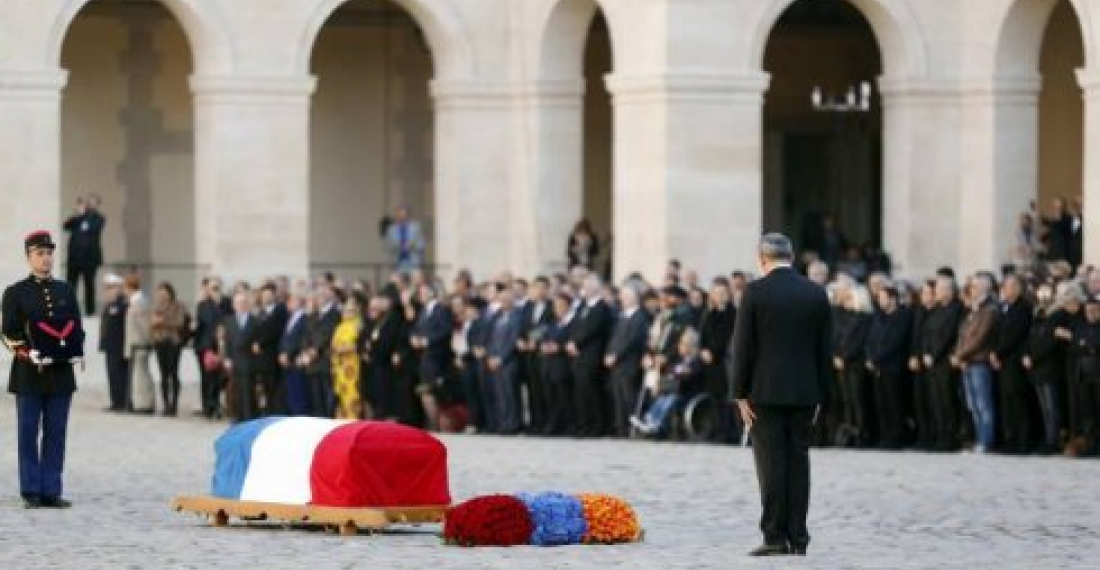
Прощание с Шарлем Азнавуром - сыном Франции и Армении

В пятницу (5 октября), в отеле "des Invalides" в Париже, состоялась церемония прощания с Шарлем Азнавуром, который ушел из жизни на этой неделе. На церемонии присутствовали президент Франции Эмануэль Макрон и премьер-министр Армении Никол Пашинян. Азнавур, легендарный певец и один из самых известных французских деятелей культуры XX-го века, имел армянское происхождение и был тесно связан с его армянским наследием, несмотря на то, что был иконой Франции.

"Мы собрались сегодня, чтобы поклониться и почитать память великого мастера французского шансона, Шарля Азнавура. В течение восьми десятилетий это имя вызывало улыбки на миллионах лиц, возбуждало или успокаивало дыхание десятков миллионов, зажигало огни в глазах сотни миллионов", - сказал премьер-министр Пашинян на церемонии прощания.

Со своей стороны президент Макрон сказал: "В течение многих лет голос Шарля Азнавура объединял нас, независимо от нашего возраста и социального статуса. Азнавур объединил нас и стал одним из лиц Франции. Песни Азнавура - это прежде всего стихи, тексты которые живут в наших сердцац, названия этих стихов и песни, которые стали для нас наследием".

"Я уверен, что в течение многих лет миллионы людей в трудные для себя времена, будут питать надежду и счастье из музыки или текстов песен, покинувшего нас первоклассного творца. Он продолжит свой путь в наших сердцах, идя, с рукой в кармане, с улыбкой на лице, и вместе с нами он с гордостью пройдет это столетие. Теперь уже он никогда не покинет нас, потому что поэты во Франции никогда не умирают".

Азнавур будет похоронен в субботу. В этот день в Армении будут приспущены флаги.

источник: commonspace.eu

Related articles

Editor's choice
News
Azerbaijan-Armenia Internet Transit Deal Marks New Step in Regional Connectivity

Azerbaijan-Armenia Internet Transit Deal Marks New Step in Regional Connectivity

Azerbaijan and Armenia have signed an agreement allowing the mutual transit of international internet traffic, creating a direct telecommunications link between the two countries for the first time since the collapse of the Soviet Union. The deal, announced on 17 June by AzerTelecom and Telecom Armenia, is intended to improve route diversity and network resilience in the South Caucasus. The development follows a gradual process of normalisation of relations between Baku and Yerevan. Notably, Azerbaijan has repeatedly identified the restoration of transport and communication links as a key component of a future peace settlement. Since the initialling of a peace agreement during a summit in Washington in August 2025, the two sides have taken several important steps, including progress on border delimitation and the easing of certain transit restrictions. The telecommunications agreement is also significant because it was negotiated by private operators rather than government officials. Industry observers note that commercial infrastructure projects can create long-term economic ties and mutual dependencies that are more difficult to reverse than political declarations.

Popular

Editor's choice
Interview
Thursday Interview: Murad Muradov

Thursday Interview: Murad Muradov

Today, commonspace.eu starts a new regular weekly series. THURSDAY INTERVIEW, conducted by Lauri Nikulainen, will host  persons who are thinkers, opinion shapers, and implementors in their countries and spheres. We start the series with an interview with Murad Muradov, a leading person in Azerbaijan's think tank community. He is also the first co-chair of the Action Committee for a new Armenian-Azerbaijani Dialogue. Last September he made history by being the first Azerbaijani civil society activist to visit Armenia after the 44 day war, and the start of the peace process. Speaking about this visit Murad Muradov said: "My experience was largely positive. My negative expectations luckily didn’t play out. The discussions were respectful, the panel format bringing together experts from Armenia, Azerbaijan, and Turkey was particularly valuable during the NATO Rose-Roth Seminar in Yerevan, and media coverage, while varied in tone, remained largely constructive. Some media outlets though attempted to represent me as more of a government mouthpiece than an independent expert, which was totally misleading.  Overall, I see these initiatives as important steps in rebuilding trust and normalising professional engagement. The fact that soon a larger Azerbaijani civil society visits to Armenia followed, reinforces the sense that this process is moving in the right direction." (click the image to read the interview in full)


