


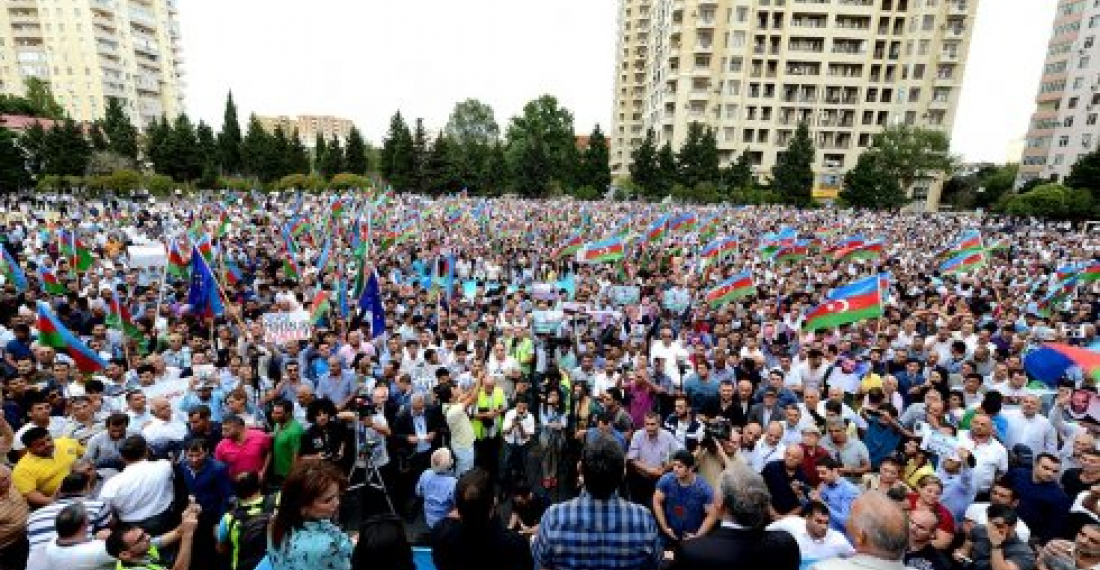
Митинг оппозиции в Баку

В воскресенье, в Баку, прошел митинг азербайджанской оппозиции в рамках "Национального совета".

Митинг прошел на стадионе "Mahsul" в Ясамальском районе города. Акция прошла с одобрения муниципальных властей Баку. Перед митингом Народный фронт Азербайджана провел демонстрацию в знак протеста против предстоящего 26 сентября референдума.

Как сообщает Meydan TV, лидеры партии потребовали отмены референдума, освобождения политических заключенных и покончить с политической и экономической коррупцией.

Лидер "Народного фронта" Али Керимли назвал это событие "новым стартом к свободе".

Правящая партия Азербайджана заявила, что деятельность оппозиции связана с иностранным финансированием. Информационное агентство Trend приводит слова заместителя исполнительного секретаря ПЕА, депутата Сиявуша Новрузова, который сказал, что организаторы акции в Баку получают финансовые ресурсы от иностранных организаций. По его словам, на митинге собрались родственники партийных лидеров и членов Национального совета.

Новрузов сказал, что организаторы митинга попытались продемонстрировать иностранным организациям, что в Азербайджане есть протестное движение.

По словам политического редактора Commonspace.eu, митинги оппозиции являются редким событием в Азербайджане и, как правило, проводятся под жестким контролем со стороны властей. Митинг оппозиции, состоявшийся 11 сентября, является частью кампании в преддверии референдума, намеченного на 26 сентября. Несколько оппозиционных организации призывают к отмене референдума. Но это вряд ли произойдет, а если же явка 26 сентября будет очень низкой, то правительству придется прибегнуть к вбросу бюллетеней для увеличения числа проголосовавших.

источник: сommonspace.eu по материалам Мейдан ТВ и информационного агентства Trend и других азербайджанских СМИ.

фото: Митинг оппозиции, организованный Национальным движением в Баку, 11 сентября 2016 года (фото любезно предоставлено Meydan TV)

 

Related articles

Editor's choice
News
The British prime minister says Europe must "stand on its own two feet" when it comes to defence

The British prime minister says Europe must "stand on its own two feet" when it comes to defence

The UK will deploy a carrier strike group, led by the aircraft carrier HMS Prince of Wales to the Arctic and the High North as part of efforts to bolster security against Russian threats. British prime minister, Sir Keir Starmer announced the deployment in a speech on Saturday (14 February) at the Munich Security Conference. Europe must be ready to fight to protect its people, values, and way of life,  Sir Keir told the Conference. Starmer also called for deeper links and cooperation, including economic ties, between the UK and EU. The PM stressed the continent must "stand on its own two feet" when it comes to defence commitments. "We must build our hard power, because that is the currency of the age," he told the conference. (Click image to read the full story).

Popular

Editor's choice
Interview
Thursday Interview: Murad Muradov

Thursday Interview: Murad Muradov

Today, commonspace.eu starts a new regular weekly series. THURSDAY INTERVIEW, conducted by Lauri Nikulainen, will host  persons who are thinkers, opinion shapers, and implementors in their countries and spheres. We start the series with an interview with Murad Muradov, a leading person in Azerbaijan's think tank community. He is also the first co-chair of the Action Committee for a new Armenian-Azerbaijani Dialogue. Last September he made history by being the first Azerbaijani civil society activist to visit Armenia after the 44 day war, and the start of the peace process. Speaking about this visit Murad Muradov said: "My experience was largely positive. My negative expectations luckily didn’t play out. The discussions were respectful, the panel format bringing together experts from Armenia, Azerbaijan, and Turkey was particularly valuable during the NATO Rose-Roth Seminar in Yerevan, and media coverage, while varied in tone, remained largely constructive. Some media outlets though attempted to represent me as more of a government mouthpiece than an independent expert, which was totally misleading.  Overall, I see these initiatives as important steps in rebuilding trust and normalising professional engagement. The fact that soon a larger Azerbaijani civil society visits to Armenia followed, reinforces the sense that this process is moving in the right direction." (click the image to read the interview in full)

