


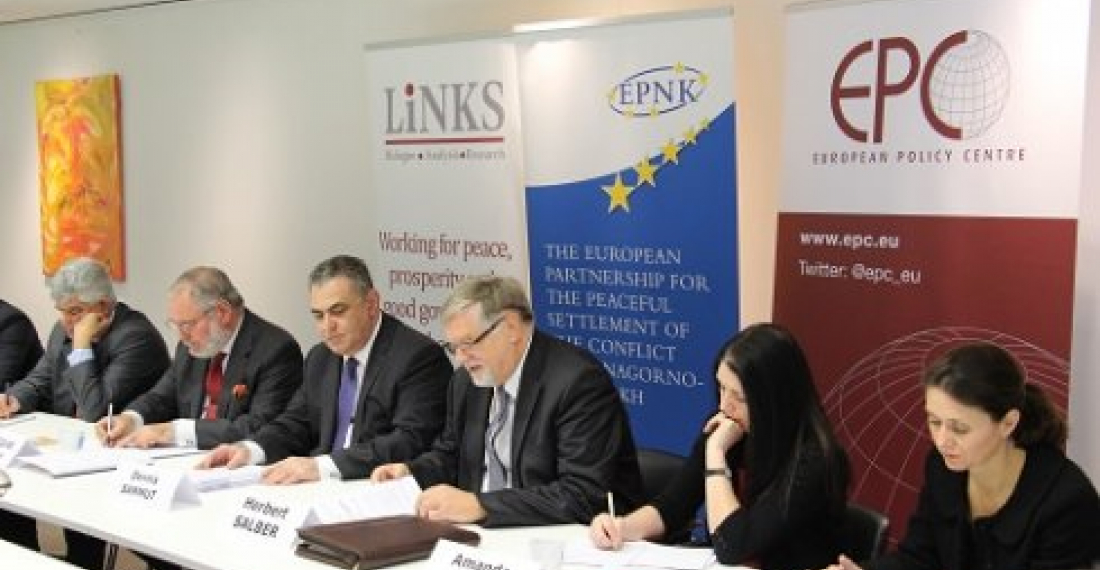
Эксперты из Армении, Азербайджана и ЕС обсудили в Брюсселе меры по укреплению доверия и поддержанию мира

6 декабря, в Брюсселе, состоялась встреча экспертов из Армении, Азербайджана и ЕС, в ходе которой были обсуждены меры по укреплению доверия и поддержанию мира в контексте процесса урегулирования карабахского конфликта. Семинар был организован НПО LINKS (Диалог, анализ и исследования) и Центром европейской политики в рамках программы EPNK при поддержке ЕС.

Семинар начался с выступления специального представителя ЕС на Южном Кавказе, посла Герберта Зальбера. В нем приняли участие дипломаты и эксперты из Армении и Азербайджана, представители институтов ЕС, НАТО и ряда экспертов. На семинаре были заслушаны доклады посла Жака Фора, бывшего французского сопредседателя Минской группы ОБСЕ; Д-р Трэйси Германа из Департамента оборонных исследований Королевского колледжа, Лондон; Д-р Денниса Саммута, исполнительного директора LINKS (DAR); и Аманды Пол, старшего аналитика в Центре европейской политики. Среди участников также были д-р Гюльшан Пашаева, заместитель директора Центра стратегических исследований при президенте Азербайджана (SAM) и д-р Беньямин Погосян, вице-президент по исследованиям из Армянского Национального университета оборонных исследований при Министерстве обороны Армении.

На семинаре обсуждался документ, автором которого является д-р Деннис Саммут и Аманда Пол, и изданный Центром европейской политики в сентябре под заголовоком: "Нагорный Карабах: Настало ли время вернуть меры по укреплению доверия и поддержанию мира в повестку дня?"

Вы можете прочесть данную статью здесь

источник: commonspace.eu

фото 1: Посол Герберт Зальберт, спецпредставитель ЕС по Южному Кавказу, выступающий со вступительным словом на семинаре, организованном LINKS (DAR) и EPC в Брюсселе, 6 декабря 2016 года.

фото 2: Участники семинара в Брюсселе

 

Related articles

Editor's choice
News
The British prime minister says Europe must "stand on its own two feet" when it comes to defence

The British prime minister says Europe must "stand on its own two feet" when it comes to defence

The UK will deploy a carrier strike group, led by the aircraft carrier HMS Prince of Wales to the Arctic and the High North as part of efforts to bolster security against Russian threats. British prime minister, Sir Keir Starmer announced the deployment in a speech on Saturday (14 February) at the Munich Security Conference. Europe must be ready to fight to protect its people, values, and way of life,  Sir Keir told the Conference. Starmer also called for deeper links and cooperation, including economic ties, between the UK and EU. The PM stressed the continent must "stand on its own two feet" when it comes to defence commitments. "We must build our hard power, because that is the currency of the age," he told the conference. (Click image to read the full story).

Popular

Editor's choice
Interview
Thursday Interview: Murad Muradov

Thursday Interview: Murad Muradov

Today, commonspace.eu starts a new regular weekly series. THURSDAY INTERVIEW, conducted by Lauri Nikulainen, will host  persons who are thinkers, opinion shapers, and implementors in their countries and spheres. We start the series with an interview with Murad Muradov, a leading person in Azerbaijan's think tank community. He is also the first co-chair of the Action Committee for a new Armenian-Azerbaijani Dialogue. Last September he made history by being the first Azerbaijani civil society activist to visit Armenia after the 44 day war, and the start of the peace process. Speaking about this visit Murad Muradov said: "My experience was largely positive. My negative expectations luckily didn’t play out. The discussions were respectful, the panel format bringing together experts from Armenia, Azerbaijan, and Turkey was particularly valuable during the NATO Rose-Roth Seminar in Yerevan, and media coverage, while varied in tone, remained largely constructive. Some media outlets though attempted to represent me as more of a government mouthpiece than an independent expert, which was totally misleading.  Overall, I see these initiatives as important steps in rebuilding trust and normalising professional engagement. The fact that soon a larger Azerbaijani civil society visits to Armenia followed, reinforces the sense that this process is moving in the right direction." (click the image to read the interview in full)


