


Город призраков.

Вряд ли есть еще такое же место, которое вызывает столько же эмоций и разногласий, когда говорят о нагорно-карабахском конфликте и его последствиях, чем город Шуша, или Шуши, как его называют на армянском языке.

В то время как большинство населения в Нагорном Карабахе в конце 1980-х, в основном, были армяне, в Шуше в подавляющем большинстве проживали азербайджанцы. Когда начался конфликт Шуша, с его расположением на высотах над главным армянским городом Степанакерт стал центром очень тяжелых боевых действий. В конце концов Шуша пал под натиском армянских сил, и всё его азербайджанское население было вынуждено покинуть это место. Большая часть города оказалась в руинах. Во многом это место стало городом-призраком, но со временем благодаря прибывшим из других мест армянское население возросло в численности.

Для перемещенных азербайджанцев Шуша остается домом, в который они мечтают вернуться, старшее поколение часто вспоминает о былых днях с ностальгией. Для тех, кто живет в Шуше сегодня, он является домом, и они предпочитают называть его Шуши. Они стараются изо всех сил оставить прошлое позади и смотреть вперед, развивая нормальную жизнь в своем обществе.

На этой неделе они принимали международных гостей. Среди них был мэр города Бур-ле-Валанс, Франция, Марлен Мурье, который посетил город в рамках фестиваля "Дней Франции в Арцахе". Шуши и Бур-ле-Валанс в октябре прошлого года подписали декларацию о дружбе, цель которой заключается в содействии образовательным, культурным, спортивным и торговым проектам. Как заявил мэр, муниципалитет Бур-ле-Валанс в ближайшее время организует мероприятия, посвященные Карабаху.

Все это, конечно, расстраивает правительство Азербайджана, которое раскритиковало соглашение и теперь включила мэра в свой черный список из-за посещения Нагорного Карабаха. Но по словам мадам Мурье, её это не беспокоит. В субботу, мэр, вместе с другими VIP гостями из Франции, сопровождала президента самопровозглашенной Нагорно-Карабахской Республики (НКР), Бако Саакяна, на торжественной церемонии по случаю открытия профессиональной школы в городе. В своем выступлении г-н Саакян подчеркнул, что такие учреждения необходимы и помогут подготовить квалифицированных специалистов, используя европейский опыт в этой сфере.

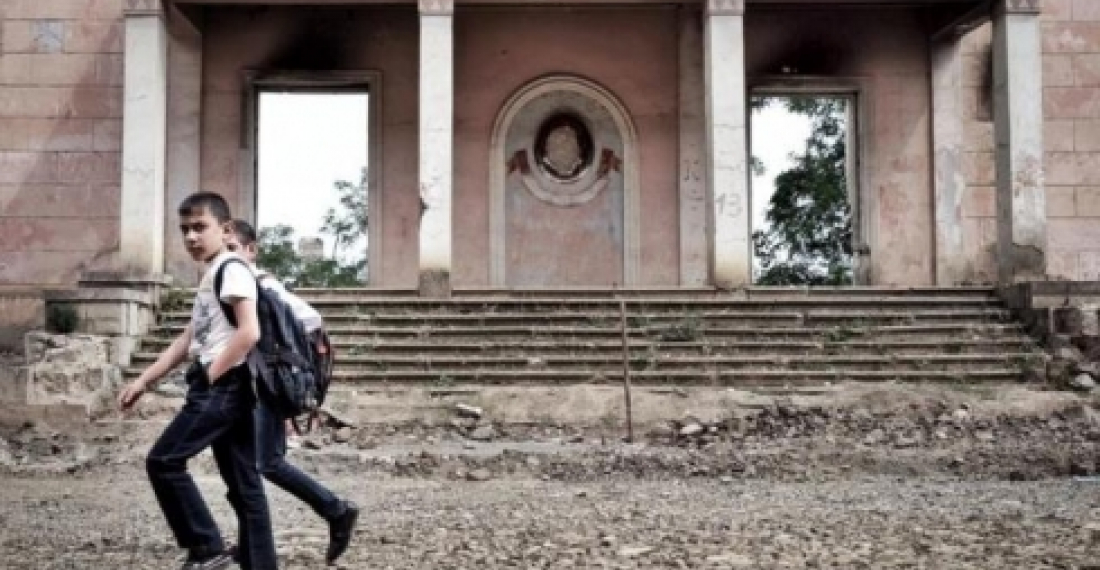
Согласно последней переписи населения, проведенной властями НКР, нынешнее население Шуши составляет 4,100 человек, хотя эта цифра может быть немного завышена. Но в дали от города тысячи азербайджанцев еще называют Шушу домом. Часто они задаются вопросом, вернутся ли они когда-нибудь. В каком-то смысле их призраки все еще обитают в Шуше. Большая часть города пустует и находится в разрушенном состоянии. Итальянский фото журналист Роберто Траван в своем фото-эссе для итальянской газеты "La Stampa" недавно заснял все эти разрушения и опустошенность.

Если нагорно-карабахский конфликт когда-нибудь будет урегулирован, то Шуша будет одним из самых сложных вопросов для разрешения. Его стратегическое положение по-прежнему будет очень чувствительным вопросом для обеих сторон.

Судьба Шуши, как и остальной части карабахского конфликта, не может быть основано только на политической целесообразности. Внимание должно быть уделено благосостоянию людей, оказавшихся жертвами этой трагедии, и решению, которое будет гарантировать, что прошлое больше не повторится.

Источник: Это комментарий был подготовлен редакцией commonspace.eu по материалам "La Stampa" (Италия), News.am

Фото: Театр в Шуше был разрушен во время боевых действий в начале 1990-х. По сей день он остается в руинах. Двое армянских детей проходят здание по дороге в школу. (Фото предоставлено Роберто Траван / La Stampa).

 

Related articles

Editor's choice
News
COP 17 in Armenia

COP 17 in Armenia

Armenia is currently hosting the COP17 conference of the Convention on Biological Diversity, which began earlier this week (19 October) and will run until 30 October, bringing around 15,000 participants from 196 different countries to Yerevan. At a leaders' summit held as part of COP17, Prime Minister Nikol Pashinyan expressed realistic ambitions: “We are halfway towards achieving these goals (Kunming-Montreal Global Biodiversity Framework), and we must honestly acknowledge that we are not yet moving in the right direction. Our task now is not to make new promises, but to fulfil the commitments we have already made.” Pashinyan pointed towards Armenia's own records, noting that the whitefish stock in Lake Sevan has increased substantially in the last ten years. Iranian President Masoud Pezeshkian and Georgian Prime Minister Irakli Kobakhidze also addressed the summit, with Turkiye sending its agriculture minister. However, there were no reports of Azerbaijani representatives attending. The conference has given Yerevan a valuable international platform, yet the absence of Azerbaijan is likely to be read as a sign that the peace process in the South Caucasus has not yet been translated into wider regional cooperation. The leaders' summit was opened by Armenian Prime Minister Nikol Pashinyan, who stressed that hosting the conference was a great honour for Armenia. He expressed hope that it would 'be productive and contribute to protecting our planet's biodiversity'. 'We – the citizens of Armenia, the government, state authorities and local governments – owe a debt to our nature,' the prime minister said. He noted that the international community had already developed the concept of 'living in harmony with nature’ and adopted the Kunming-Montreal Global Biodiversity Framework in 2022, setting out goals and specific targets to be achieved by 2030. 'We are halfway towards achieving these goals, and we must honestly acknowledge that we are not yet moving in the right direction. Our task now is not to make new promises, but to fulfil the commitments we have already made,' Nikol Pashinyan said. The COP17 conference is expected to adopt a declaration at leaders' level. More than 30 documents are scheduled for discussion. If approved, the commitments set out in them will become legally binding on countries that are parties to the Convention on Biological Diversity.”
Editor's choice
News
Landmines present to the European Union both a contradiction and a dilemma

Landmines present to the European Union both a contradiction and a dilemma

Finland’s decision to buy one million landmines creates a serious contradiction in the policy of the European Union, and is symbolic of a bigger dilemma facing European countries as they get used to the need to acquire “hard” power to face an increasing threat from Russia. Finland is seeking to acquire one million anti-personnel mines at a cost of 100 million euros. Finland, together with Poland, Latvia, Lithuania and Estonia last year abandoned the Ottawa agreement, the international framework that bans the use of anti-personnel mines, which the EU had been instrumental in establishing and supporting. All five countries cite the threat from Moscow as the reason. Colonel Riku Mikkonen of the Army Command told Finland’s national news agency STT that officials are now gathering information from suppliers regarding the deal, the AFP news agency reports. Helsinki would like domestic manufacturers to supply the mines, with contracts signed by the end of 2027 and production up and running by 2028. “It would be useful in many ways if Finnish companies produced the anti-personnel mines in Finland,” Mikkonen said. About half a dozen Finnish firms qualify, he told STT. “However, at this stage, buying the mines from abroad is not totally ruled out,” he added. LANDMINES PROVIDE THE EU WITH BOTH A CONTRADICTION, AND A DILEMMA Eliminating landmine contamination worldwide is one of the EU’s main soft power postures, and it basks in its record as the biggest funder of anti-landmine action in the world. But the fact that 5 of its 27 member states  have now left the Ottawa Treaty dents the EU moral high ground. It is a contradiction that is too big and important to be ignored. It also presents the European Union with a deeper dilemma. The threat from Russia is changing what the EU has stood for decades, namely a force for good able to mobilise its considerable soft power for the greater good of humanity. How the Union will implement this change will define its future. In the meantime landmines have not become any less lethal, benign, or unimportant. They remain in many parts of the world a major threat to life, an impediment to prosperity, and a potential trigger to further conflict. The 22 EU members states that still adhere to the Ottawa treaty must regroup, and be more assertive in their quest against anti-personnel land mines. All the reasons why they supported the Ottawa treaty in the first place still exist. The message must be clear: NO TO LANDMINES!

Popular

Editor's choice
Interview
Thursday Interview: Murad Muradov

Thursday Interview: Murad Muradov

Today, commonspace.eu starts a new regular weekly series. THURSDAY INTERVIEW, conducted by Lauri Nikulainen, will host  persons who are thinkers, opinion shapers, and implementors in their countries and spheres. We start the series with an interview with Murad Muradov, a leading person in Azerbaijan's think tank community. He is also the first co-chair of the Action Committee for a new Armenian-Azerbaijani Dialogue. Last September he made history by being the first Azerbaijani civil society activist to visit Armenia after the 44 day war, and the start of the peace process. Speaking about this visit Murad Muradov said: "My experience was largely positive. My negative expectations luckily didn’t play out. The discussions were respectful, the panel format bringing together experts from Armenia, Azerbaijan, and Turkey was particularly valuable during the NATO Rose-Roth Seminar in Yerevan, and media coverage, while varied in tone, remained largely constructive. Some media outlets though attempted to represent me as more of a government mouthpiece than an independent expert, which was totally misleading.  Overall, I see these initiatives as important steps in rebuilding trust and normalising professional engagement. The fact that soon a larger Azerbaijani civil society visits to Armenia followed, reinforces the sense that this process is moving in the right direction." (click the image to read the interview in full)

