


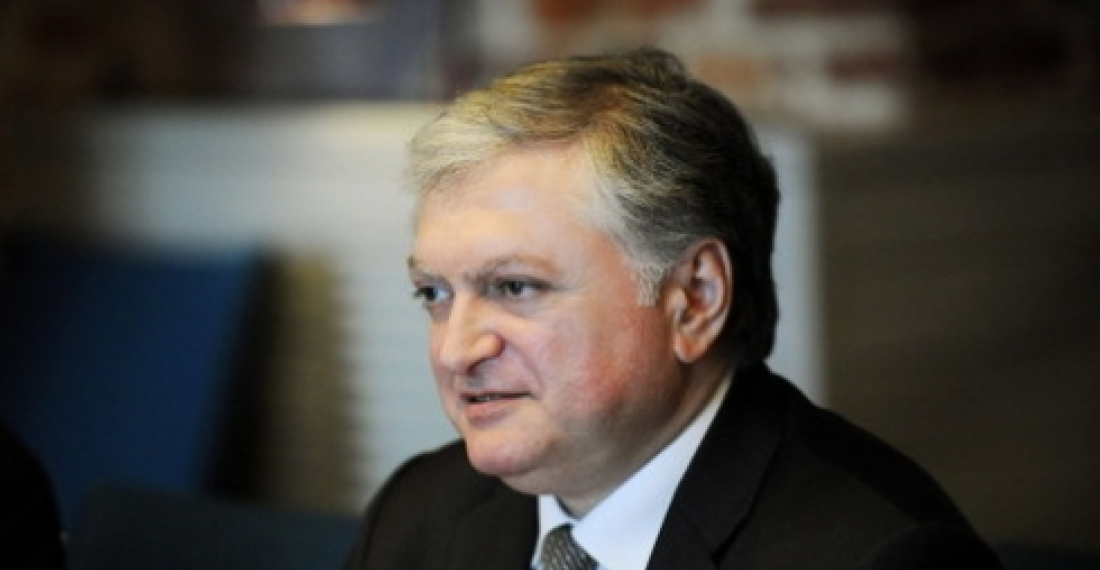
Глава МИД Армении:

Госсекретарь США Хиллари Клинтон в 2010 году в Астане от имени трех сопредседателей заявила, что все представленные принципы и элементы предложений по вопросу НК разработаны как единое целое, и разделение или придание одному из них приоритета - неприемлемо. Об этом заявил министр иностранных дел Армении Эдвард Налбандян в интервью австрийской Der Standard.

Отвечая на вопрос журналиста издания о том, что основным препятствием на пути решения конфликта является то, что «Армения оккупировала значительную часть азербайджанской территории», министр отметил: «В ответ на агрессию Азербайджана, силы самообороны Нагорного Карабаха с целью обеспечения физической безопасности народа, были вынуждены сформировать буферный пояс вокруг Нагорного Карабаха. Вопрос возвращения территорий является одним из элементов представленного сопредседателями Минской группы ОБСЕ общего переговорного пакета. Но, если Азербайджан подчеркивает только вопрос возвращения территорий и обходит стороной все остальные аспекты предложений.

Министр также коснулся армяно-турецких отношений  и выдвигаемых Турцией условий, отметив, что до инициативы президента Армении армяно-турецкие отношения находились в тупике.  «Мы попытались вывести их из тупика. Однако турецкая сторона делает все, чтобы вернуть их в тупик. Что касается комиссии историков,  то договоренность следующая: после открытия границ, установления дипломатических отношений, создать межправительственную комиссию, в рамках которой будет действовать ряд подкомиссий. Целью одной из подкомиссий будет не обсуждение того, был ли Геноцид или нет, а посредством диалога, в том числе в исторической плоскости, восстановить доверие между двумя народами. Факт Геноцида армян, признанный многими странами и международными организациями, не подлежит обсуждению. Могли бы Вы себе представить, чтобы евреев пригласили обсудить факт Холокоста?», - отметил Эдвард Налбандян.


 

Related articles

Editor's choice
News
The British prime minister says Europe must "stand on its own two feet" when it comes to defence

The British prime minister says Europe must "stand on its own two feet" when it comes to defence

The UK will deploy a carrier strike group, led by the aircraft carrier HMS Prince of Wales to the Arctic and the High North as part of efforts to bolster security against Russian threats. British prime minister, Sir Keir Starmer announced the deployment in a speech on Saturday (14 February) at the Munich Security Conference. Europe must be ready to fight to protect its people, values, and way of life,  Sir Keir told the Conference. Starmer also called for deeper links and cooperation, including economic ties, between the UK and EU. The PM stressed the continent must "stand on its own two feet" when it comes to defence commitments. "We must build our hard power, because that is the currency of the age," he told the conference. (Click image to read the full story).

Popular

Editor's choice
Interview
Thursday Interview: Murad Muradov

Thursday Interview: Murad Muradov

Today, commonspace.eu starts a new regular weekly series. THURSDAY INTERVIEW, conducted by Lauri Nikulainen, will host  persons who are thinkers, opinion shapers, and implementors in their countries and spheres. We start the series with an interview with Murad Muradov, a leading person in Azerbaijan's think tank community. He is also the first co-chair of the Action Committee for a new Armenian-Azerbaijani Dialogue. Last September he made history by being the first Azerbaijani civil society activist to visit Armenia after the 44 day war, and the start of the peace process. Speaking about this visit Murad Muradov said: "My experience was largely positive. My negative expectations luckily didn’t play out. The discussions were respectful, the panel format bringing together experts from Armenia, Azerbaijan, and Turkey was particularly valuable during the NATO Rose-Roth Seminar in Yerevan, and media coverage, while varied in tone, remained largely constructive. Some media outlets though attempted to represent me as more of a government mouthpiece than an independent expert, which was totally misleading.  Overall, I see these initiatives as important steps in rebuilding trust and normalising professional engagement. The fact that soon a larger Azerbaijani civil society visits to Armenia followed, reinforces the sense that this process is moving in the right direction." (click the image to read the interview in full)

