


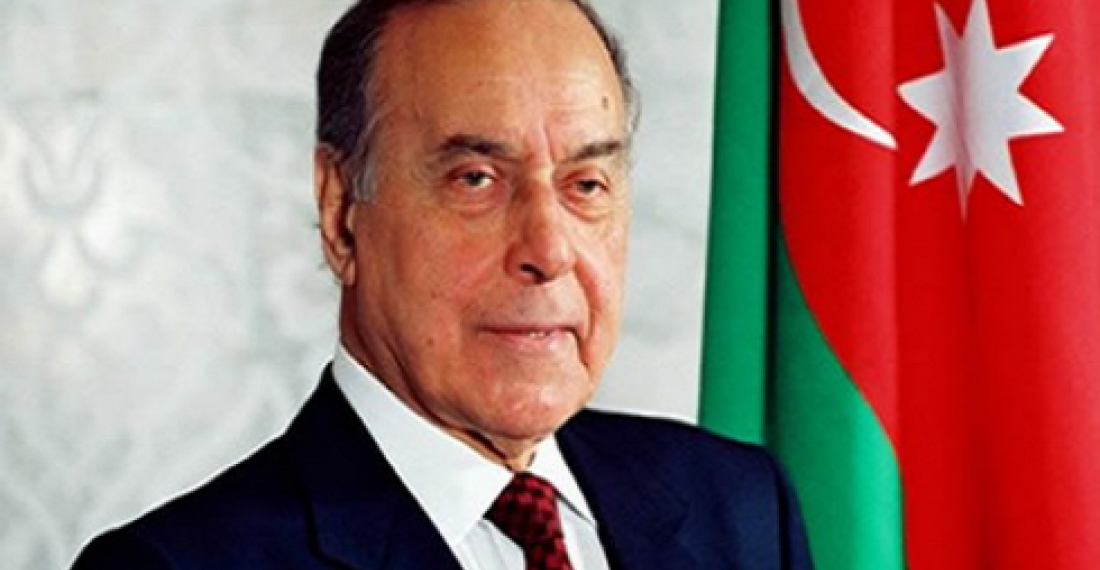
Гейдар Алиев: Основатель политической династии и современного Азербайджана.

Комментарий: Деннис Саммут, директор LINKS Анализ, о Гейдаре Алиеве и его наследии.

Азербайджан отмечает 90-летие со дня рождения Гейдара Алиева, почитаемый как национальный лидер правительством во главе с его сыном, но критикуемый его противниками как основатель деспотичной политической династии.

Гейдар Алиев родился 10 мая 1923 года в Нахичеванском районе Азербайджана. Сделав карьеру в КГБ, Алиев был назначен Леонидом Брежневым на пост руководителя Советского Азербайджана (с 1969 по 1982), а с 1982 по 1987 он также был членом Политбюро ЦК КПСС. С 1993 по 2003 год Гейдар Алиев занимал пост президента Азербайджана после чего его сменил на этом посту его сын Ильхам.

После распада СССР Гейдар Алиев вернулся в свою родную провинцию, Нахичеванскую Автономную Республику, в то время как ситуация в стране ухудшилась под давлением экономического коллапса, этнической напряженности и войны с соседней Арменией. Летом 1993 года на фоне опасений, что Азербайджан распадется Алиев вернулся в Баку с группой последователей и вскоре после этого был назначен Председателем Парламента, ступенька к посту президента, который он занял несколько месяцев спустя.

Гейдар Алиев был проницательным политическим деятелем. В первые годы своего президентства он использовал различные средства для стабилизации ситуации в стране - от охоты на некоторых своих оппонентов до заключения союзов с другими. Он попытался оживить старую коммунистическую номенклатуру, но убедился, что она была лишена  идеологии. Он сократил свои потери по Карабаху, согласившись на прекращение огня, и отложил задачу восстановления потерянных территорий на другой день. Затем он начал восстановление Азербайджана вокруг новой национальной идеи "Азербайджанство".

В своем выступлении на первом съезде азербайджанцев мира Алиев заявил,

"Мы азербайджанцы. Азербайджан является родиной для всех нас. Эта земля воспитала нас как народ, как нацию, как человеческую личность. Поэтому дух азербайджанства, идея азербайджанства должна стать связью, объединяющей нас вместе и подталкивающая нас к еще большей сплоченности. Каждое государство имеет свою собственную национальную идеологию. Национальной идеологией независимой Республики Азербайджан является идеология "Азербайджанство"".

Путем распространения идеи "азербайджанство" Алиев не только дал развивающемуся государству национальную идею, но он также дистанцировал себя от предыдущего правительства Абульфаза Эльчибей, который прочно закрепился в пантюркизме, а также от тех, кто видел Азербайджан в основном исламской нацией, которая должна иметь тесные связи с соседним Ираном. Алиев также осторожно начал отношения с Западом, и сыграл важную роль в подписании "сделки века", соглашение, которое привело к началу эксплуатации природных ресурсов Азербайджана в сотрудничестве с крупнейшими западными компаниями, такими как BP. Гейдар Алиев также стремился к интеграции Азербайджана в европейские институты, и принял все меры, которые были необходимы, чтобы Азербайджан мог вступить в Совет Европы. Назначив своего сына Ильхама в качестве главы делегации в Совете Европы, он дал понять ту важность, которую новый Азербайджан придает европейской идее. Во время своего президентства Гейдар Алиев имел тщательно сбалансированные отношения с Россией и Турцией - установив хорошие отношения с обоими, но не дав им слишком большого влияния.

После смерти Гейдара Алиева в 2003 году его сменил его сын, Ильхам, нынешний президент Азербайджана, шаг, в котором критики увидели создание династии в республике. Критики Алиевых заявляют, что это политическая династия основана на репрессиях и феодализме. Как ни странно, многие активисты азербайджанской оппозиции сейчас оглядываются назад на эпоху правления Гейдара Алиева как на время, когда в стране было возможно политическое инакомыслие, даже несмотря на некоторые ограничения.

Нет никаких сомнений, что Гейдар Алиев сыграл важную роль в стабилизации Азербайджана после начала 1990-х, в  создании основы для современного и успешного государства. В день его 90-летия со дня рождения азербайджанцы имеют возможность задуматься была ли заплаченная цена слишком высокой, или же это было оправдано.

Источник: Этот комментарий был подготовлен Деннисом Саммутом для Сommonspace.eu

Related articles

Editor's choice
News
Israeli parliament votes to bring back the death penalty, but only for Palestinians

Israeli parliament votes to bring back the death penalty, but only for Palestinians

srael’s parliament approved a bill on Monday that would allow the execution of Palestinians convicted on terror charges for deadly attacks, a move that has been criticized as discriminatory and immediately drew a court challenge. Sixty-two lawmakers, including Prime Minister Benjamin Netanyahu, voted in favor and 48 against the bill, championed by far-right National Security Minister Itamar Ben Gvir. There was one abstention and the rest of the lawmakers were not present. Ben Gvir in the run-up to the vote had worn a lapel pin in the shape of a noose, symbolising his support for the legislation. “We made history!!! We promised. We delivered,” he posted on X after the vote. The bill would make the death penalty the default punishment for Palestinians in the Israeli-occupied West Bank found guilty of intentionally carrying out deadly attacks deemed “acts of terrorism” by an Israeli military court. The bill says that the sentence may be reduced to life imprisonment under “special circumstances.” Palestinians in the West Bank are automatically tried in Israeli military courts. Meanwhile, under the bill, in Israeli criminal courts anyone “who intentionally causes the death of a person with the aim of harming an Israeli citizen or resident out of an intention to put an end to the existence of the State of Israel shall be sentenced to death or life imprisonment.” Criminal courts try Israeli nationals, including Palestinian citizens and residents of east Jerusalem. The bill sets the execution method as hanging, adding that it should be carried out within 90 days of the sentencing, with a possible postponement of up to 180 days. - ‘Parallel tracks’ - The bill appears to conflict with Israel’s Basic Laws, which prohibit arbitrary discrimination, and shortly after it was passed, a leading human rights group announced that it had filed a petition with the Supreme Court demanding the legislation’s annulment. “The law creates two parallel tracks, both designed to apply to Palestinians,” the Association for Civil Rights in Israel said in a statement. “In military courts — which have jurisdiction over West Bank Palestinians — it establishes a near-mandatory death sentence,” the rights group said. In civilian courts, the law’s stipulation that defendants must have acted “with the aim of negating the existence” of Israel “structurally excludes Jewish perpetrators,” the group added. The association argued the law should be annulled on both jurisdictional and constitutional grounds. During the debate in parliament, opposition lawmaker and former deputy Mossad director, Ram Ben Barak, expressed outrage at the legislation. “Do you understand what it means that there is one law for Arabs in Judea and Samaria, and a different law for the general public for which the State of Israel is responsible?” he asked fellow parliamentarians, using the Israeli name for the West Bank. “It says that Hamas has defeated us. It has defeated us because we have lost all our values.” - ‘Discriminatory application’ - Lawmaker Limor Son Har-Melech from Ben Gvir’s party, who years ago survived an attack by Palestinian militants in which her husband was killed, urged fellow parliamentarians to approve the bill. “For years, we endured a cruel cycle of terror, imprisonment, release in reckless deals, and the return of these human monsters to murder Jews again ... And today, my friends, this cycle has come full circle.” The Palestinian Authority condemned the law’s adoption, saying that “Israel has no sovereignty over Palestinian land.” “This law once again reveals the nature of the Israeli colonial system, which seeks to legitimize extrajudicial killing under legislative cover,” it added. In February, Amnesty International had urged Israeli lawmakers to reject the legislation, citing its “discriminatory application against Palestinians.” On Sunday, Britain, France, Germany and Italy expressed “deep concern” over the bill, which they said risked “undermining Israel’s commitments with regards to democratic principles.” While the death penalty exists for a small number of crimes in Israel, it has become a de facto abolitionist country — the Nazi Holocaust perpetrator Adolf Eichmann was the last person to be executed in 1962. Israel has occupied the West Bank since 1967 and violence there has soared since Hamas’s October 7, 2023 attack on Israel triggered the Gaza war. (read more by clicking the image above).

Popular

Editor's choice
Interview
Thursday Interview: Murad Muradov

Thursday Interview: Murad Muradov

Today, commonspace.eu starts a new regular weekly series. THURSDAY INTERVIEW, conducted by Lauri Nikulainen, will host  persons who are thinkers, opinion shapers, and implementors in their countries and spheres. We start the series with an interview with Murad Muradov, a leading person in Azerbaijan's think tank community. He is also the first co-chair of the Action Committee for a new Armenian-Azerbaijani Dialogue. Last September he made history by being the first Azerbaijani civil society activist to visit Armenia after the 44 day war, and the start of the peace process. Speaking about this visit Murad Muradov said: "My experience was largely positive. My negative expectations luckily didn’t play out. The discussions were respectful, the panel format bringing together experts from Armenia, Azerbaijan, and Turkey was particularly valuable during the NATO Rose-Roth Seminar in Yerevan, and media coverage, while varied in tone, remained largely constructive. Some media outlets though attempted to represent me as more of a government mouthpiece than an independent expert, which was totally misleading.  Overall, I see these initiatives as important steps in rebuilding trust and normalising professional engagement. The fact that soon a larger Azerbaijani civil society visits to Armenia followed, reinforces the sense that this process is moving in the right direction." (click the image to read the interview in full)


