


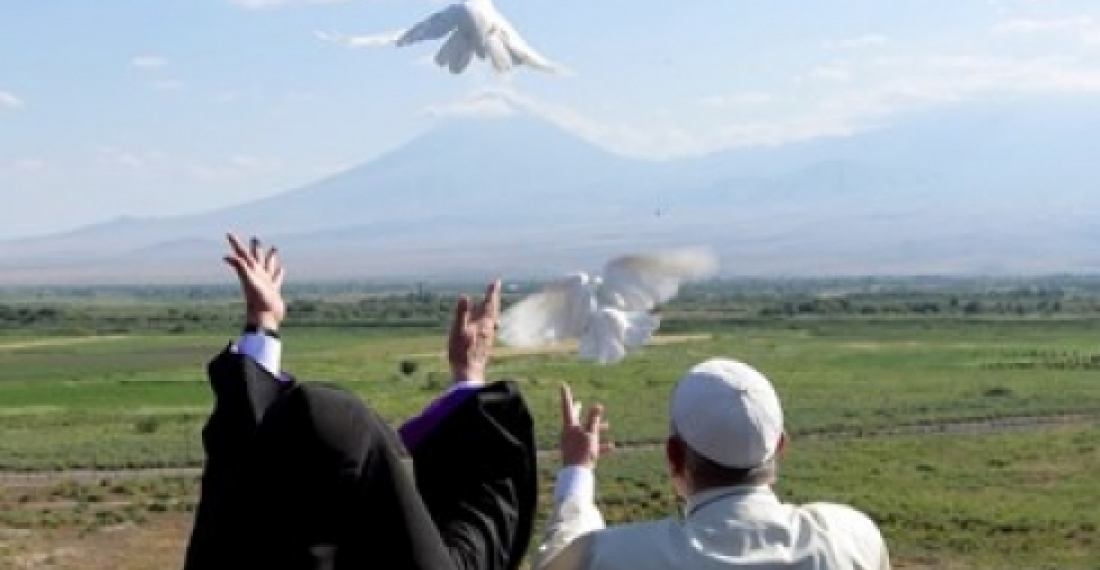
Франциск завершил свой визит в Армению

Франциск завершил трехдневный визит в Армению, во время которого он призвал к единству между Римско-Католической Церковью и Армянской Апостольской Церковью, и молился за мир, справедливость и примирения во всем мире.

Commonspace.eu освещал визит Папы в прямой текстовой трансляции, который вы можете прочитать здесь

Политический редактор Commonspace.eu подводит итоги визита:

Это был визит главы крупнейшей христианской церкви - Римско-католической церкви, одной из ветвей христианства, по приглашению Армянской Апостольской Церкви, которая отделилась от Рима в пятом веке из-за богословского рассуждения о природе Христа как сына Божьего. Для Папы визит стал в первую очередь частью процесса по примирению и в конечном итоге воссоединения. Эта тема доминировала во время его визита и речей. Конечно, этого не произойдет в ближайшее время, но думаю, что Церкви думаю в более долгосрочной перспективе, чем правительства, поэтому для Папы это был важным шагом в долгосрочной стратегии.

Однако, визит также носил политическое значение для Армении. Запертые в политическом, военном и стратегическом союзе с Россией, особые отношения Армении с Римско-католической церковью представляют возможность поддержания баланса в международных отношениях страны. Франциск продемонстрировал готовность протянуть руку армянскому народу, что выходит далеко за рамки обычной дипломатии Ватикана. В последние три дня он говорил с такими впечатлениями об Армении, о её вере, истории и страданиях. Упоминая массовые убийства армян в Анатолии в 1915 году он использовал слово геноцид, которого не было в подготовленном для него тексте выступления, что, наверное, расстроило некоторых даже среди консервативной дипломатии Ватикана. Ватиканские чиновники в преддверии визита проинформировали СМИ, что Папе, вероятно, нет нужды использовать это слово снова. На это обязательно будет реакция со стороны Турции, хотя может и не такая сильная. Но помимо этого, в Турции обязательно разглядят в словах Папы еще один пример антитурецких настроений в Европе.

Вопрос мира должен был быть другим ключевым элементом визита Папы. Откровенно говоря о нем было сказано очень мало, и многих расстроит то, что папа не использовал более сильный язык говоря о мире на Кавказе.

Однако, в целом для армянской дипломатии этот визит стал огромным успехом. Церковь и государство хорошо сработали в этом случае, чтобы достиь успеха в этом. Значительную роль в этом сыграл посол Армении в Ватикане, Микаэль Минасян. Визит Папы также стал отличным упражнением в работе по освещению визита. Освещение в СМИ в Европе и во всем мире было чуть меньше, чем ожидалось, учитывая новость о brexit, которая доминировала все время визита Папы. Тем не менее, освещение в СМИ в целом порадовало армян.

Для Ватикана визит также стал успешным, хоть за него и придется "заплатить". В конце сентября Папа посетит Азербайджан. Как пройдет этот визит будет видно. Это будет визит другого рода. Азербайджан - мусульманская страна с очень маленькой католической общиной. Но католическая церковь универсальна и не любит, чтобы на карте были пустые места. Поэтому Ватикану придется развить дискурс, который может примирить то, что папа сказал в Ереване с тем, что он захочет сказать в Баку".

источник: commonspace.eu по материалам Радио Ватикана

фото: Франциск и армянский Католикос-Патриарх Гарегин II выпустили белых голубей в направлении Турции под конец визита Папы в Армению 24-26 июня. (Фото любезно предоставлено Радио Ватикана).
 

Related articles

Editor's choice
News
Russia adds pressure on Armenia ahead of key elections; recalls Ambassador in Yerevan for consultations

Russia adds pressure on Armenia ahead of key elections; recalls Ambassador in Yerevan for consultations

Ahead of key parliamentary elections,scheduled to be held in Armenia on Sunday, 7 June, Russia continues to attempt to put pressure on the Armenian Government led by prime minister Nikol Pashinyan. On 30 May, Russia recalled its Ambassador to Yerevan for consultations. A terse statement, published on the website of the Russian Foreign Ministry, said, "The Ambassador of the Russian Federation to the Republic of Armenia , S.P. Kopyrkin, has been summoned to Moscow for consultations in connection with the steps taken by the Armenian leadership to move closer to the European Union, which are detrimental to cooperation within the EAEU." This followed a statement issued the day before, by the leaders of the Eurasian Economic Union (EAEU) that challenges the Armenian trajectory towards approximating to the European Union. Vladimir Putin is undertood to have personally pushed the other four EAEU leaders to issue the statement, which said: "Taking into account the significant risks to the economic security of the member states of the Eurasian Economic Union (hereinafter referred to as the Union) arising in connection with the preparation of the Republic of Armenia for accession to the European Union, as well as the need to prevent the associated damage to the member states of the Union: decided that the members of the Eurasian Intergovernmental Council from the Republic of Belarus, the Republic of Kazakhstan, the Kyrgyz Republic and the Russian Federation will report at the next meeting of the Supreme Eurasian Economic Council in December 2026 on the possible consequences of the suspension of the Treaty on the Eurasian Economic Union with respect to the Republic of Armenia. We share the position on the need to hold a national referendum in the Republic of Armenia as soon as possible on joining the European Union or continuing to be part of the Eurasian Economic Union."
Editor's choice
News
The leaders of the states of the Eurasian Economic Union issued a tough statement warning fellow-member state Armenia of the consequences of its desire to join the European Union.

The leaders of the states of the Eurasian Economic Union issued a tough statement warning fellow-member state Armenia of the consequences of its desire to join the European Union.

The leaders of the states of the Eurasian Economic Union (EEAS) issued a tough statement warning fellow-member state Armenia of the consequences of its desire to join the European Union. The stark, sharply worded,  warning, comes days before crucial parliamentary elections in Armenia, scheduled for 7 June. The full statement said, “We, the Presidents of the Republic of Belarus, the Republic of Kazakhstan, the Kyrgyz Republic and the Russian Federation, Taking into account the actions of the Republic of Armenia aimed at joining the European Union, including the approval in 2025 by the National Assembly of the Republic of Armenia and the signing by the President of the Republic of Armenia of the Law of the Republic of Armenia "On the Start of the Process of Accession of the Republic of Armenia to the European Union", as well as the confirmation by the European Union of the European aspirations of the Government of the Republic of Armenia, expressed in the joint declaration following the first Armenia-European Union summit, adopted on 5 May 2026, Taking into account the significant risks to the economic security of the member states of the Eurasian Economic Union (hereinafter referred to as the Union) arising in connection with the preparation of the Republic of Armenia for accession to the European Union, as well as the need to prevent the associated damage to the member states of the Union: decided that the members of the Eurasian Intergovernmental Council from the Republic of Belarus, the Republic of Kazakhstan, the Kyrgyz Republic and the Russian Federation will report at the next meeting of the Supreme Eurasian Economic Council in December 2026 on the possible consequences of the suspension of the Treaty on the Eurasian Economic Union with respect to the Republic of Armenia. We share the position on the need to hold a national referendum in the Republic of Armenia as soon as possible on joining the European Union or continuing to be part of the Eurasian Economic Union. Astana, May 29, 2026” A meeting of the Supreme Eurasian Economic Council was held in Astana, Kazakhstan, on May 29, 2026. The meeting of the Supreme Eurasian Economic Council in a restricted format was attended by Russian President Vladimir Putin, Belarusian President Alexander Lukashenko , Kazakh President Kassym-Jomart Tokayev , Kyrgyz President Sadyr Japarov , Armenian Deputy Prime Minister Mher Grigoryan, and Chairman of the Board of the Eurasian Economic Commission Bakytzhan Sagintayev. From the Russian side, the meeting was also attended by Deputy Prime Minister and member of the Council of the Eurasian Economic Commission Alexey Overchuk and Presidential Aide Yury Ushakov . The heads of delegations from EAEU observer states, including President of Uzbekistan Shavkat Mirziyoyev , Vice President of Cuba Salvador Valdés Mesa, Minister of Industry, Mines, and Trade of Iran Mohammad Atabak, and CIS Secretary General Sergei Lebedev, joined the expanded meeting . Following the meeting of the Supreme Eurasian Economic Council, a number of documents were signed .

Popular

Editor's choice
Interview
Thursday Interview: Murad Muradov

Thursday Interview: Murad Muradov

Today, commonspace.eu starts a new regular weekly series. THURSDAY INTERVIEW, conducted by Lauri Nikulainen, will host  persons who are thinkers, opinion shapers, and implementors in their countries and spheres. We start the series with an interview with Murad Muradov, a leading person in Azerbaijan's think tank community. He is also the first co-chair of the Action Committee for a new Armenian-Azerbaijani Dialogue. Last September he made history by being the first Azerbaijani civil society activist to visit Armenia after the 44 day war, and the start of the peace process. Speaking about this visit Murad Muradov said: "My experience was largely positive. My negative expectations luckily didn’t play out. The discussions were respectful, the panel format bringing together experts from Armenia, Azerbaijan, and Turkey was particularly valuable during the NATO Rose-Roth Seminar in Yerevan, and media coverage, while varied in tone, remained largely constructive. Some media outlets though attempted to represent me as more of a government mouthpiece than an independent expert, which was totally misleading.  Overall, I see these initiatives as important steps in rebuilding trust and normalising professional engagement. The fact that soon a larger Azerbaijani civil society visits to Armenia followed, reinforces the sense that this process is moving in the right direction." (click the image to read the interview in full)

