


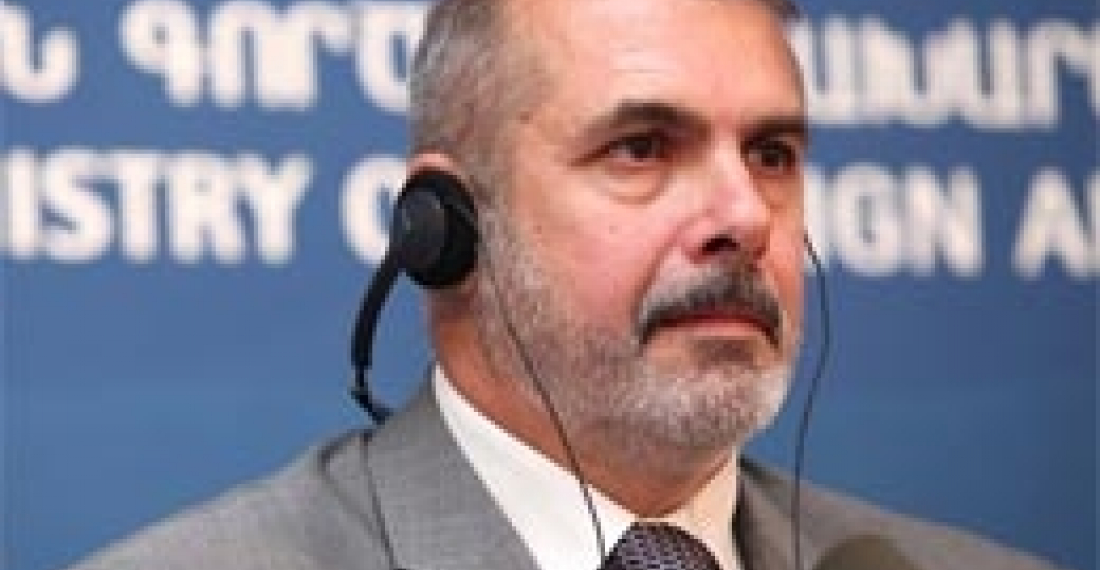
Филипп Лефор ждет пояснений от азербайджанских властей относительно дела Сафарова

12 сентября президент Армении Серж Саргсян принял спецпредставителя ЕС  по вопросам кризиса на Южном Кавказе и Грузии Филиппа Лефора.

Как сообщили АрмИнфо в пресс-службе президента, в ходе встречи собеседники обсудили темы, касающиеся отношений Армении - ЕС, и развития сотрудничества.  Собеседники также коснулись последних событий в процессе урегулирования нагорно- карабахского конфликта, и ситуации с экстрадицией и помилованием Рамиля Сафарова, зарубившего топором в 2004 году армянского офицера Гургена Маргаряна, а также реакцию международного сообщества в связи с этим инцидентом.

Президент поблагодарил те государства, международные организации и ряд европейских структур за однозначные и резкие заявления по поводу злополучной экстрадиции Сафарова. В то же время президент посчитал неприемлемой реакцию тех международных структур, которые не отреагировали на героизацию Сафарова должным образом.

В свою очередь, Лефор заметил, что после встречи с президентом Армении собирается посетить Баку и ожидает получить пояснения азербайджанских властей относительно дела Сафарова. Он также подчеркнул, что ЕС осуждает этот шаг, который нанес ущерб взаимному доверию сторон нагорно-карабахского конфликта. Он также заметил, что в вопросе урегулирования конфликта ЕС поддерживает усилия Минской группы ОБСЕ. Он также коснулся развития сотрудничества Армении  с ЕС и готовности поддержки усилий Армении к евроинтеграции. В этой связи он отметил, что уже ведутся работы по организации конференции доноров для Армении с участием представителей международных финансовых структур.

Напомним, что 31 августа осужденный в 2004-м году в Венгрии на пожизненный срок азербайджанский офицер Рамиль Сафаров был экстрадирован на родину. В тот же день президент Азербайджана Ильхам Алиев своим указом помиловал его и повысил в звании. Этот поступок вызвал резкую реакцию международного сообщества. По всему миру проходят акции протеста в связи с безумным и гнусным шагом Баку и Будапешта.

Related articles

Editor's choice
News
The British prime minister says Europe must "stand on its own two feet" when it comes to defence

The British prime minister says Europe must "stand on its own two feet" when it comes to defence

The UK will deploy a carrier strike group, led by the aircraft carrier HMS Prince of Wales to the Arctic and the High North as part of efforts to bolster security against Russian threats. British prime minister, Sir Keir Starmer announced the deployment in a speech on Saturday (14 February) at the Munich Security Conference. Europe must be ready to fight to protect its people, values, and way of life,  Sir Keir told the Conference. Starmer also called for deeper links and cooperation, including economic ties, between the UK and EU. The PM stressed the continent must "stand on its own two feet" when it comes to defence commitments. "We must build our hard power, because that is the currency of the age," he told the conference. (Click image to read the full story).

Popular

Editor's choice
Interview
Thursday Interview: Murad Muradov

Thursday Interview: Murad Muradov

Today, commonspace.eu starts a new regular weekly series. THURSDAY INTERVIEW, conducted by Lauri Nikulainen, will host  persons who are thinkers, opinion shapers, and implementors in their countries and spheres. We start the series with an interview with Murad Muradov, a leading person in Azerbaijan's think tank community. He is also the first co-chair of the Action Committee for a new Armenian-Azerbaijani Dialogue. Last September he made history by being the first Azerbaijani civil society activist to visit Armenia after the 44 day war, and the start of the peace process. Speaking about this visit Murad Muradov said: "My experience was largely positive. My negative expectations luckily didn’t play out. The discussions were respectful, the panel format bringing together experts from Armenia, Azerbaijan, and Turkey was particularly valuable during the NATO Rose-Roth Seminar in Yerevan, and media coverage, while varied in tone, remained largely constructive. Some media outlets though attempted to represent me as more of a government mouthpiece than an independent expert, which was totally misleading.  Overall, I see these initiatives as important steps in rebuilding trust and normalising professional engagement. The fact that soon a larger Azerbaijani civil society visits to Armenia followed, reinforces the sense that this process is moving in the right direction." (click the image to read the interview in full)

