


Cтатус-кво в Карабахе является "неприемлемым"

Статус-кво в Нагорном Карабахе является "неприемлемым" и урегулирование конфликта является приоритетом для ЕС, об этом заявили высокопоставленные чиновники в понедельник вечером по завершению Совета по сотрудничеству ЕС-Армения, предлагая свою неизменную поддержку мирному процессу и призывая к сдержанности с обеих сторон.

"Ситуация с безопасностью вдоль линии соприкосновения и международной границы между Арменией и Азербайджаном является предметом серьезной озабоченности", говорится в официальном заявлении 16 заседания Совета по сотрудничеству Армении и ЕС.

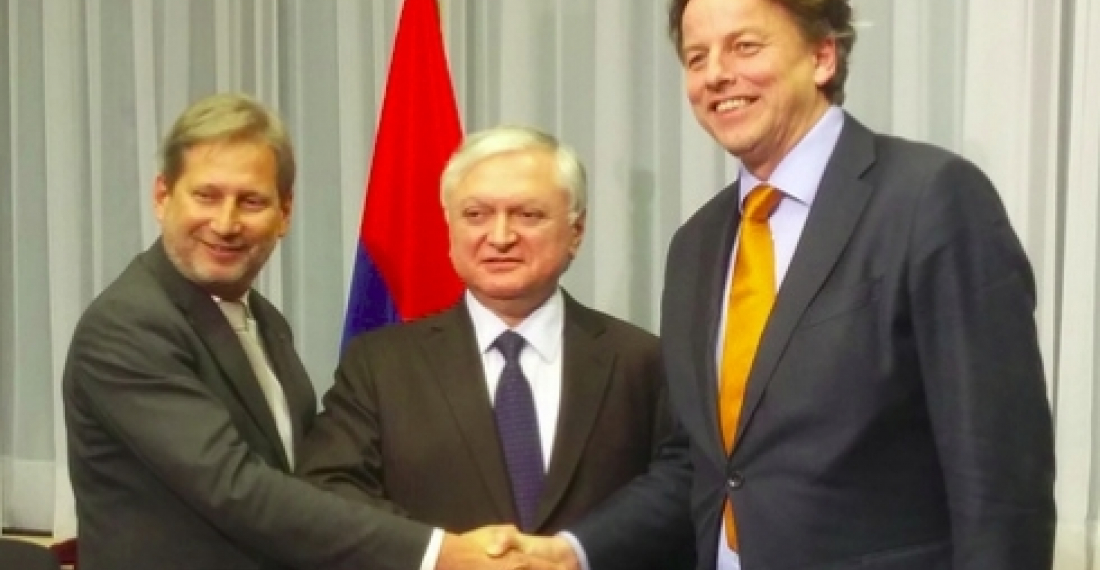
В Брюсселе министр иностранных дел Армении Эдвард Налбандян встретился с высокопоставленными представителями ЕС для обсуждения Карабаха, а также других вопросов, в том числе либерализация визового режима.

В сентябре 2013 года Армения объявила о вступлении в возглавляемый Россией Евразийский экономический союз, отказавшись тем самым от предлагаемого Соглашения об ассоциации с ЕС.

Налбандян обсудил эти вопросы с Бертом Кундерсом, министром иностранных дел Нидерландов (страны, текущего председателя в ЕС), и Йоханнесом Ханом, Комиссаром по вопросам расширения и политики добрососедства.

Также на повестке дня стоял вопрос о встрече между президентами Армении и Азербайджана, которая состоялась в Берне, Швейцарии, в декабре прошлого года.

"Повестка дня встречи в Берне была продиктована эскалацией ситуации в результате провокаций Азербайджана, грубых нарушений режима прекращения огня," сказал Налбандян.

Европейские чиновники были более позитивно настроены касательно переговоров в Берне, говоря, что они предоставили важную возможность для будущих обменов, и предоставили практическую поддержку регионам, пострадавших от конфликта.

Призывая к сдержанности в зоне конфликта, ЕС также подтвердил свою поддержку Минского процесса ОБСЕ.

Чиновники ЕС поприветствовали политические, экономические и социальные реформы, проводимые в Армении, в тоже время призвали к изменениям в других областях, в том числе в сфере верховенства закона, прав человека и избирательной системы.

Армения было выделено 140-170 млн € в рамках помощи на 2014-2017 гг, говорится в заявлении ЕС, эти средства сосредоточены на развитии частного сектора, на реформах государственного управления и системы правосудия.

источник: commonspace.eu по материалам www.armardio.am, www.consilium.europa.eu

Фото: Эдвард Налбандян, Берт Кундерс и Йоханнес Хан 18 января, в Брюсселе.

 

Related articles

Editor's choice
News
Uzbekistan calls for bigger voice for Central Asia in the UN

Uzbekistan calls for bigger voice for Central Asia in the UN

Uzbekistan called for a more effective and representative United Nations on September 23, as presidential administration chief Saida Mirziyoyeva used her address to the UN General Assembly to seek support for the country’s candidacy for a nonpermanent Security Council seat in 2035–2036. Speaking at the Assembly’s 81st session in New York, Mirziyoyeva argued that international cooperation remains necessary despite growing geopolitical divisions. She endorsed UN Secretary-General António Guterres’ UN80 reform initiative and called for an expanded Security Council, arguing that international rules should be applied consistently rather than according to the interests of powerful states. Uzbekistan’s planned chairmanship of the Non-Aligned Movement in 2027 was presented as another platform for promoting dialogue. Her emphasis on multilateralism also fits a broader Central Asian effort to increase the region’s role in international institutions. Kyrgyzstan, for example, will hold its first Security Council seat in 2027–2028. Mirziyoyeva also highlighted regional cooperation, pointing to improved relations among Central Asian states over longstanding border and water disputes. On Afghanistan, she urged countries not to view it solely as a security threat, stressing the importance of creating conditions for peaceful development. She linked Uzbekistan’s international agenda to domestic reforms, citing economic growth, falling poverty and expanded education. Climate and water security also featured prominently, with the Aral Sea serving as an example of the consequences of poor environmental management. (click image to read more)
Editor's choice
News
Kazakhstan declares national day of mourning after tragedy

Kazakhstan declares national day of mourning after tragedy

Kazakh president, Kassym-Jomart Tokayev, declared September 25 a national day of mourning following the deaths of servicemen during military exercises in the Caspian Sea. Twelve Kazakh servicemen died after being swept into the Caspian Sea during the Khazar Qorgany–2026 naval exercises in the Mangystau region on Thursday (September 24). The incident occurred after weather conditions suddenly deteriorated and winds intensified during a combat training mission. In a Telegram post, the Ministry of Defence reported that 19 servicemen had been swept into the sea. So far, three have been rescued, one of whom was hospitalized, while 12 bodies have been recovered.  Search operations were continuing for the remaining four servicemen. A large-scale rescue and recovery effort has been launched, involving Kazakhstan’s Naval Forces, the Ministry of Emergency Situations, aviation assets and other relevant services.   Deputy Prime Minister Kanat Bozumbayev, who is leading a government commission at the scene, ordered a continuous, round-the-clock search for those still missing. Authorities were also instructed to provide financial and other assistance to the families of the deceased. (click image to read in full)

Popular

Editor's choice
Interview
Thursday Interview: Murad Muradov

Thursday Interview: Murad Muradov

Today, commonspace.eu starts a new regular weekly series. THURSDAY INTERVIEW, conducted by Lauri Nikulainen, will host  persons who are thinkers, opinion shapers, and implementors in their countries and spheres. We start the series with an interview with Murad Muradov, a leading person in Azerbaijan's think tank community. He is also the first co-chair of the Action Committee for a new Armenian-Azerbaijani Dialogue. Last September he made history by being the first Azerbaijani civil society activist to visit Armenia after the 44 day war, and the start of the peace process. Speaking about this visit Murad Muradov said: "My experience was largely positive. My negative expectations luckily didn’t play out. The discussions were respectful, the panel format bringing together experts from Armenia, Azerbaijan, and Turkey was particularly valuable during the NATO Rose-Roth Seminar in Yerevan, and media coverage, while varied in tone, remained largely constructive. Some media outlets though attempted to represent me as more of a government mouthpiece than an independent expert, which was totally misleading.  Overall, I see these initiatives as important steps in rebuilding trust and normalising professional engagement. The fact that soon a larger Azerbaijani civil society visits to Armenia followed, reinforces the sense that this process is moving in the right direction." (click the image to read the interview in full)


