


Жертвы, дипломатия и диалог: долгий день в армяно-азербайджанских отношениях

Сложные отношения между Арменией и Азербайджаном вчера заявили о себе в полный голос на отдельных, казалось бы, несвязанных между собой событиях, которые выделили многие аспекты этих отношений.

Рано утром стали поступать сообщения о крупных военных столкновениях в северной части международной границы между двумя странами. Министерство обороны Республики Армения затем опубликовало информацию о том, что трое армянских солдат были убиты и шесть получили серьезные ранения, когда они попытались дать отпор азербайджанскому продвижению на территорию Армении вблизи села Бердаван и Чинари, в Тавушской области. Армянские источники заявили, что они остановили азербайджанские силы, пытавшиеся занять позиции.

"Заранее спланированное наступление было остановлена, и враг был отбит, понеся жертвы," говорится в заявлении Министерства обороны Армении. "Вооруженные силы Армении контролируют ситуацию по всей линии соприкосновения, осуществляя адекватные действия.", говорится в заявлении без подробностей.

В течение нескольких часов Министерство обороны Азербайджана выпустило встречное заявление, в котором отрицает, что их силы были вовлечены в какие-либо столкновения с армянскими вооруженными силами, по сообщению Радио Свобода, хотя некоторые азербайджанские СМИ, в том числе АПА, говорили, что Азербайджан предотвратил "попытку провокации армянской армии на линии фронта".

Иностранный дипломат базирующийся в Армении, посетивший регион, написал на facebook о мрачной атмосфере, царившей в деревне перед похоронами мертвых.

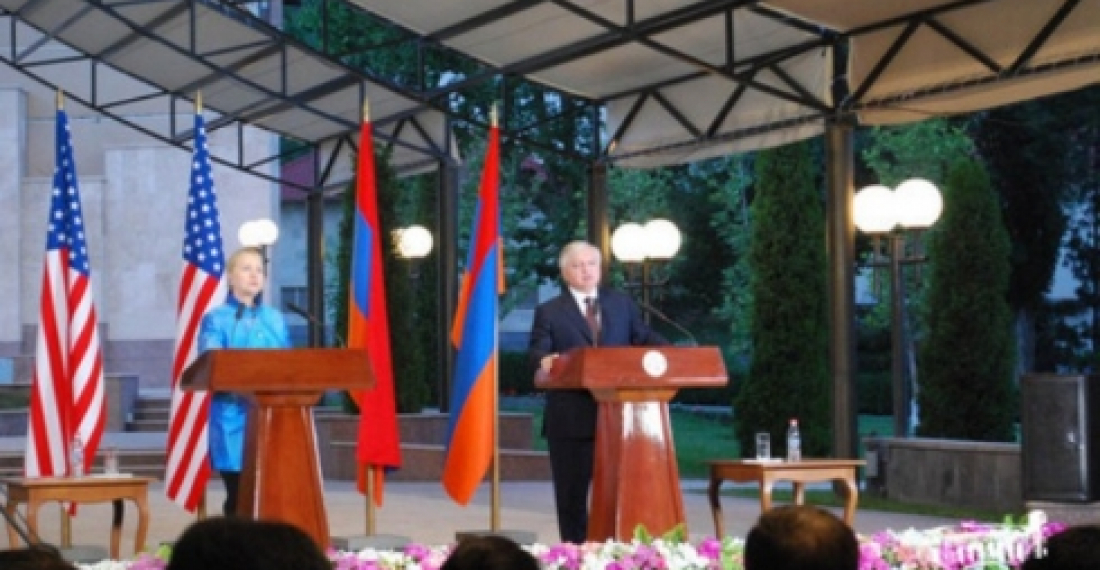
В начале второй половины дня самолет Государственного секретаря США, Хилари Клинтон, которая в настоящее время находится в турне по региону, приземлился в Ереване. К этому времени армянские политические комментаторы, пишущие для ряда новостных блогов и сайтов, связали инцидент в Тавушской области с ее визитом, заявив, что это была попытка Азербайджана сорвать какие-либо мирные усилия. То же самое повторил министр иностранных дел Армении, Эдвард Налбандян, на пресс-конференции с Клинтон вечером. "Азербайджанские действия ставят под угрозу переговорный процесс и стабильность в регионе, и ответственность за все возможные последствия этого ложатся на азербайджанскую сторону", сказал Налбандян.

Клинтон в свою очередь упомянула инцидент на пресс-конференции. Ссылаясь на встречу с президентом Армении, Сержем Саргсяном, Клинтон сказала:

"Конечно, президент и я имели серьезный разговор о Нагорном Карабахе, в том числе о самом последнем инциденте вдоль линии фронта. Как только я узнала об этом инциденте, я очень обеспокоилась опасностью эскалации напряженности и бессмысленных смертей молодых солдат и мирных жителей. Применение силы не решит нагорно-карабахского конфликта, и поэтому сила не должна применяться. И мы призываем все силы отказаться, а также воздержаться от насилия. Я заверила президента, что я отмечу эти моменты в Баку, когда я буду там послезавтра.

Эти инциденты подчеркивают необходимость попытаться сохранить достижения прогресса в мирном процессе. Как сопредседатель Минской группы ОБСЕ, Соединенные Штаты намерены работать со всеми сторонами для поиска пути продвижения вперед. И я убеждена, что должен быть путь вперед. И этим должны быть не только действия руководителей, но это должно быть и действия граждан, попытаться найти способ, чтобы народы региона жили вместе в мире и в достоинстве".

Одновременно с этими событиями в Москве состоялось еще ​​одно знаменательное событие, спонсируемое Россией общественное дипломатическое событие, с участием глав армянских и азербайджанских СМИ, проходящее в офисе "Российской газеты". По различным сообщениям встреча предположительно прошла успешно и в хорошей атмосфере.

По словам посла Азербайджана в Москве, Полада Бюль-Бюль оглы, на встрече стороны выразили свои позиции и взгляды. "По общему мнению участников встречи, журналистика должна быть патриотичной, но не тенденциозной. Недопустимо оскорблять государственных, общественных деятелей. Надо вести обсуждения в рамках нормальной журналистики. Стороны выдвинули предложение о том, что бы для проведения подобных встреч создать постоянно действующую группу. Это послужит укреплению связей между журналистами. Так же было отмечено, что мы живем в одном регионе, и никто этот регион покидать не собирается"

С жертвами, дипломатией и диалогом происходящими одновременно трудно сделать вывод, был ли это хороший или плохой день в армяно-азербайджанских отношениях. Тем не менее это было еще одно отражение сложности конфликта между ними, который продолжает заявлять о себе в полный голос на различных фронтах и в разных контекстах.

Источник: Commonspace.eu по материалам АПА, RFE / RL, и государственного департамента США.

Фото: Хилари Клинтон и Эдвард Налбандян на совместной пресс-конференции в Ереване 4 июня 2012 года. (фото любезно предоставлено пресс-службой МИД Армении).


Related articles

Editor's choice
News
Israeli parliament votes to bring back the death penalty, but only for Palestinians

Israeli parliament votes to bring back the death penalty, but only for Palestinians

srael’s parliament approved a bill on Monday that would allow the execution of Palestinians convicted on terror charges for deadly attacks, a move that has been criticized as discriminatory and immediately drew a court challenge. Sixty-two lawmakers, including Prime Minister Benjamin Netanyahu, voted in favor and 48 against the bill, championed by far-right National Security Minister Itamar Ben Gvir. There was one abstention and the rest of the lawmakers were not present. Ben Gvir in the run-up to the vote had worn a lapel pin in the shape of a noose, symbolising his support for the legislation. “We made history!!! We promised. We delivered,” he posted on X after the vote. The bill would make the death penalty the default punishment for Palestinians in the Israeli-occupied West Bank found guilty of intentionally carrying out deadly attacks deemed “acts of terrorism” by an Israeli military court. The bill says that the sentence may be reduced to life imprisonment under “special circumstances.” Palestinians in the West Bank are automatically tried in Israeli military courts. Meanwhile, under the bill, in Israeli criminal courts anyone “who intentionally causes the death of a person with the aim of harming an Israeli citizen or resident out of an intention to put an end to the existence of the State of Israel shall be sentenced to death or life imprisonment.” Criminal courts try Israeli nationals, including Palestinian citizens and residents of east Jerusalem. The bill sets the execution method as hanging, adding that it should be carried out within 90 days of the sentencing, with a possible postponement of up to 180 days. - ‘Parallel tracks’ - The bill appears to conflict with Israel’s Basic Laws, which prohibit arbitrary discrimination, and shortly after it was passed, a leading human rights group announced that it had filed a petition with the Supreme Court demanding the legislation’s annulment. “The law creates two parallel tracks, both designed to apply to Palestinians,” the Association for Civil Rights in Israel said in a statement. “In military courts — which have jurisdiction over West Bank Palestinians — it establishes a near-mandatory death sentence,” the rights group said. In civilian courts, the law’s stipulation that defendants must have acted “with the aim of negating the existence” of Israel “structurally excludes Jewish perpetrators,” the group added. The association argued the law should be annulled on both jurisdictional and constitutional grounds. During the debate in parliament, opposition lawmaker and former deputy Mossad director, Ram Ben Barak, expressed outrage at the legislation. “Do you understand what it means that there is one law for Arabs in Judea and Samaria, and a different law for the general public for which the State of Israel is responsible?” he asked fellow parliamentarians, using the Israeli name for the West Bank. “It says that Hamas has defeated us. It has defeated us because we have lost all our values.” - ‘Discriminatory application’ - Lawmaker Limor Son Har-Melech from Ben Gvir’s party, who years ago survived an attack by Palestinian militants in which her husband was killed, urged fellow parliamentarians to approve the bill. “For years, we endured a cruel cycle of terror, imprisonment, release in reckless deals, and the return of these human monsters to murder Jews again ... And today, my friends, this cycle has come full circle.” The Palestinian Authority condemned the law’s adoption, saying that “Israel has no sovereignty over Palestinian land.” “This law once again reveals the nature of the Israeli colonial system, which seeks to legitimize extrajudicial killing under legislative cover,” it added. In February, Amnesty International had urged Israeli lawmakers to reject the legislation, citing its “discriminatory application against Palestinians.” On Sunday, Britain, France, Germany and Italy expressed “deep concern” over the bill, which they said risked “undermining Israel’s commitments with regards to democratic principles.” While the death penalty exists for a small number of crimes in Israel, it has become a de facto abolitionist country — the Nazi Holocaust perpetrator Adolf Eichmann was the last person to be executed in 1962. Israel has occupied the West Bank since 1967 and violence there has soared since Hamas’s October 7, 2023 attack on Israel triggered the Gaza war. (read more by clicking the image above).

Popular

Editor's choice
Interview
Thursday Interview: Murad Muradov

Thursday Interview: Murad Muradov

Today, commonspace.eu starts a new regular weekly series. THURSDAY INTERVIEW, conducted by Lauri Nikulainen, will host  persons who are thinkers, opinion shapers, and implementors in their countries and spheres. We start the series with an interview with Murad Muradov, a leading person in Azerbaijan's think tank community. He is also the first co-chair of the Action Committee for a new Armenian-Azerbaijani Dialogue. Last September he made history by being the first Azerbaijani civil society activist to visit Armenia after the 44 day war, and the start of the peace process. Speaking about this visit Murad Muradov said: "My experience was largely positive. My negative expectations luckily didn’t play out. The discussions were respectful, the panel format bringing together experts from Armenia, Azerbaijan, and Turkey was particularly valuable during the NATO Rose-Roth Seminar in Yerevan, and media coverage, while varied in tone, remained largely constructive. Some media outlets though attempted to represent me as more of a government mouthpiece than an independent expert, which was totally misleading.  Overall, I see these initiatives as important steps in rebuilding trust and normalising professional engagement. The fact that soon a larger Azerbaijani civil society visits to Armenia followed, reinforces the sense that this process is moving in the right direction." (click the image to read the interview in full)

