


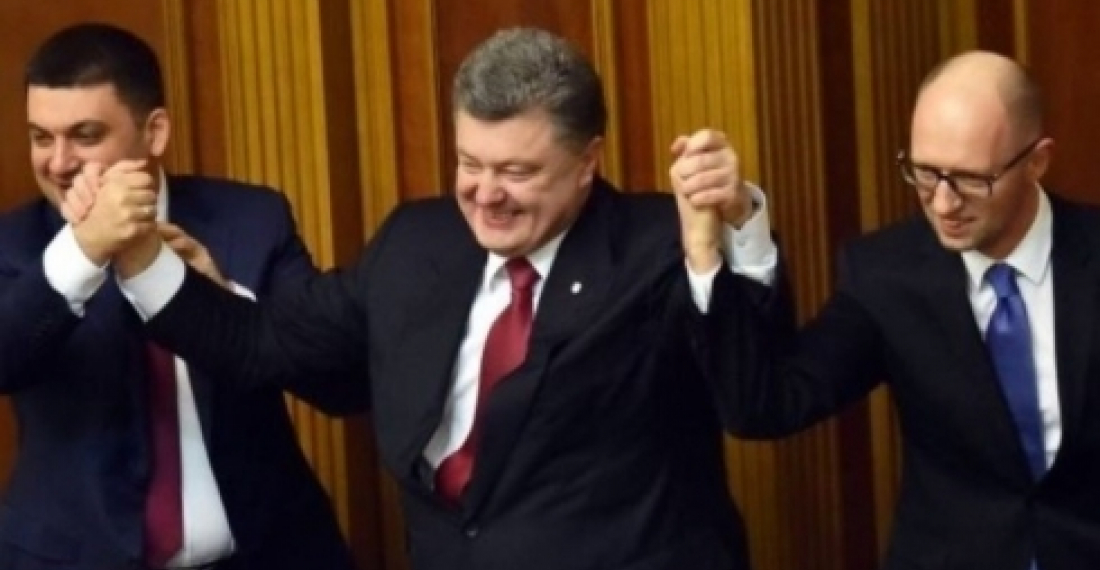
Украина шлет мощный сигнал единства на заседании нового парламента.

Политическая элита Украины во время церемонии по случаю заседания нового парламента после прошедших в октябре выборов ясно дала понять России, что они едины в достижении про-европейского курса во внешней политике, и будут сопротивлятся попыткам России расчленить их страну. Первая сессия вновь избранного парламента (Рады) состоялась сегодня в Киеве с участием президента Порошенко. Он также одобрил Арсений Яценюка на новый срок в качестве премьер-министра. Порошенко и Яценюку придется работать совместно, если они хотят провезти важные реформы, которые так необходимы для преодоления хронических экономических проблем Украины, а также коррупции в правительстве.

В своем выступлении президент Порошенко заявил, что для Украины не может быть никакой другой политической системы кроме единого государства, и что народ не поддерживает федерализации.

Президент отметил, что основными проблемами были отсутствие надежных внешних гарантий безопасности, коррумпированность государственного аппарата и судебной системы, безработица, бедность и социальная несправедливость, которые будут, безусловно, использоваться противником с целью дестабилизации ситуации в Украине.

Две трети депутатов парламента (всего 450 мест) проголосовали за Яценюка в качестве главы правительства, эту должность он занимал с весны 2014. Сообщалось, что между Порошенко и Яценюком существуют разногласия касательно разделения портфелей в новом правительстве, о котором будет объявлено в ближайшее время. Однако, демонстрация единства в парламенте посылает ясный сигнал, что президент и премьер-министр, готовы к совместной работе на фоне угроз из России.

Политические партии выступающие в пользу более тесных связей с Европейским Союзом одержали убедительную победу на парламентских выборах в октябре.

источник: commonspace.eu

Фото: Президент Порошенко (в центре) со спикером новой Рады Владимиром Гросманом и премьер-министром Яценюком на первом заседании нового парламента в Киеве, 27 ноября 2014 года.


Related articles

Editor's choice
News
The British prime minister says Europe must "stand on its own two feet" when it comes to defence

The British prime minister says Europe must "stand on its own two feet" when it comes to defence

The UK will deploy a carrier strike group, led by the aircraft carrier HMS Prince of Wales to the Arctic and the High North as part of efforts to bolster security against Russian threats. British prime minister, Sir Keir Starmer announced the deployment in a speech on Saturday (14 February) at the Munich Security Conference. Europe must be ready to fight to protect its people, values, and way of life,  Sir Keir told the Conference. Starmer also called for deeper links and cooperation, including economic ties, between the UK and EU. The PM stressed the continent must "stand on its own two feet" when it comes to defence commitments. "We must build our hard power, because that is the currency of the age," he told the conference. (Click image to read the full story).

Popular

Editor's choice
Interview
Thursday Interview: Murad Muradov

Thursday Interview: Murad Muradov

Today, commonspace.eu starts a new regular weekly series. THURSDAY INTERVIEW, conducted by Lauri Nikulainen, will host  persons who are thinkers, opinion shapers, and implementors in their countries and spheres. We start the series with an interview with Murad Muradov, a leading person in Azerbaijan's think tank community. He is also the first co-chair of the Action Committee for a new Armenian-Azerbaijani Dialogue. Last September he made history by being the first Azerbaijani civil society activist to visit Armenia after the 44 day war, and the start of the peace process. Speaking about this visit Murad Muradov said: "My experience was largely positive. My negative expectations luckily didn’t play out. The discussions were respectful, the panel format bringing together experts from Armenia, Azerbaijan, and Turkey was particularly valuable during the NATO Rose-Roth Seminar in Yerevan, and media coverage, while varied in tone, remained largely constructive. Some media outlets though attempted to represent me as more of a government mouthpiece than an independent expert, which was totally misleading.  Overall, I see these initiatives as important steps in rebuilding trust and normalising professional engagement. The fact that soon a larger Azerbaijani civil society visits to Armenia followed, reinforces the sense that this process is moving in the right direction." (click the image to read the interview in full)

