


Различные мнения царят в России по предстоящей встрече по Карабаху в Сочи
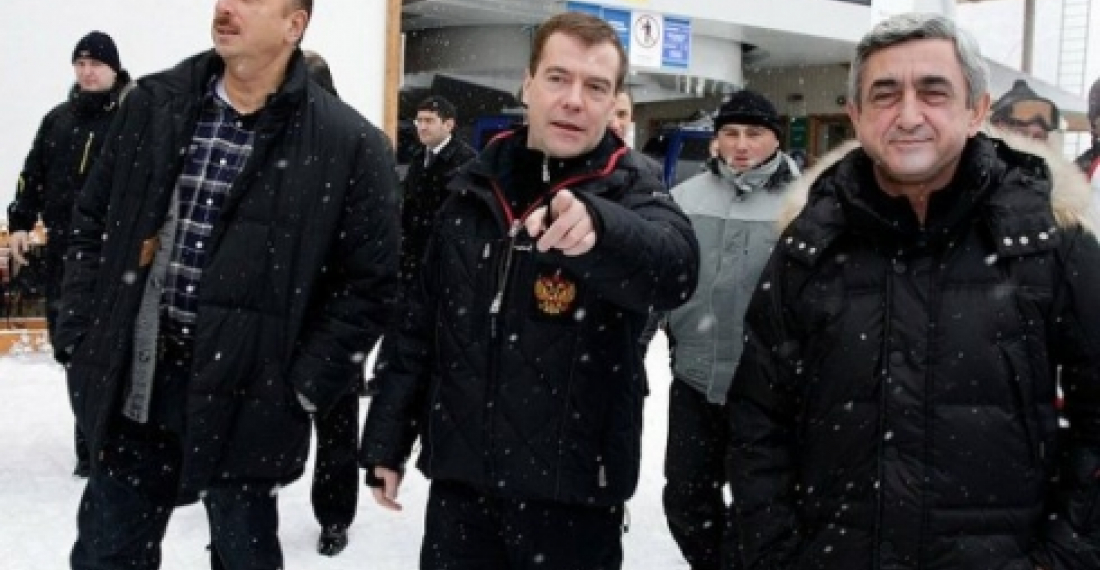
Российские комментаторы выразили различные мнения по поводу решения президента Дмитрия Медведева провести очередную встречу президентов Армении и Азербайджана в Сочи, в понедельник. Все комментаторы выразили сомнения, что встреча принесёт какие-либо ощутимые результаты. Некоторые даже предположили, что это просто попытка президента Медведева сковать в кузнице роль для себя после того, как он покинет свой пост весной.

В статье в российской про правительственной ежедневной газете "Известия" в пятницу (20 января) Константин Затулин, глава Института стран СНГ России, обвинил чиновников  в навязывании своего "нам виднее" без объективного анализа.

В статье, озаглавленной "Еще раз об общем и особенном" Затулин говорит, что "Ответ на вопрос «хотят ли русские войны?» в Нагорном Карабахе и Приднестровье совершенно очевиден в условиях, когда Москва стремится сохранить и Азербайджан, и Молдову как дружественные, суверенные государства в составе СНГ. В отношении Молдовы, на которую явно претендует Румыния, призыв к скорейшему урегулированию и воссозданию общего договорного, федеративного или конфедеративного пространства с Приднестровьем, уже давно стал мантрой нашей политики в регионе: без Приднестровья молдавский астероид рано или поздно свалится на поверхность притягивающей его румынской планеты. Все правильно, казалось бы. Но от великого до смешного один шаг..."

"Можно было бы только аплодировать желанию Президента Дмитрия Медведева взять на Россию главную роль в попытке добиться быстрого прогресса в нагорно-карабахском урегулировании. Если бы это было реально при существующем несовпадении позиций сторон..." Автор добавляет, что "Кругом, в Нагорном Карабахе, Абхазии, Приднестровье, Южной Осетии, мы видим природу заблуждений и успехов  нашей политики в одном и том же –отношении к реальности, в попытках учесть или поправить ее, не считаясь с силами, возможностями и побочными последствиями. Слишком у многих в исполнительной власти желание творить самому, навязывать свое «нам виднее» опасно превышает способность к объективному анализу, развивается на фоне ухода от диалога и дискуссии. Нет никакого иного рецепта, кроме просвещения и общественного контроля – через парламент, если он окажется соответствующим своей роли, и с высоты Первого лица в государстве. Если 4 марта будет избран человек, способный не только царствовать, но и править."

Этот пессимизм контрастирует с эйфорией, предшествующая последней встрече, которую президент Медведев провёл с президентами Армении и Азербайджана, в Казани, в июне 2010 года. Перед этой встречей были большие надежды, что прорыв может быть достигнут, и позднее было сообщено, что Медведев лично был очень разочарован результатами.

В своём комментарии политический редактор Commonspace.eu сказал следующее: "Это не плохо, что встреча в Сочи будет проходить в настроении реализма, а не оптимистичной эйфории. Роли личностей, участвующих в переговорах, является важным, но в итоге позиции настолько укоренившийся, что роль личности не является определяющим фактором. Было очевидно какое-то время, что мирный процесс требует нового подхода, и одним из возможных результатов встречи в понедельник может стать закрытие прошлых глав и подготовка к открытию новых, для будущего. Факт, что стороны продолжают говорить это позитивная вещь и то, что российская дипломатия проявила терпение в отношениях со сторонами, это тоже положительный фактор."

Источник: commonspace.eu по материалам Известия

Фото: Президенты Алиев, Медведев и Саргсян в Сочи в марте 2011 года (фото из архива)

Related articles

Editor's choice
News
Russia adds pressure on Armenia ahead of key elections; recalls Ambassador in Yerevan for consultations

Russia adds pressure on Armenia ahead of key elections; recalls Ambassador in Yerevan for consultations

Ahead of key parliamentary elections,scheduled to be held in Armenia on Sunday, 7 June, Russia continues to attempt to put pressure on the Armenian Government led by prime minister Nikol Pashinyan. On 30 May, Russia recalled its Ambassador to Yerevan for consultations. A terse statement, published on the website of the Russian Foreign Ministry, said, "The Ambassador of the Russian Federation to the Republic of Armenia , S.P. Kopyrkin, has been summoned to Moscow for consultations in connection with the steps taken by the Armenian leadership to move closer to the European Union, which are detrimental to cooperation within the EAEU." This followed a statement issued the day before, by the leaders of the Eurasian Economic Union (EAEU) that challenges the Armenian trajectory towards approximating to the European Union. Vladimir Putin is undertood to have personally pushed the other four EAEU leaders to issue the statement, which said: "Taking into account the significant risks to the economic security of the member states of the Eurasian Economic Union (hereinafter referred to as the Union) arising in connection with the preparation of the Republic of Armenia for accession to the European Union, as well as the need to prevent the associated damage to the member states of the Union: decided that the members of the Eurasian Intergovernmental Council from the Republic of Belarus, the Republic of Kazakhstan, the Kyrgyz Republic and the Russian Federation will report at the next meeting of the Supreme Eurasian Economic Council in December 2026 on the possible consequences of the suspension of the Treaty on the Eurasian Economic Union with respect to the Republic of Armenia. We share the position on the need to hold a national referendum in the Republic of Armenia as soon as possible on joining the European Union or continuing to be part of the Eurasian Economic Union."
Editor's choice
News
The leaders of the states of the Eurasian Economic Union issued a tough statement warning fellow-member state Armenia of the consequences of its desire to join the European Union.

The leaders of the states of the Eurasian Economic Union issued a tough statement warning fellow-member state Armenia of the consequences of its desire to join the European Union.

The leaders of the states of the Eurasian Economic Union (EEAS) issued a tough statement warning fellow-member state Armenia of the consequences of its desire to join the European Union. The stark, sharply worded,  warning, comes days before crucial parliamentary elections in Armenia, scheduled for 7 June. The full statement said, “We, the Presidents of the Republic of Belarus, the Republic of Kazakhstan, the Kyrgyz Republic and the Russian Federation, Taking into account the actions of the Republic of Armenia aimed at joining the European Union, including the approval in 2025 by the National Assembly of the Republic of Armenia and the signing by the President of the Republic of Armenia of the Law of the Republic of Armenia "On the Start of the Process of Accession of the Republic of Armenia to the European Union", as well as the confirmation by the European Union of the European aspirations of the Government of the Republic of Armenia, expressed in the joint declaration following the first Armenia-European Union summit, adopted on 5 May 2026, Taking into account the significant risks to the economic security of the member states of the Eurasian Economic Union (hereinafter referred to as the Union) arising in connection with the preparation of the Republic of Armenia for accession to the European Union, as well as the need to prevent the associated damage to the member states of the Union: decided that the members of the Eurasian Intergovernmental Council from the Republic of Belarus, the Republic of Kazakhstan, the Kyrgyz Republic and the Russian Federation will report at the next meeting of the Supreme Eurasian Economic Council in December 2026 on the possible consequences of the suspension of the Treaty on the Eurasian Economic Union with respect to the Republic of Armenia. We share the position on the need to hold a national referendum in the Republic of Armenia as soon as possible on joining the European Union or continuing to be part of the Eurasian Economic Union. Astana, May 29, 2026” A meeting of the Supreme Eurasian Economic Council was held in Astana, Kazakhstan, on May 29, 2026. The meeting of the Supreme Eurasian Economic Council in a restricted format was attended by Russian President Vladimir Putin, Belarusian President Alexander Lukashenko , Kazakh President Kassym-Jomart Tokayev , Kyrgyz President Sadyr Japarov , Armenian Deputy Prime Minister Mher Grigoryan, and Chairman of the Board of the Eurasian Economic Commission Bakytzhan Sagintayev. From the Russian side, the meeting was also attended by Deputy Prime Minister and member of the Council of the Eurasian Economic Commission Alexey Overchuk and Presidential Aide Yury Ushakov . The heads of delegations from EAEU observer states, including President of Uzbekistan Shavkat Mirziyoyev , Vice President of Cuba Salvador Valdés Mesa, Minister of Industry, Mines, and Trade of Iran Mohammad Atabak, and CIS Secretary General Sergei Lebedev, joined the expanded meeting . Following the meeting of the Supreme Eurasian Economic Council, a number of documents were signed .

Popular

Editor's choice
Interview
Thursday Interview: Murad Muradov

Thursday Interview: Murad Muradov

Today, commonspace.eu starts a new regular weekly series. THURSDAY INTERVIEW, conducted by Lauri Nikulainen, will host  persons who are thinkers, opinion shapers, and implementors in their countries and spheres. We start the series with an interview with Murad Muradov, a leading person in Azerbaijan's think tank community. He is also the first co-chair of the Action Committee for a new Armenian-Azerbaijani Dialogue. Last September he made history by being the first Azerbaijani civil society activist to visit Armenia after the 44 day war, and the start of the peace process. Speaking about this visit Murad Muradov said: "My experience was largely positive. My negative expectations luckily didn’t play out. The discussions were respectful, the panel format bringing together experts from Armenia, Azerbaijan, and Turkey was particularly valuable during the NATO Rose-Roth Seminar in Yerevan, and media coverage, while varied in tone, remained largely constructive. Some media outlets though attempted to represent me as more of a government mouthpiece than an independent expert, which was totally misleading.  Overall, I see these initiatives as important steps in rebuilding trust and normalising professional engagement. The fact that soon a larger Azerbaijani civil society visits to Armenia followed, reinforces the sense that this process is moving in the right direction." (click the image to read the interview in full)



