


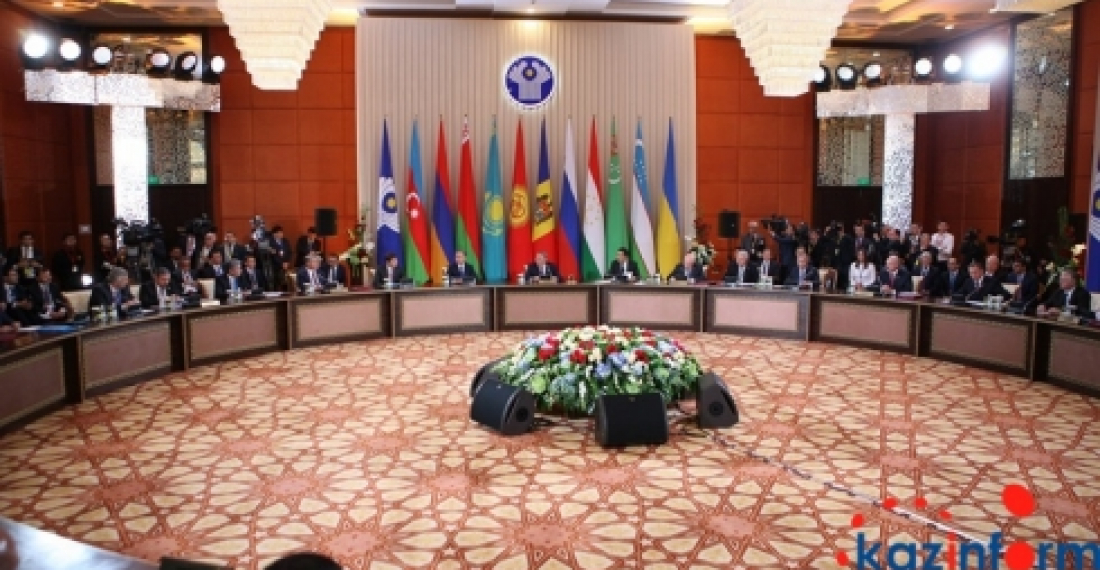
Экономические вопросы возглавили повестку дня на саммите СНГ в Казахстане

В пятницу, 16 октября, в Казахстане был проведен саммит Содружества Независимых Государств (СНГ) с участием президента России Владимира Путина и других глав и правительств государств-членов. Повестку дня возглавили экономические вопросы.

Исходящий председатель СНГ, президент Казахстана Нурсултан Назарбаев, на заседании глав государств СНГ сказал, что "Честно признаюсь, что нам выпало трудное время с экономической точки зрения, но мы старались выполнить свою миссию."

Он отметил, что в Астане пройдет десятый юбилейный форум творческой научной интеллигенции государств СНГ, также в Душанбе состоится заседание Совета глав правительств СНГ.

"Этими мероприятиями мы завершаем свое председательство. Пользуясь случаем, хочу поблагодарить всех наших партнеров за понимание, поддержку нашего председательствования в СНГ", - сказал Назарбаев.

Председательствующей страной в СНГ в 2016 году станет Кыргызстан и следующее заседание глав государств СНГ пройдет в Кыргызстане 16 сентября 2016 года.

В своем выступлении Президент России Владимир Путин также сосредоточился на экономических вопросах. Путин предложил лидерам "более активно переходить на использование наднациональных валют во взаиморасчетах".

Президент России напомнил о соглашении о зоне свободной торговли СНГ, подписанном в 2011 году: "Нужно в полной мере раскрыть его потенциал и максимально упростить условия для движения товарных и инвестиционных потоков," сказал Путин. Он отметил, что "совокупный ВВП стран Содружества в первом полугодии 2015 года снизился, так же как инвестиции в основной капитал." "Товарооборот между нашими странами также просел. В этой ситуации необходимо продумать комплекс мер по снижению зависимости национальных экономик от внешних рынков и подумать об оживлении деловых связей внутри самого Содружества," добавил он.

Путин отметил, что Россия завершает ратификацию Соглашения об интегрированном валютном рынке Содружества. "Соглашение было подписано в Ашхабаде в декабре 2012 года Арменией, Белоруссией, Казахстаном, Киргизией, Россией и Таджикистаном. Вступление в силу этого документа позволит вести согласованную валютную политику, а в перспективе, может быть, и сформировать общий финансовый рынок СНГ", сказал президент России.

источник: commonspace.eu по материалам агентства Казинформ (Казахстан) и ИТАР-ТАСС (Россия).

фото: Открытие заседния Совета глав правительств СНГ в Боровом, в Казахстане, в пятницу, 16 октября 2015 года (фото любезно предоставлено агентством Казинформ).


 

Related articles

Editor's choice
News
Women emerge favourite to lead United Nations from next year, after straw-poll of UN Security Council members

Women emerge favourite to lead United Nations from next year, after straw-poll of UN Security Council members

​ Two women have emerged as favourite to lead the United Nations as Secretary-General from 1 January 2027, when the term of the present incumbent, Antonio Gutteres, expires. A straw poll of the members of the UN Security Council, held on Thursday, 30 July showed that of the seven candidates, Rebecca Grynspan of Costa Rica and Carolyn Rodriguez-Birkett of Guyana received ten and nine positive endorsements respectively, by the 15 members UN Security Council Although the poll and its result are supposed to be secret, the result leaked within minutes, and was carried on world media outlets, such as Reuters. The result was as follows   Michelle Bachelet 6 encourage 5  discourage   4 no opinion María Fernanda Espinosa 5 2 8 Rafael Grossi 7 2 6 Rebeca Grynspan 10 1 4 Olara Otunnu 2 5 8 Carolyn Rodrigues-Birkett 9 2 4 Macky Sall 6 7 2   Article 97 of the UN Charter states that the “Secretary-General shall be appointed by the General Assembly upon the recommendation of the Security Council”. Straw polls are informal ballots used to determine the viability of Secretary-General candidates.  The seven current candidates are: Michelle Bachelet Jeria (Chile), who was nominated by Brazil, Chile, and Mexico on 2 February, with Chile withdrawing its nomination on 24 March; María Fernanda Espinosa Garcés (Ecuador), who was nominated by Antigua and Barbuda on 11 May; Rafael Mariano Grossi (Argentina), who was nominated by Argentina on 26 November 2025; Rebeca Grynspan Mayufis (Costa Rica), who was nominated by Costa Rica on 3 March; Olara Otunnu (Uganda), who was nominated by Uganda on 24 July; Carolyn Rodrigues Birkett (Guyana), who was nominated by Guyana on 15 June; and Macky Sall (Senegal), who was nominated by Burundi on 2 March. At Thursday's straw poll, there was no difference between the ballots presented to the five permanent members (P5) and the ten elected members (E10). Council members received one ballot per candidate, containing the candidate’s name followed by three options: “encouraged”, “discouraged”, and “no opinion expressed”.   It is ofcourse early days, and the straw poll is just an informal indication of the mood of the UN Security Council, but the strong showwing by the two womencandidates may be an indication that for the first time, the head of the UN can be a women. (click image to read more) ​

Popular

Editor's choice
Interview
Thursday Interview: Murad Muradov

Thursday Interview: Murad Muradov

Today, commonspace.eu starts a new regular weekly series. THURSDAY INTERVIEW, conducted by Lauri Nikulainen, will host  persons who are thinkers, opinion shapers, and implementors in their countries and spheres. We start the series with an interview with Murad Muradov, a leading person in Azerbaijan's think tank community. He is also the first co-chair of the Action Committee for a new Armenian-Azerbaijani Dialogue. Last September he made history by being the first Azerbaijani civil society activist to visit Armenia after the 44 day war, and the start of the peace process. Speaking about this visit Murad Muradov said: "My experience was largely positive. My negative expectations luckily didn’t play out. The discussions were respectful, the panel format bringing together experts from Armenia, Azerbaijan, and Turkey was particularly valuable during the NATO Rose-Roth Seminar in Yerevan, and media coverage, while varied in tone, remained largely constructive. Some media outlets though attempted to represent me as more of a government mouthpiece than an independent expert, which was totally misleading.  Overall, I see these initiatives as important steps in rebuilding trust and normalising professional engagement. The fact that soon a larger Azerbaijani civil society visits to Armenia followed, reinforces the sense that this process is moving in the right direction." (click the image to read the interview in full)

