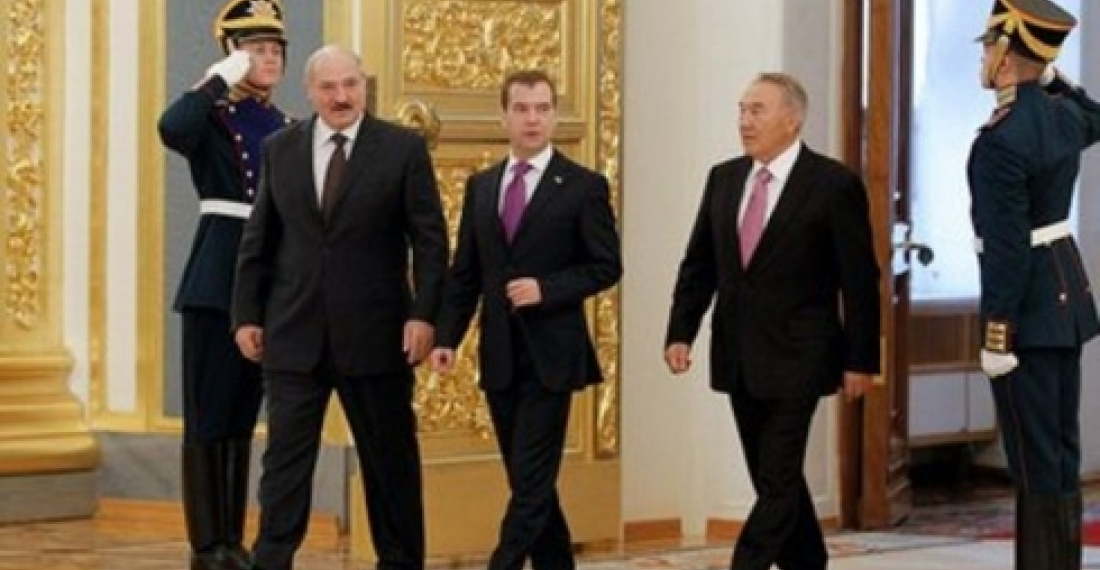
"ДАВАЙТЕ НЕ БУДЕМ ЗАБЕГАТЬ ВПЕРЕД" Соглашение о Евразийском экономическом союзе было подписано в Москве.

Президенты России, Казахстана и Белорусси, Дмитрий Медведев, Нурсултан Назарбаев и Александр Лукашенко вчера на церемонии в Кремле подписали Декларацию о Евразийской экономической интеграции, Договор о Евразийской экономической комиссии и резолюцию Правил по Евразийской экономической комиссии.

Выступая после церемонии подписания президент России не исключил, что Евразийский экономический союз может быть полностью создан к 2015 году. "Если созреют предпосылки – будем двигаться быстрее, если сможем. Не будем забегать вперёд, не будем суетиться, совершать лишних действий, но если будут созревать для этого возможности, будем двигаться быстрее.", сказал он. Президент Медведев также добавил, что некоторые соседние страны были заинтересованы в участии в новом экономическом союзе.

"Сама жизнь подсказывает, что наше многоплановое взаимодействие – это огромный общий ресурс, поэтому интерес к новой интеграционной структуре проявляют и другие партнёры по ЕврАзЭС, по СНГ.", сказал он.

Президент России заявил, что "И следующий этап (он тоже всем понятен) – это создание к 2015 году Евразийского экономического союза. Мы тоже сейчас это обсуждали. Если созреют предпосылки – будем двигаться быстрее, если сможем. Не будем забегать вперёд, не будем суетиться, совершать лишних действий, но если будут созревать для этого возможности, будем двигаться быстрее. Сегодня мы впервые договорились о формировании наднационального, нейтрального по отношению к нашим странам органа, которому будут передаваться всё новые и новые полномочия. Это, конечно, очень серьёзное решение. Особо отмечу, что механизм принятия решений в рамках Комиссии абсолютно исключает доминирование какой-либо страны над другой. Это равноправная комиссия. Она будет работать, надеюсь, эффективно, а принципы её работы – строиться на рыночных, демократических началах и, надеюсь, будут учитывать лучший мировой интеграционный опыт."

Россия лидер говорил о Европейском Союзе и о евро, отвечая на вопросы журналистов после церемонии. Он сказал, что "несмотря на большие трудности, которые сегодня переживает Евросоюз и еврозона, это всё-таки очень успешное объединение, которое, по сути, позволило создать большой общий рынок и вывести целый ряд весьма средненьких стран, которые входили в состав Европейского экономического сообщества, на весьма приличный уровень за счёт интеграции, взаимной помощи и поддержки. Я не говорю даже о евро, которое сейчас находится под ударом. Но скажу одну вещь, о которой говорил неоднократно и на «двадцатке», и в других форматах: если бы не евро, я не знаю, как бы мир справился с кризисом, который разразился в 2008 году, только за счёт одного доллара в качестве резервной валюты. Но у евро есть свои проблемы, связанные с тем, что евро обслуживает не только очень сильные экономики, развитые экономики, но и экономики значительно более слабые или же попавшие в силу определённых проблем и некачественного управления в тяжёлую ситуацию."

Медведев подчеркнул, что новый союз будет основан на принципах равенства: "Особо отмечу, что механизм принятия решений в рамках [Евразийской экономической] Комиссии абсолютно исключает доминирование какой-либо страны над другой. Это равноправная комиссия. Она будет работать, надеюсь, эффективно, а принципы её работы – строиться на рыночных, демократических началах и, надеюсь, будут учитывать лучший мировой интеграционный опыт."

Источник: commonspace.eu

Фото: Любезно предоставлено пресс-службой Президента России

Related articles

Editor's choice
News
Russia adds pressure on Armenia ahead of key elections; recalls Ambassador in Yerevan for consultations

Russia adds pressure on Armenia ahead of key elections; recalls Ambassador in Yerevan for consultations

Ahead of key parliamentary elections,scheduled to be held in Armenia on Sunday, 7 June, Russia continues to attempt to put pressure on the Armenian Government led by prime minister Nikol Pashinyan. On 30 May, Russia recalled its Ambassador to Yerevan for consultations. A terse statement, published on the website of the Russian Foreign Ministry, said, "The Ambassador of the Russian Federation to the Republic of Armenia , S.P. Kopyrkin, has been summoned to Moscow for consultations in connection with the steps taken by the Armenian leadership to move closer to the European Union, which are detrimental to cooperation within the EAEU." This followed a statement issued the day before, by the leaders of the Eurasian Economic Union (EAEU) that challenges the Armenian trajectory towards approximating to the European Union. Vladimir Putin is undertood to have personally pushed the other four EAEU leaders to issue the statement, which said: "Taking into account the significant risks to the economic security of the member states of the Eurasian Economic Union (hereinafter referred to as the Union) arising in connection with the preparation of the Republic of Armenia for accession to the European Union, as well as the need to prevent the associated damage to the member states of the Union: decided that the members of the Eurasian Intergovernmental Council from the Republic of Belarus, the Republic of Kazakhstan, the Kyrgyz Republic and the Russian Federation will report at the next meeting of the Supreme Eurasian Economic Council in December 2026 on the possible consequences of the suspension of the Treaty on the Eurasian Economic Union with respect to the Republic of Armenia. We share the position on the need to hold a national referendum in the Republic of Armenia as soon as possible on joining the European Union or continuing to be part of the Eurasian Economic Union."
Editor's choice
News
The leaders of the states of the Eurasian Economic Union issued a tough statement warning fellow-member state Armenia of the consequences of its desire to join the European Union.

The leaders of the states of the Eurasian Economic Union issued a tough statement warning fellow-member state Armenia of the consequences of its desire to join the European Union.

The leaders of the states of the Eurasian Economic Union (EEAS) issued a tough statement warning fellow-member state Armenia of the consequences of its desire to join the European Union. The stark, sharply worded,  warning, comes days before crucial parliamentary elections in Armenia, scheduled for 7 June. The full statement said, “We, the Presidents of the Republic of Belarus, the Republic of Kazakhstan, the Kyrgyz Republic and the Russian Federation, Taking into account the actions of the Republic of Armenia aimed at joining the European Union, including the approval in 2025 by the National Assembly of the Republic of Armenia and the signing by the President of the Republic of Armenia of the Law of the Republic of Armenia "On the Start of the Process of Accession of the Republic of Armenia to the European Union", as well as the confirmation by the European Union of the European aspirations of the Government of the Republic of Armenia, expressed in the joint declaration following the first Armenia-European Union summit, adopted on 5 May 2026, Taking into account the significant risks to the economic security of the member states of the Eurasian Economic Union (hereinafter referred to as the Union) arising in connection with the preparation of the Republic of Armenia for accession to the European Union, as well as the need to prevent the associated damage to the member states of the Union: decided that the members of the Eurasian Intergovernmental Council from the Republic of Belarus, the Republic of Kazakhstan, the Kyrgyz Republic and the Russian Federation will report at the next meeting of the Supreme Eurasian Economic Council in December 2026 on the possible consequences of the suspension of the Treaty on the Eurasian Economic Union with respect to the Republic of Armenia. We share the position on the need to hold a national referendum in the Republic of Armenia as soon as possible on joining the European Union or continuing to be part of the Eurasian Economic Union. Astana, May 29, 2026” A meeting of the Supreme Eurasian Economic Council was held in Astana, Kazakhstan, on May 29, 2026. The meeting of the Supreme Eurasian Economic Council in a restricted format was attended by Russian President Vladimir Putin, Belarusian President Alexander Lukashenko , Kazakh President Kassym-Jomart Tokayev , Kyrgyz President Sadyr Japarov , Armenian Deputy Prime Minister Mher Grigoryan, and Chairman of the Board of the Eurasian Economic Commission Bakytzhan Sagintayev. From the Russian side, the meeting was also attended by Deputy Prime Minister and member of the Council of the Eurasian Economic Commission Alexey Overchuk and Presidential Aide Yury Ushakov . The heads of delegations from EAEU observer states, including President of Uzbekistan Shavkat Mirziyoyev , Vice President of Cuba Salvador Valdés Mesa, Minister of Industry, Mines, and Trade of Iran Mohammad Atabak, and CIS Secretary General Sergei Lebedev, joined the expanded meeting . Following the meeting of the Supreme Eurasian Economic Council, a number of documents were signed .

Popular

Editor's choice
Interview
Thursday Interview: Murad Muradov

Thursday Interview: Murad Muradov

Today, commonspace.eu starts a new regular weekly series. THURSDAY INTERVIEW, conducted by Lauri Nikulainen, will host  persons who are thinkers, opinion shapers, and implementors in their countries and spheres. We start the series with an interview with Murad Muradov, a leading person in Azerbaijan's think tank community. He is also the first co-chair of the Action Committee for a new Armenian-Azerbaijani Dialogue. Last September he made history by being the first Azerbaijani civil society activist to visit Armenia after the 44 day war, and the start of the peace process. Speaking about this visit Murad Muradov said: "My experience was largely positive. My negative expectations luckily didn’t play out. The discussions were respectful, the panel format bringing together experts from Armenia, Azerbaijan, and Turkey was particularly valuable during the NATO Rose-Roth Seminar in Yerevan, and media coverage, while varied in tone, remained largely constructive. Some media outlets though attempted to represent me as more of a government mouthpiece than an independent expert, which was totally misleading.  Overall, I see these initiatives as important steps in rebuilding trust and normalising professional engagement. The fact that soon a larger Azerbaijani civil society visits to Armenia followed, reinforces the sense that this process is moving in the right direction." (click the image to read the interview in full)