


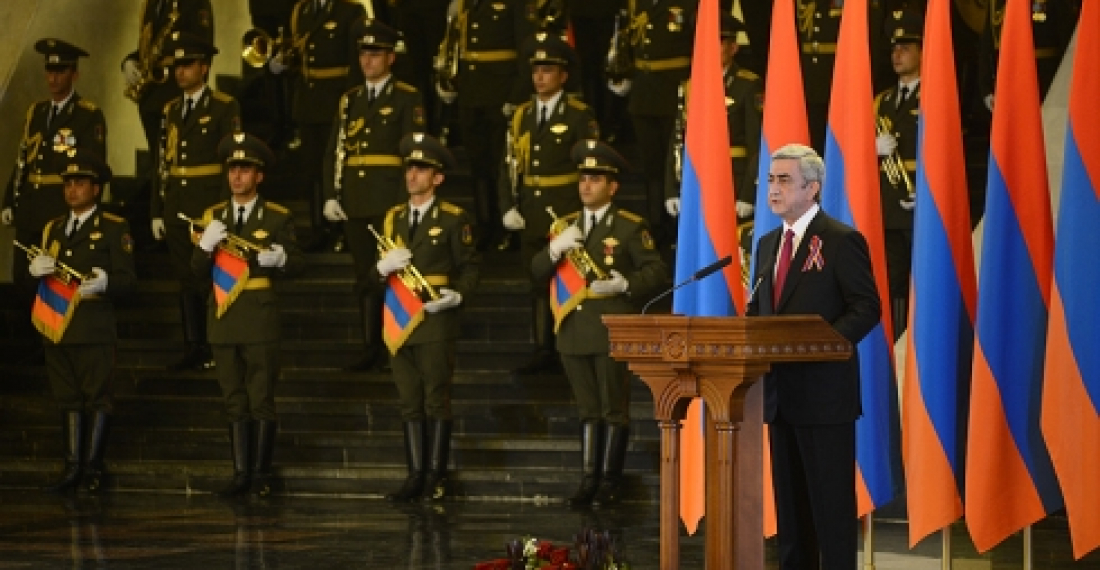
Армения отмечает День Независимости. В своем выступлении президент Серж Саргсян заявил, что Армении "необходимы надежная оборона, мирный труд и стабильное развитие".

В субботу Армения отпраздновала 22-ую годовщину своей независимости. Президент Серж Саргсян посетил пантеон Ераблур, чтобы воздать должное памяти тех, кто отдал свою жизнь за независимость Армении.

Его сопровождали Католикос всех армян Гарегин II, а также президент Нагорно-Карабахской Республики Бако Саакян и другие высокопоставленные официальные лица Армении. Президент Саргсян выступил с речью перед собравшимися гостями на приеме в спортивно-концертном комплексе им. Карена Демирчяна, во время которой он рассказал о видении, которым руководствуются нынешние власти Армении в своих стремлениях.

Президент заявил:

"Наш народ очень долго был вынужден решать задачи не развития, а, в первую очередь, выживания. Сегодня наши задачи изменились: ныне мы воплощаем в жизнь программы укрепления и развития армянского государства. Несомненно, безопасность является приоритетом номер один для всех в мире, и мы не являемся исключением из этого правила. Вопросы безопасности сегодня, как и всегда, будут в центре нашего первоочередного внимания. Мы постоянно ищем пути для придания нового импульса подъему нашей экономики. И тут есть результаты. Мы ставим задачи расширения границ возможного, чтобы суметь с четкой периодичностью ежегодно повышать зарплаты и пенсии. Параллельно с этим, осуществляем реформы, которые последовательно обеспечивают укрепление демократии, верховенства закона, повышение качества государственного управления так же, как и по всем другим направлениям. Наша политика направлена на решение именно этих задач.

Подходы властей Армении, так же, как и всего нашего общества, однозначны. Мы сыты войной, потрясениями, резкими поворотами и авантюрами. Нам необходимы надежная оборона, мирный труд и стабильное развитие. Мы сейчас заняты именно этим. Может, подчас медленно, может, подчас и совершаем ошибки, но точно не в самом главном, точно не по судьбоносным вопросам.

Армянское государство символизирует осуществление армянской мечты. В этом величайший смысл сегодняшнего праздника. С восстановлением независимости в 1991 году стала реальностью извечная мечта нашего народа. Наши братья и сестры из Диаспоры и, в первую очередь, граждане Армении являются питательной средой для этой ставшей реальностью их мечты. В состоянии ли мы в современном мире поднять на новые высоты нашу осуществившуюся мечту? Да, если не будем переоценивать и недооценивать наши силы. Для идущего горными тропами необходимо заранее верно оценить все участки пути."

Политический редактор Commonspace.eu в своем комментарии сообщает:

"Это была первая годовщина независимости после переизбрания президента Саргсяна на второй срок в начале этого года. В своем выступлении в День Независимости президент призвал нацию помнить стоикость прошлых лет, и быть уверенным в будущем, давая понять, что «суверенитет - обстоятельство, неизменное в любой ситуации». Армения сталкивается с рядом проблем в плане ее внутренней политической системы, ее экономики, и также ее безопасности. Речь Саргсяна призвана объединить армян вокруг основной идеи государственности. Саргсян осторожный политик, и это отражается в его речи. Его слова - "Уже двадцать два года мы движемся по новому пути, который зачастую узок и каменист, как наши горные тропы. Мы движемся осторожно и оглядываясь, потому что на наших плечах лежит огромная ответственность." - вероятно являются посланием адресованным его критикам, которые обвиняют его в застое и, которые хотят видеть быстрых перемен в стране".


Источник: commonspace.eu

Фото: Президент Саргсян в День Независимости Армении. Ереван, 21 сентября 2013 г. (Фото предоставлено пресс-службой президента Армении).
Related articles

Editor's choice
News
Pope Leo XIV, has called on world leaders to lay down their weapons and choose “encounter” over domination

Pope Leo XIV, has called on world leaders to lay down their weapons and choose “encounter” over domination

The leader of the Catholic Church, Pope Leo XIV, has called on world leaders to lay down their weapons and choose “encounter” over domination. “Let those who have weapons lay them down!”, the Pope urged on Easter Sunday in his traditional Urbi et Orbi message. Speaking to the tens of thousands of pilgrims gathered in St Peter's Square, Pope Leo urged "those who have the power to unleash wars" to chose peace.  This should not be a peace “imposed by force”, he stressed, but one achieved through dialogue – “not with the desire to dominate others, but to encounter them”. Pope Leo warned that the world is “growing accustomed to violence”. We are “becoming indifferent”, he said, not only to the deaths of thousands of people, but to the “hatred and division” war causes, as well as its “economic and social consequences”. Borrowing a phrase from the late Pope Francis, Pope Leo warned of the “ever-increasing ‘globalisation of indifference’”. “We cannot continue to be indifferent!”, he urged. “We cannot resign ourselves to evil!”. For this reason, he said, he would be leading a prayer vigil for peace next Saturday, April 11th, in St Peter’s Basilica.
Editor's choice
News
Israel destroys 17 UNIFIL Cameras

Israel destroys 17 UNIFIL Cameras

Israeli forces destroyed 17 surveillance cameras linked to the United Nations peacekeepers’ main headquarters in southern Lebanon in 24 hours, a UN security official told AFP on Saturday. Since the start of the Israel-Hezbollah war on March 2, the UN Interim Force in Lebanon (UNIFIL) has been caught in the crossfire in the country’s south, with Hezbollah launching attacks on Israel and its troops, and Israeli forces pushing into border towns. The official, who requested anonymity, said “17 of the headquarters’ cameras have been destroyed by the Israeli army” in the coastal town of Naqura. UNIFIL spokeswoman Kandice Ardiel told AFP on Saturday that “the cameras appear to have been destroyed by some kind of laser.” She added that “(Israeli) soldiers are present in Naqura and have been undertaking massive demolitions of buildings in the village this week.” Earlier this week, Ardiel told AFP that “not only have these demolitions destroyed civilian homes and businesses, but the strength of the blasts have caused damage to UNIFIL’s headquarters.” Three Indonesian peacekeepers from the UN force have been killed in two separate incidents over the past week. UNIFIL also reported Friday an “explosion” in one of its bases near Odaisseh in south Lebanon that wounded three personnel, adding that they “do not yet know the origin of the explosion.” The Israeli army accused Hezbollah of firing “a rocket that landed in a UNIFIL outpost.” The UN office in Jakarta said on Saturday the wounded were Indonesian. Indonesia condemned the incident as “unacceptable,” saying “these events underscore the urgent need to strengthen protection for UN peacekeeping forces amid an increasingly dangerous conflict situation.” According to the UN, 97 force members have been killed in violence since its establishment in 1978 to monitor the withdrawal of Israeli forces after they invaded Lebanon.

Popular

Editor's choice
Interview
Thursday Interview: Murad Muradov

Thursday Interview: Murad Muradov

Today, commonspace.eu starts a new regular weekly series. THURSDAY INTERVIEW, conducted by Lauri Nikulainen, will host  persons who are thinkers, opinion shapers, and implementors in their countries and spheres. We start the series with an interview with Murad Muradov, a leading person in Azerbaijan's think tank community. He is also the first co-chair of the Action Committee for a new Armenian-Azerbaijani Dialogue. Last September he made history by being the first Azerbaijani civil society activist to visit Armenia after the 44 day war, and the start of the peace process. Speaking about this visit Murad Muradov said: "My experience was largely positive. My negative expectations luckily didn’t play out. The discussions were respectful, the panel format bringing together experts from Armenia, Azerbaijan, and Turkey was particularly valuable during the NATO Rose-Roth Seminar in Yerevan, and media coverage, while varied in tone, remained largely constructive. Some media outlets though attempted to represent me as more of a government mouthpiece than an independent expert, which was totally misleading.  Overall, I see these initiatives as important steps in rebuilding trust and normalising professional engagement. The fact that soon a larger Azerbaijani civil society visits to Armenia followed, reinforces the sense that this process is moving in the right direction." (click the image to read the interview in full)

