Алиев: "Эта ситуация нетерпима, неприемлема и должна быть изменена!"
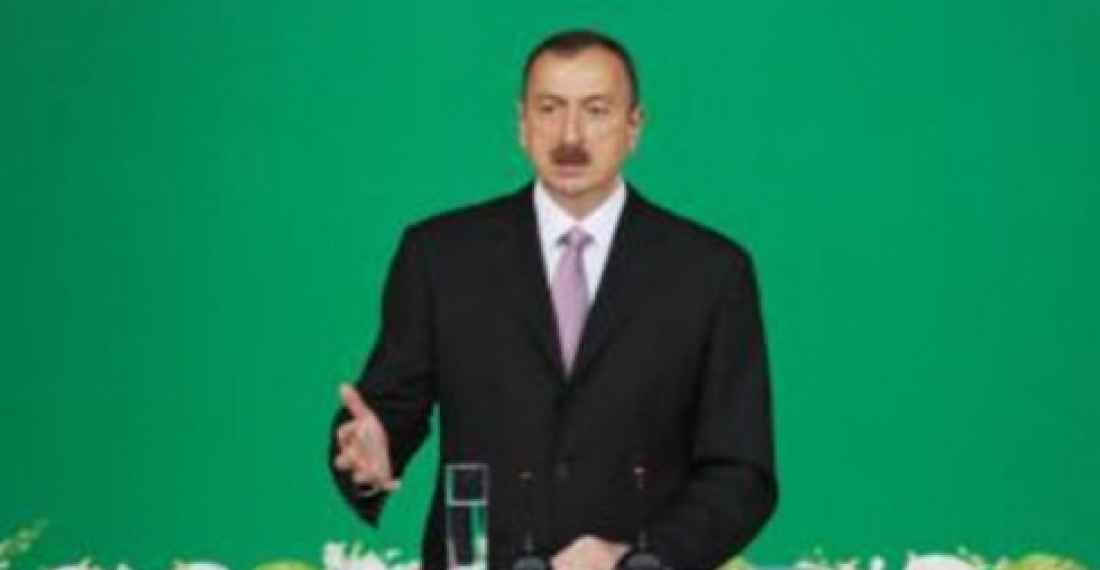
Президент Азербайджана Ильхам Алиев изложил мнение его страны по текущему состоянию дел в отношении нагорно-карабахского конфликта. Президент выступил на торжественном приеме по случаю национального праздника Азербайджана – Дня Республики.

Алиев заявил, что Армения игнорирует нормы международного права, не следует заявлениям глав государств стран-сопредседателей Минской группы, хочет как можно дольше сохранить статус-кво неизменным, неискренне ведет себя на переговорах. Президент отметил, что многочисленные усилия Азербайджана остались без ответа.

Президент сказал: "Как вам известно, Азербайджан дал свое согласие на обновленные Мадридские принципы, предложенные Минской группой в конце 2009 года. Посчитал, что эти принципы могут стать основой для большого мирного соглашения. Предложил, что нужно не медля, не теряя времени вести работу над большим мирным соглашением. Армения же отвергла эти предложения, а в последующий период мобилизовала все возможности, чтобы на переговорах возникла и укрепилась эта застойная ситуация."

Ильхам Алиев добавил, что "Азербайджан является стороной, наиболее заинтересованной в решении вопроса. Армения же просто пытается затянуть время. Если их политики примут во внимание интересы Армении, то увидят, что затягивание времени ввергнет их в еще более сложную ситуацию. Но, несмотря на это, это - тактические шаги. Армения избрала тактику затягивания времени, намерена вести переговоры ради переговоров."

Президент Ильхам Алиев отметил, что посредники в основном сосредоточены на поддержании режима прекращения огня. "Мы тоже хотим сохранить режим прекращения огня. Но в то же время мы хотим восстановить нашу территориальную целостность, требуем этого. Международное право требует этого. Резолюции Совета Безопасности ООН, решения и резолюции других организаций требуют этого. Поэтому здесь интересы Азербайджана в некоторой степени отличаются. Мы тоже хотим, чтобы был мир. Мы тоже хотим, чтобы вопрос был решен мирным путем, но был решен. Армения не хочет решения вопроса, еще раз говорю, хочет как можно дольше сохранить статус-кво. А посредники, к сожалению, в последнее время больше занимаются усилением мер доверия, стабилизацией ситуации на линии соприкосновения войск и другими вопросами, не относящимися непосредственно к существу переговоров. Эта ситуация нетерпима, неприемлема и должна быть изменена. Если переговоры будут вестись, то они должны вестись по существу. А существо заключается в том, что признанная международным сообществом наша территориальная целостность должна быть восстановлена, оккупационные силы должны быть выведены с захваченных земель, Азербайджан должен восстановить свою территориальную целостность."

Президент Азербайджана также говорил о будущем граждан, проживающих в Нагорном Карабахе, и граждан, которые вернуться туда после урегулирования конфликта. "В мире существуют позитивный опыт, автономии, в том числе есть позитивный опыт на Европейском континенте. Не выходя за рамки этого опыта, принцип самоуправления может найти свое решение." Ильхам Алиев подчеркнул, что "Нагорный Карабах – это исконная и историческая азербайджанская земля. Так было всегда. Так это есть сегодня, так это будет и в будущем. В вопросе территориальной целостности со стороны Азербайджана не может быть и не будет ни малейших уступок."

На самом деле выбор здесь не такой уж большой. Либо военный путь, либо мирный путь! Мы готовы к обоим вариантам. Мы никогда не исключали военный путь. Международное право, Устав ООН признает за нами возможности самообороны, и Азербайджан может в любое время провести любую операцию на территориях, признанных международным сообществом как территория Азербайджана. Просто мы пока стараемся, чтобы этот вопрос был решен мирным путем. Считаю, что возможности в этом направлении пока не исчерпаны полностью. Мы должны еще больше активизировать свои усилия, чтобы поскорее и справедливо решить вопрос мирным путем. Мы должны стать и становимся еще сильнее во внешней политике, внутренней политике, в экономической сфере.

"Мы и впредь должны держать Армению в изоляции от всех международных проектов. Эта тактика и эта политика приносят свои плоды. Согласно официальной статистике самой Армении, ежегодно эту страну покидают 80-100 тысяч человек. Покидают навсегда. В этой стране усиливаются тенденции депопуляции, наблюдается демографический кризис. И этот кризис будет постепенно углубляться, так как чем больше трудоспособных людей уезжает оттуда, тем больше сокращаются возможности возродить экономику. Что же касается возрождения экономики, то таких перспектив вообще нет. Там наблюдается период полной стагнации.

Мы должны активизировать свои усилия, усилить нашу страну. Мы должны и будем удерживать Армению в изолированном состоянии. Мы должны, используя все возможности, обрести еще больший потенциал. Это также и военный потенциал. Сегодня Азербайджанская армия является самой сильной армией на Южном Кавказе. Мы неоднократно демонстрировали это, демонстрировали на военных парадах, продемонстрируем вновь.

Наша внешняя политика приносит свои плоды. В итоговых декларациях, подписанных с абсолютным большинством глав государств, с которыми я встречался в двустороннем формате за последние десять лет, отражены принципы территориальной целостности Азербайджана."

Источник: commonspace.eu по материалам агентств

Фото: Ильхам Алиев на национальном празднике Азербайджана - День Республики.

Related articles

Editor's choice
News
Russia adds pressure on Armenia ahead of key elections; recalls Ambassador in Yerevan for consultations

Russia adds pressure on Armenia ahead of key elections; recalls Ambassador in Yerevan for consultations

Ahead of key parliamentary elections,scheduled to be held in Armenia on Sunday, 7 June, Russia continues to attempt to put pressure on the Armenian Government led by prime minister Nikol Pashinyan. On 30 May, Russia recalled its Ambassador to Yerevan for consultations. A terse statement, published on the website of the Russian Foreign Ministry, said, "The Ambassador of the Russian Federation to the Republic of Armenia , S.P. Kopyrkin, has been summoned to Moscow for consultations in connection with the steps taken by the Armenian leadership to move closer to the European Union, which are detrimental to cooperation within the EAEU." This followed a statement issued the day before, by the leaders of the Eurasian Economic Union (EAEU) that challenges the Armenian trajectory towards approximating to the European Union. Vladimir Putin is undertood to have personally pushed the other four EAEU leaders to issue the statement, which said: "Taking into account the significant risks to the economic security of the member states of the Eurasian Economic Union (hereinafter referred to as the Union) arising in connection with the preparation of the Republic of Armenia for accession to the European Union, as well as the need to prevent the associated damage to the member states of the Union: decided that the members of the Eurasian Intergovernmental Council from the Republic of Belarus, the Republic of Kazakhstan, the Kyrgyz Republic and the Russian Federation will report at the next meeting of the Supreme Eurasian Economic Council in December 2026 on the possible consequences of the suspension of the Treaty on the Eurasian Economic Union with respect to the Republic of Armenia. We share the position on the need to hold a national referendum in the Republic of Armenia as soon as possible on joining the European Union or continuing to be part of the Eurasian Economic Union."
Editor's choice
News
The leaders of the states of the Eurasian Economic Union issued a tough statement warning fellow-member state Armenia of the consequences of its desire to join the European Union.

The leaders of the states of the Eurasian Economic Union issued a tough statement warning fellow-member state Armenia of the consequences of its desire to join the European Union.

The leaders of the states of the Eurasian Economic Union (EEAS) issued a tough statement warning fellow-member state Armenia of the consequences of its desire to join the European Union. The stark, sharply worded,  warning, comes days before crucial parliamentary elections in Armenia, scheduled for 7 June. The full statement said, “We, the Presidents of the Republic of Belarus, the Republic of Kazakhstan, the Kyrgyz Republic and the Russian Federation, Taking into account the actions of the Republic of Armenia aimed at joining the European Union, including the approval in 2025 by the National Assembly of the Republic of Armenia and the signing by the President of the Republic of Armenia of the Law of the Republic of Armenia "On the Start of the Process of Accession of the Republic of Armenia to the European Union", as well as the confirmation by the European Union of the European aspirations of the Government of the Republic of Armenia, expressed in the joint declaration following the first Armenia-European Union summit, adopted on 5 May 2026, Taking into account the significant risks to the economic security of the member states of the Eurasian Economic Union (hereinafter referred to as the Union) arising in connection with the preparation of the Republic of Armenia for accession to the European Union, as well as the need to prevent the associated damage to the member states of the Union: decided that the members of the Eurasian Intergovernmental Council from the Republic of Belarus, the Republic of Kazakhstan, the Kyrgyz Republic and the Russian Federation will report at the next meeting of the Supreme Eurasian Economic Council in December 2026 on the possible consequences of the suspension of the Treaty on the Eurasian Economic Union with respect to the Republic of Armenia. We share the position on the need to hold a national referendum in the Republic of Armenia as soon as possible on joining the European Union or continuing to be part of the Eurasian Economic Union. Astana, May 29, 2026” A meeting of the Supreme Eurasian Economic Council was held in Astana, Kazakhstan, on May 29, 2026. The meeting of the Supreme Eurasian Economic Council in a restricted format was attended by Russian President Vladimir Putin, Belarusian President Alexander Lukashenko , Kazakh President Kassym-Jomart Tokayev , Kyrgyz President Sadyr Japarov , Armenian Deputy Prime Minister Mher Grigoryan, and Chairman of the Board of the Eurasian Economic Commission Bakytzhan Sagintayev. From the Russian side, the meeting was also attended by Deputy Prime Minister and member of the Council of the Eurasian Economic Commission Alexey Overchuk and Presidential Aide Yury Ushakov . The heads of delegations from EAEU observer states, including President of Uzbekistan Shavkat Mirziyoyev , Vice President of Cuba Salvador Valdés Mesa, Minister of Industry, Mines, and Trade of Iran Mohammad Atabak, and CIS Secretary General Sergei Lebedev, joined the expanded meeting . Following the meeting of the Supreme Eurasian Economic Council, a number of documents were signed .

Popular

Editor's choice
Interview
Thursday Interview: Murad Muradov

Thursday Interview: Murad Muradov

Today, commonspace.eu starts a new regular weekly series. THURSDAY INTERVIEW, conducted by Lauri Nikulainen, will host  persons who are thinkers, opinion shapers, and implementors in their countries and spheres. We start the series with an interview with Murad Muradov, a leading person in Azerbaijan's think tank community. He is also the first co-chair of the Action Committee for a new Armenian-Azerbaijani Dialogue. Last September he made history by being the first Azerbaijani civil society activist to visit Armenia after the 44 day war, and the start of the peace process. Speaking about this visit Murad Muradov said: "My experience was largely positive. My negative expectations luckily didn’t play out. The discussions were respectful, the panel format bringing together experts from Armenia, Azerbaijan, and Turkey was particularly valuable during the NATO Rose-Roth Seminar in Yerevan, and media coverage, while varied in tone, remained largely constructive. Some media outlets though attempted to represent me as more of a government mouthpiece than an independent expert, which was totally misleading.  Overall, I see these initiatives as important steps in rebuilding trust and normalising professional engagement. The fact that soon a larger Azerbaijani civil society visits to Armenia followed, reinforces the sense that this process is moving in the right direction." (click the image to read the interview in full)