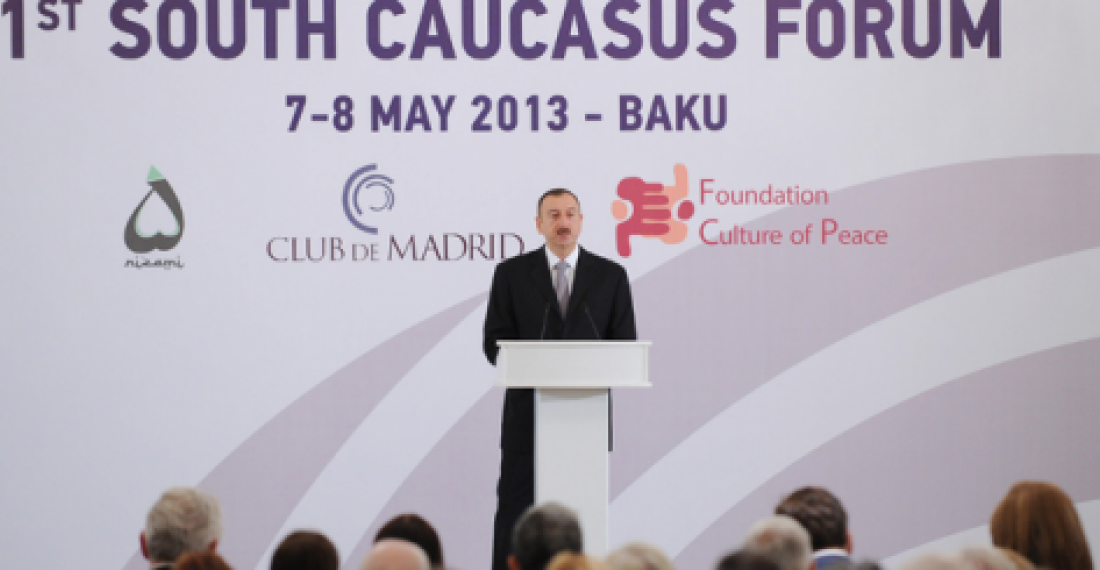
АЛИЕВ: "Демократизация нашего общества является приоритетом для нас." На открытии Первого Южнокавказского Форума в Баку президент Азербайджана сделал редкие для него заявления о демократических реформах.

Президент Азербайджана, Ильхам Алиев, правительство которого в последние месяцы испытывает растущую критику за подавление инакомыслия и активности оппозиции сделал редкое заявление о демократических реформах в своей стране на открытии Первого Южно-кавказского форума в Баку. "Мы проводим политические реформы. Демократизация нашего общества является приоритетом для нас", заявил он участникам.

"Мы реализуем политические реформы, и дальнейшая демократизация общества является для нас одним из главных приоритетов", заявил президент Азербайджана Ильхам Алиев на открытии Первого Южно-Кавказского форума в Баку, сообщает АПА.

"Осуществление политических и экономических реформ должно идти параллельно с целью достижения устойчивого развития. Что касается экономических реформ, то Азербайджан со времени обретения независимости добился в этой сфере огромного прогресса", - заявил президент.

"В течение последних десяти лет ВВП Азербайджана вырос втрое, что является мировым рекордом. В то же время стране удалось сократить уровень бедности с 50 процентов до шести процентов, а уровень безработицы - до пяти процентов. По его словам, экономические достижения Азербайджана не остались незамеченными для международных финансовых институтов."

"Оценка основных международных финансовых институтов является очень позитивной. В годы экономического и финансового кризиса в мире три основных рейтинговых агентства - Fitch, Moody's и Standard & Poors повысили кредитный рейтинг Азербайджана. Давосский международный форум поставил Азербайджан на 46 место в Глобальном индексе конкурентоспособности, и это является отражением реформ в стране", - заявил президент Ильхам Алиев.

Будущее развитие страны с экономической точки зрения выглядит очень привлекательным. Как отметил глава государства, сейчас приоритетными направлениями являются развитие неэнергетического сектора экономики и ее диверсификация. По его словам, первый квартал 2013 года ознаменовался значительным ростом ненефтяного сектора экономики, который превысил 11 процентов. "Это свидетельствует о том, что инвестиции, которые привлечены из-за рубежа и сгенерированы внутри страны, работают на диверсификацию экономики, так как без диверсификации мы не сможем достичь успеха", - сказал Ильхам Алиев.

Ильхам Алиев заявил, что Азербайджан активно инвестирует в современные технологии: "В этом году произошло еще одно знаменательное событие, которым является запуск первого азербайджанского спутника - AzerSpace-1, и это является началом развития космической промышленности в Азербайджане. Запуск Azerspace-1 означает, что появятся второй и третий спутник и так далее. Мы тесно сотрудничаем с нашими международными партнерами в области развития сильной космической промышленности в Азербайджане."

Президент Ильхам Алиев сообщил, что энергетический сектор является основной частью экономики Азербайджана и это естественно, потому что на протяжении многих десятилетий Азербайджан был известен как нефтяная страна, а сейчас еще и как страна, добывающая газ. Инвестиции в энергетический сектор также позволили Азербайджану создать в стране положительный инвестиционный климат. По его словам, по объему иностранных инвестиций, приходящихся на душу населения, Азербайджан занимает лидирующие позиции в регионе. Мы создали механизм, такой как Государственный нефтяной фонд для того, чтобы избежать тяжелых последствий, с которыми сталкиваются некоторые страны. Государственный нефтяной фонд известен как один из самых прозрачных фондов в мире. Этим мы застраховали себя от тяжелых условий. Мы избежали ситуации, когда бедные становятся беднее, а богатые становятся богаче ", сказал он.

Президент Алиев добавил, что инвестиции также осуществляются и в человеческий капитал, особенно в области образования. "Образование является критерием предварительного успеха. История и опыт различных стран показывает, что не только экономический рост, но и интеллектуальный потенциал имеет важное значение. 10 лет назад мы заявили, что мы намерены превратить "черное золото" в человеческий капитал. Диверсификация экономики, реализации социальных проектов, инфраструктурных проектов и перемены, наблюдаемые в Азербайджане, показывают, что у нас есть хороший опыт в области перехода - переход от тоталитарного общества к демократическому обществу, от государственной экономики к частной экономике", сказал он.

Президент Ильхам Алиев отметил, что Азербайджан сегодня является страной с собственными ресурсами и сильными финансовыми возможностями.

"Это означает, что экономический кризис не повлиял на нас. Конечно, все это будет играть важную роль в будущем развитии страны.", сказал он . Глава государства заявил, что энергоресурсов Азербайджана хватит на 100 лет.

Источник: commonspace.eu по материалам AПА.

Фото: Ильхам Алиев
Related articles

Editor's choice
News
Russia adds pressure on Armenia ahead of key elections; recalls Ambassador in Yerevan for consultations

Russia adds pressure on Armenia ahead of key elections; recalls Ambassador in Yerevan for consultations

Ahead of key parliamentary elections,scheduled to be held in Armenia on Sunday, 7 June, Russia continues to attempt to put pressure on the Armenian Government led by prime minister Nikol Pashinyan. On 30 May, Russia recalled its Ambassador to Yerevan for consultations. A terse statement, published on the website of the Russian Foreign Ministry, said, "The Ambassador of the Russian Federation to the Republic of Armenia , S.P. Kopyrkin, has been summoned to Moscow for consultations in connection with the steps taken by the Armenian leadership to move closer to the European Union, which are detrimental to cooperation within the EAEU." This followed a statement issued the day before, by the leaders of the Eurasian Economic Union (EAEU) that challenges the Armenian trajectory towards approximating to the European Union. Vladimir Putin is undertood to have personally pushed the other four EAEU leaders to issue the statement, which said: "Taking into account the significant risks to the economic security of the member states of the Eurasian Economic Union (hereinafter referred to as the Union) arising in connection with the preparation of the Republic of Armenia for accession to the European Union, as well as the need to prevent the associated damage to the member states of the Union: decided that the members of the Eurasian Intergovernmental Council from the Republic of Belarus, the Republic of Kazakhstan, the Kyrgyz Republic and the Russian Federation will report at the next meeting of the Supreme Eurasian Economic Council in December 2026 on the possible consequences of the suspension of the Treaty on the Eurasian Economic Union with respect to the Republic of Armenia. We share the position on the need to hold a national referendum in the Republic of Armenia as soon as possible on joining the European Union or continuing to be part of the Eurasian Economic Union."
Editor's choice
News
The leaders of the states of the Eurasian Economic Union issued a tough statement warning fellow-member state Armenia of the consequences of its desire to join the European Union.

The leaders of the states of the Eurasian Economic Union issued a tough statement warning fellow-member state Armenia of the consequences of its desire to join the European Union.

The leaders of the states of the Eurasian Economic Union (EEAS) issued a tough statement warning fellow-member state Armenia of the consequences of its desire to join the European Union. The stark, sharply worded,  warning, comes days before crucial parliamentary elections in Armenia, scheduled for 7 June. The full statement said, “We, the Presidents of the Republic of Belarus, the Republic of Kazakhstan, the Kyrgyz Republic and the Russian Federation, Taking into account the actions of the Republic of Armenia aimed at joining the European Union, including the approval in 2025 by the National Assembly of the Republic of Armenia and the signing by the President of the Republic of Armenia of the Law of the Republic of Armenia "On the Start of the Process of Accession of the Republic of Armenia to the European Union", as well as the confirmation by the European Union of the European aspirations of the Government of the Republic of Armenia, expressed in the joint declaration following the first Armenia-European Union summit, adopted on 5 May 2026, Taking into account the significant risks to the economic security of the member states of the Eurasian Economic Union (hereinafter referred to as the Union) arising in connection with the preparation of the Republic of Armenia for accession to the European Union, as well as the need to prevent the associated damage to the member states of the Union: decided that the members of the Eurasian Intergovernmental Council from the Republic of Belarus, the Republic of Kazakhstan, the Kyrgyz Republic and the Russian Federation will report at the next meeting of the Supreme Eurasian Economic Council in December 2026 on the possible consequences of the suspension of the Treaty on the Eurasian Economic Union with respect to the Republic of Armenia. We share the position on the need to hold a national referendum in the Republic of Armenia as soon as possible on joining the European Union or continuing to be part of the Eurasian Economic Union. Astana, May 29, 2026” A meeting of the Supreme Eurasian Economic Council was held in Astana, Kazakhstan, on May 29, 2026. The meeting of the Supreme Eurasian Economic Council in a restricted format was attended by Russian President Vladimir Putin, Belarusian President Alexander Lukashenko , Kazakh President Kassym-Jomart Tokayev , Kyrgyz President Sadyr Japarov , Armenian Deputy Prime Minister Mher Grigoryan, and Chairman of the Board of the Eurasian Economic Commission Bakytzhan Sagintayev. From the Russian side, the meeting was also attended by Deputy Prime Minister and member of the Council of the Eurasian Economic Commission Alexey Overchuk and Presidential Aide Yury Ushakov . The heads of delegations from EAEU observer states, including President of Uzbekistan Shavkat Mirziyoyev , Vice President of Cuba Salvador Valdés Mesa, Minister of Industry, Mines, and Trade of Iran Mohammad Atabak, and CIS Secretary General Sergei Lebedev, joined the expanded meeting . Following the meeting of the Supreme Eurasian Economic Council, a number of documents were signed .

Popular

Editor's choice
Interview
Thursday Interview: Murad Muradov

Thursday Interview: Murad Muradov

Today, commonspace.eu starts a new regular weekly series. THURSDAY INTERVIEW, conducted by Lauri Nikulainen, will host  persons who are thinkers, opinion shapers, and implementors in their countries and spheres. We start the series with an interview with Murad Muradov, a leading person in Azerbaijan's think tank community. He is also the first co-chair of the Action Committee for a new Armenian-Azerbaijani Dialogue. Last September he made history by being the first Azerbaijani civil society activist to visit Armenia after the 44 day war, and the start of the peace process. Speaking about this visit Murad Muradov said: "My experience was largely positive. My negative expectations luckily didn’t play out. The discussions were respectful, the panel format bringing together experts from Armenia, Azerbaijan, and Turkey was particularly valuable during the NATO Rose-Roth Seminar in Yerevan, and media coverage, while varied in tone, remained largely constructive. Some media outlets though attempted to represent me as more of a government mouthpiece than an independent expert, which was totally misleading.  Overall, I see these initiatives as important steps in rebuilding trust and normalising professional engagement. The fact that soon a larger Azerbaijani civil society visits to Armenia followed, reinforces the sense that this process is moving in the right direction." (click the image to read the interview in full)