


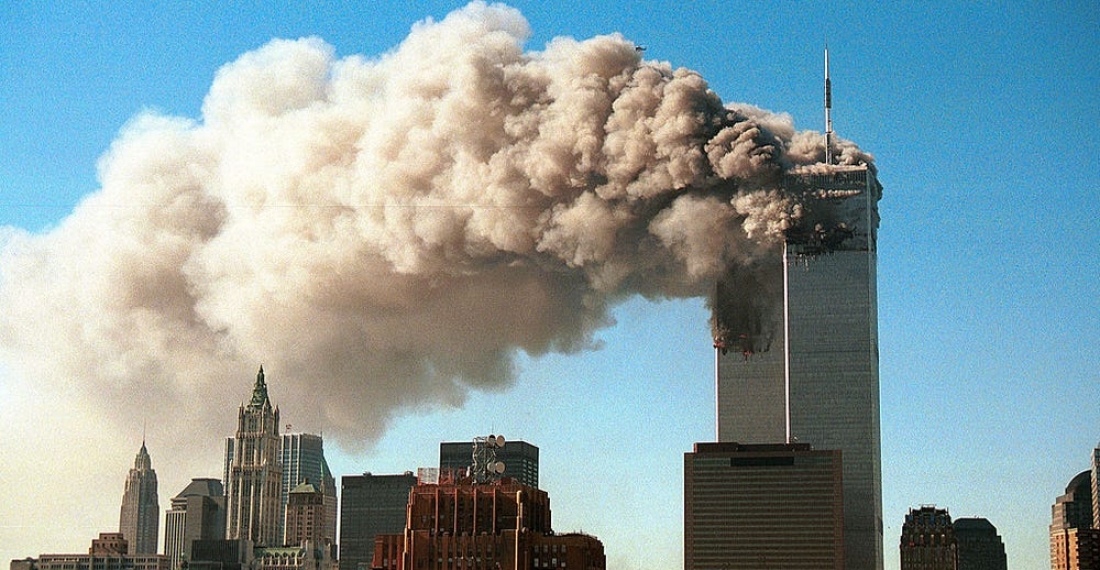
America and the world mark the 20th anniversary of 9/11

In the United States and throughout the world people on Saturday are marking the 20th anniversary of the terrorist attacks on the United States, and paying tribute to the 2,977 people who lost their lives.

The attacks, which were planned by al-Qaeda from Afghanistan, and involved four US passenger planes being seized by suicide attackers - two of which were flown into the Twin Towers of the World Trade Center in New York. Another plane crashed into the Pentagon, just outside the US capital, Washington DC, and a fourth plane crashed in a field in Pennsylvania after passengers fought back.

In a message on the eve of the anniversary, President Joe Biden said, 

"No matter how much time has passed, these commemorations bring everything painfully back as if you just got the news a few seconds ago".

He acknowledged the "darker forces of human nature - fear and anger, resentment and violence against Muslim Americans" which followed the attacks, but said that unity had remained the US' "greatest strength".

The European Union is also marking the anniversary, The EU foreign policy chief, Josep Borrell said in a statement issued for the occasion, that 9/11 "marked a turn in history. It fundamentally changed the global political agenda – for the first time ever, NATO invoked Article 5, allowing its members to respond together in self-defense, and it launched the war against Afghanistan."

Borrell added that "20 years on, terrorist groups such as Al Qaida and Da’esh remain active and virulent in many parts of the world, for example in the Sahel, Middle East and Afghanistan. Their attacks have caused thousands of victims around the world, enormous pain and suffering. They attempt to destroy lives, damage communities and change our way of life. Seeking to destabilise countries as a whole, they prey in particular on fragile societies, but also our Western democracies and the values we stand for. They remind us that terrorism is a threat we live with every day."

Now, as then, we stand determined to fight terrorism in all its forms, anywhere. We stand in admiration, humility and gratitude to those who risk their lives to protect us from this threat and to those who respond in the aftermath of attacks.

President Biden is set to lead commemorations on Saturday and will visit the three attack sites with the first lady, Jill Biden.

There will also be six moments of silence to correspond with the times the two World Trade Center towers were struck and fell, and the moments the Pentagon was attacked and Flight 93 crashed.
source: commonspace.eu
photo: Images of the burning twin towers in New York that shocked the world.


Related articles

Editor's choice
News
The European Parliament approved the temporary elimination of customs duties on goods exported from Armenia to the EU in a plenary session.

The European Parliament approved the temporary elimination of customs duties on goods exported from Armenia to the EU in a plenary session.

The European Parliament, during its plenary session in Strasbourg, approved the European Commission's proposal to apply a system of trade measures for "Made in Armenia" products, which means there will be a temporary elimination of customs duties on a wide range of products imported from Armenia to the European Union.   The proposal presented by the European Commission was adopted at the plenary session of the Council of Europe with 583 votes in favor, 49 against and 39 abstentions. According to the proposal, the European Union plans to eliminate customs duties on a number of Armenian goods for a period of two years. At the same time, it is planned to establish duty-free import quotas for eight types of Armenian agricultural products. These include grapes, apricots, cherries, peaches, and cucumbers. The draft also provides for safeguard mechanisms that will allow the European Union to intervene, if necessary, if increased imports from Armenia have a negative impact on European producers. This step is due to the restrictions imposed by Russia on a number of important Armenian export products since May 2026. They relate, in particular, to alcoholic beverages, mineral waters, fruits and vegetables, as well as their transit through Russian territory. According to the European Commission, these restrictions have disrupted Armenia's traditional supply chains and significantly limited the country's access to traditional export markets. The situation has had a particularly severe impact on small and medium-sized enterprises, as well as agricultural producers, while creating challenges for Armenia's economic resilience. The EU sees the initiative as a temporary measure to support the Armenian economy and create additional opportunities for exporters to access the EU market. The next step for the proposal is formal approval by the EU Council. The regulation will enter into force the day after its publication in the Official Journal of the European Union. Let us recall that on September 2, the Council of the European Union approved the proposal to establish temporary trade liberalization measures for Armenian products and sent the draft to the European Parliament for approval. 

Popular

Editor's choice
Interview
Thursday Interview: Murad Muradov

Thursday Interview: Murad Muradov

Today, commonspace.eu starts a new regular weekly series. THURSDAY INTERVIEW, conducted by Lauri Nikulainen, will host  persons who are thinkers, opinion shapers, and implementors in their countries and spheres. We start the series with an interview with Murad Muradov, a leading person in Azerbaijan's think tank community. He is also the first co-chair of the Action Committee for a new Armenian-Azerbaijani Dialogue. Last September he made history by being the first Azerbaijani civil society activist to visit Armenia after the 44 day war, and the start of the peace process. Speaking about this visit Murad Muradov said: "My experience was largely positive. My negative expectations luckily didn’t play out. The discussions were respectful, the panel format bringing together experts from Armenia, Azerbaijan, and Turkey was particularly valuable during the NATO Rose-Roth Seminar in Yerevan, and media coverage, while varied in tone, remained largely constructive. Some media outlets though attempted to represent me as more of a government mouthpiece than an independent expert, which was totally misleading.  Overall, I see these initiatives as important steps in rebuilding trust and normalising professional engagement. The fact that soon a larger Azerbaijani civil society visits to Armenia followed, reinforces the sense that this process is moving in the right direction." (click the image to read the interview in full)

